
Listening to Learners:
Insights on California Students’ Career Preparation


What support are California college students receiving to transition into today’s workforce? Here’s what they have to say.
California Competes, in partnership with College Futures Foundation and Strada Education Foundation, analyzed data from over 5,000 California college students and recent graduates to understand their experiences with career guidance, work-based learning, and early career outcomes. The research finds that many students face barriers to the guidance and preparation that could set them up for meaningful employment and highlights opportunities to strengthen college-to-career pathways and advance economic mobility.
Building off our research on higher education’s return on investment, this series of briefs digs into a key component of ROI: career preparation in college that may shape their transitions into the workforce. It includes a summary and an infographic that outline the key takeaways. Read on for actionable insights on strengthening the link between college and meaningful careers for students, institutions, and the state.
Key Findings
- Colleges are students’ primary source of career pathways guidance, but the level of support across all sources is uneven, often arrives too late (even after graduation), and leaves many students less than fully satisfied.
- Students report heavy course loads and uncertainty about finding opportunities as barriers to participating in work-based learning.
- Less than half of recent graduates are highly satisfied with their first job or their career progress.
Summary
Most learners enroll in higher education seeking better economic opportunities, and indeed more than eight in ten first-year college students say obtaining a better job was a very important reason for attending, more than any other goal1. Still, as will be shown, many Californians leave college without the guidance and career-building activities they need to succeed in the workforce. Rising higher education costs and growing concern about the workplace value of college degrees are driving interest in better understanding how and for whom higher education promotes economic mobility and how best to support this vital mission.
This series of briefs explores the experiences of over 5,000 current and recent California college students in three areas: career pathways guidance, work-based learning experiences, and early career outcomes. Together, they reveal a mixed picture of education-to-career transitions marked by both successes and significant disparities among groups of learners. These findings highlight the importance of tracking education-to-career transitions to inform future policies and investments aimed at boosting economic mobility for all learners.
Key insights include:
- Career Pathways Guidance
Colleges are students’ primary source of career pathways guidance, but the level of support across all sources is uneven, often arrives too late (even after graduation), and leaves many students less than fully satisfied. Most learners received career guidance while enrolled, but in many cases not until after their first year despite the fact that the first year of college is a critical period for establishing academic momentum and making key decisions. Moreover, many learners never received certain types of career information while enrolled, with proportions ranging from 21 percent to 58 percent, depending on the specific information. Among the variety of information sources, learners most often received career information from faculty and staff at their respective colleges, followed by family and friends. The level of support offered to learners in planning career goals was uneven, and only one in five learners was fully satisfied with available resources and support in this area. - Work-Based Learning
Work-based learning can enhance career readiness, but barriers such as heavy course loads and uncertainty about finding opportunities prevent most students from participating. Participation in internships and other types of work-based learning can be a valuable component of higher education, but access to these opportunities is far from universal. Recent graduates who had completed internships were more likely than their classmates to hold positive views about their education: that it opened up good career opportunities, was worth the cost, had a positive impact on their career success, and more. Yet fewer than half of graduates and just one-third of near-graduates (who expect to graduate by the end of the following year) participated in internships, and even fewer near-graduates completed other types of work-based learning, such as co-ops, apprenticeships, or practicums. Barriers such as heavy course loads and difficulty finding opportunities disproportionately affect lower-income and first-generation college students, limiting access to these valuable experiences. - Early Career Outcomes
Less than half of recent graduates are satisfied with their first job or their career progress. Recent college graduates’ assessments of their first few years in the workplace are useful early indicators of how well their education prepared them for employment. Just 48 percent of recent graduates are satisfied with their first postcollege job, and only 42 percent are satisfied with their career progress in general, which may reflect subsequent positions and their trajectory to date.
To bridge these gaps, future research and efforts should focus on assessing how colleges prepare learners for rewarding careers, identifying which learners are being left behind, and ultimately using the findings to guide investments and activities. Strategies to advance this include the following:
- Collecting and analyzing qualitative data to add context and reveal insights about how learners understand and evaluate their education-to-career pathways
- Elevating promising practices from colleges excelling in career preparation as models for others to follow
- Strengthening alignment between educational programs and workforce needs to boost satisfaction and outcomes
These steps will inform college policies and practices to help more Californians complete an education leading to a rewarding career.
Listening to Learners: California Students’ Experiences with Career Pathways Guidance
Key Takeaways
- While most learners receive career guidance while enrolled, information often comes too late—after students’ first year, which is a critical period for establishing academic momentum and making key decisions.
- College faculty and staff, followed by family and friends, are the most common sources of career information.
- Four out of five learners receive some support in planning career goals, but the level of support is uneven.
- While the majority of learners are satisfied with the guidance they receive, satisfaction is lower among Native American and Black students as well as older learners.
- Colleges should identify the main obstacles to participation in work-based learning specific to their respective campuses, then seek to eliminate these obstacles.
Most learners enroll in higher education seeking better economic opportunities, but many leave college without the guidance they need to succeed in the workforce. To better understand why, this brief, one in a series of three (see “About the From College to Career Briefs”), describes the experiences with career pathways guidance of a sample of over 5,000 current and recent California college students. Timely, accurate, and uniformly accessible guidance is critical to helping students stay on track and reach their career goals, yet many learners report receiving this support after their first year or after they left, which is too late to influence key decisions. Delayed or incomplete information can lead to misaligned programs, unmet expectations, and diminished economic returns. Strengthening career pathways guidance is essential to building a more effective and equitable higher education system. Colleges, funders, and their partners should continue tracking how college students receive career guidance to assess progress over time and guide future activities and investments.
Students Receive Career Information Too Late or Not At All
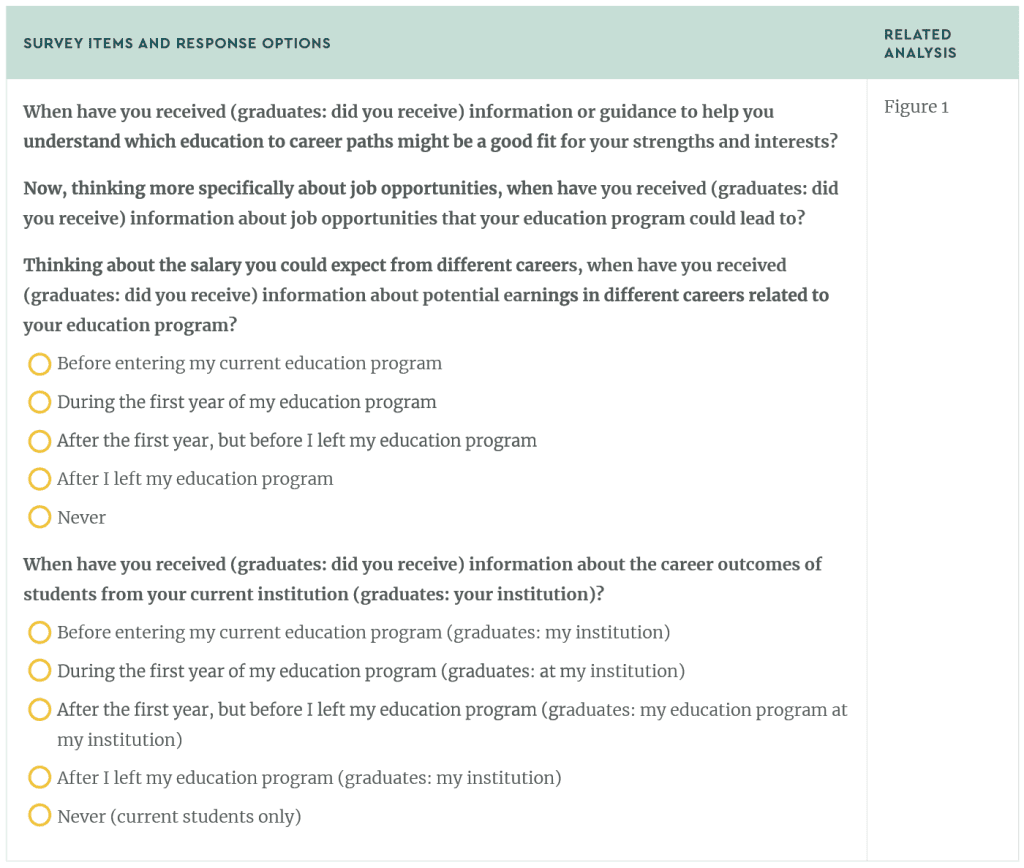
Most California learners receive career guidance while enrolled, but for many this assistance arrives too late to shape critical decisions and maintain momentum toward completion. Sixty-four percent of students and graduates report receiving information about which education-to-career pathways might be a good fit for their strengths and interests before the end of their first year (figure 1). Fewer students learn about job prospects for their programs (55%), potential earnings in careers related to their programs (50%), and career outcomes of graduates from their college (35%) in that time frame. While such information may be better late than never, receiving it before or during the first year of college enables learners to enroll in competitive programs, increases their likelihood of a timely graduation, and helps them avoid additional costs in terms of tuition and forgone income1. This early direction also helps learners stay motivated and persist in their programs2. Alarmingly, many learners never received certain types of career information while enrolled, with proportions ranging from 21 percent to 58 percent depending on the specific information.

Colleges Are the Main Source of Education and Career
Information
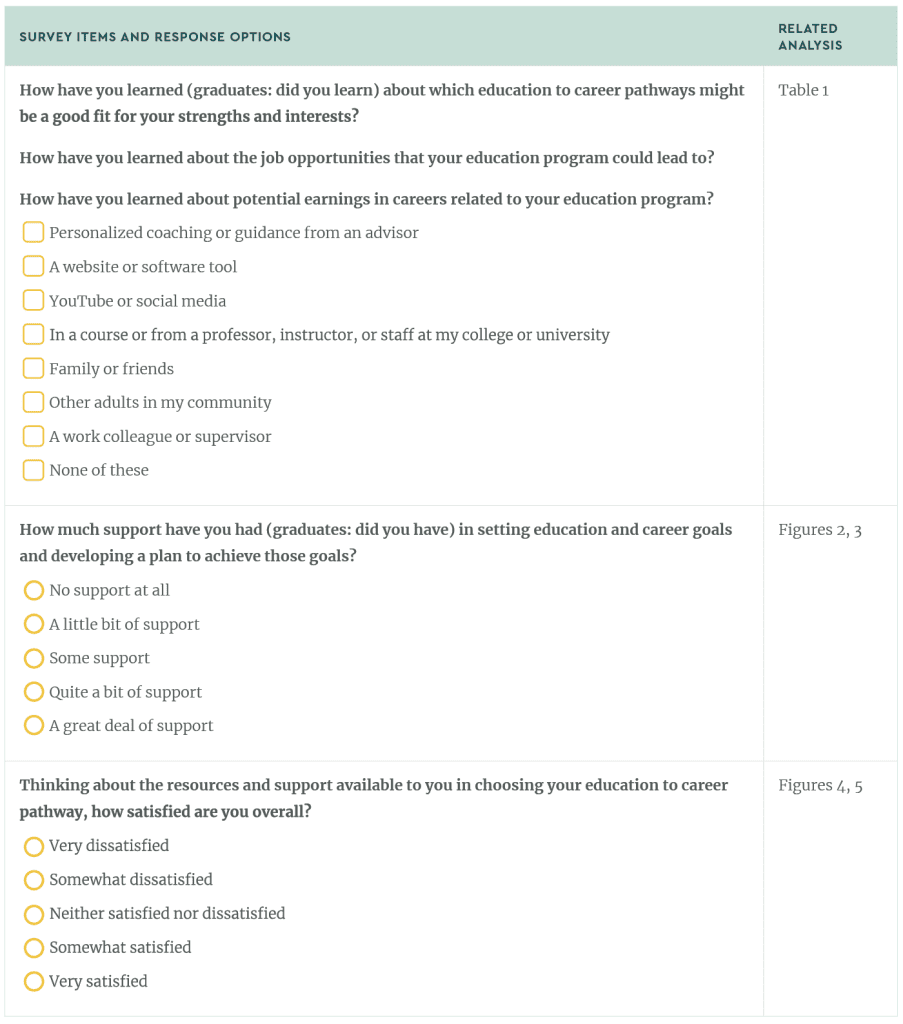
College courses, instructors, and staff are the most commonly cited sources of career information (66%), including guidance on education-to-career pathways, relevant job opportunities, and potential earnings in related careers (table 1). Family and friends were tied with websites and software tools as the second most frequently mentioned information source overall (59% each). Notably, advice from family members sometimes steers students to less-than-optimal choices, replicating existing disparities across generations (see “Career Advice from Family and Friends May Reinforce Inequity”). Another source of information is advisors, which presumably refers to college advisors in most cases.

Most Learners Receive Some Support in Planning Education and Career Goals
Four out of five learners receive at least some support in planning their education and career goals–though depth of support varies. Half of students and graduates report receiving quite a bit or a great deal of support in this respect, and another 30 percent receive some support (figure 2). An additional 16 percent receive a little bit of support, and 5 percent receive none.

Breaking down these results reveals meaningful variation across certain groups of learners, as shown in figure 3. For example, proportionally more Native American (54%) and Black learners (27%) reported receiving a great deal of resources and support, while proportionally fewer Asian (16%) and white learners (16%) and those of two or more races (14%) did the same. Learners under age 25 were less likely to say they received a great deal of resources and support (18%) than older learners. More learners at California Community Colleges (28%) and other colleges (26%) received a great deal of resources and support, whereas fewer University of California (UC) learners did so (14%).

Fewer Learners Are Fully Satisfied with Available Resources and Support
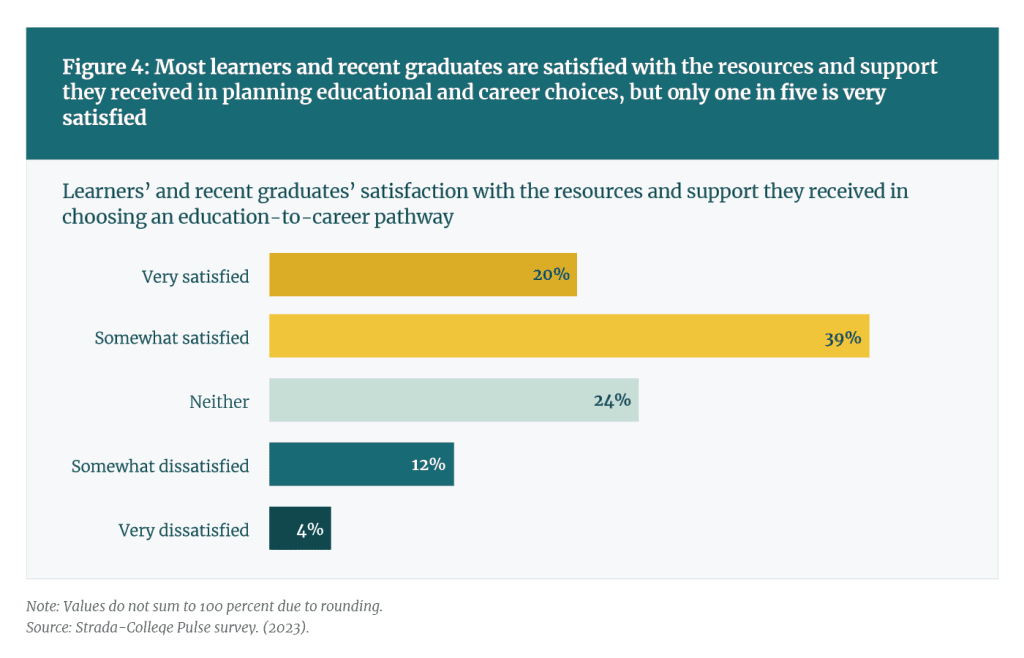
Although the majority of students and graduates received some planning support, only one in five reported feeling very satisfied with the resources and support available to guide education-to-career pathway decisions, and another 39 percent are somewhat satisfied (figure 4). On the other hand, approximately one in six students was either very dissatisfied or dissatisfied about the support and resources they received, indicating substantial room for improvement in how colleges deliver this guidance.
Satisfaction with Resources and Support Varies Widely Across Groups of Learners
Specific populations of learners are less satisfied than others, raising the question of equitable access to education and career guidance. Native American, Asian, and Black learners, nonbinary and agender learners, those ages 25 through 29, and those attending or who graduated from UC have lower rates of satisfaction compared with all other learners (figure 5).

Recommendations for Future Research and Practice
Faculty, staff, and institution and system leaders share the primary responsibility, and enjoy the greatest leverage, to ensure that California learners receive the timely and useful guidance they need to successfully transition from college to rewarding and meaningful careers. Working with funders, policymakers, employers, and mission-aligned community-based organizations, they should redouble their efforts to ensure each student can choose a path toward eventual success. In particular, they should make better use of data, focusing on the circumstances and experiences of both learners who are dissatisfied with their career guidance and those who are satisfied.
Pay special attention to dissatisfied and underserved learners.
Even though learners and recent graduates are, by and large, satisfied with the support and guidance they receive on their journeys from higher education to employment, certain populations report being left behind. These groups of learners merit extra attention, and if future research continues to find that they have less favorable outcomes, they should be prioritized for targeted interventions.
Learn what works by examining experiences of satisfied learners.
Colleges and their partners should also focus on those learners who are receiving timely career information and guidance. Identifying and spotlighting colleges that already excel at education-to-career guidance will give the colleges the credit they are due; inspire other colleges to follow their lead; and perhaps reveal specific structures, policies, and practices that lead to success. Through this cycle of assessment and improvement, colleges can advance the goal of helping every student achieve economic success.
Leverage survey data to monitor progress and guide future work, and seek deeper understanding with qualitative data.
The Strada Education Foundation plans to repeat this survey regularly and with minimal changes over the coming years, enabling analysts to monitor progress over time. Colleges, funders, and their partners should use these future results to propose, develop, implement, and evaluate promising solutions in delivering career information. They should also consider collecting and using qualitative data from and about learners through such means as focus groups, interviews, participant observation, open-ended survey items, diary studies, and journey mapping. Qualitative research provides valuable context and nuance that surveys cannot and helps compensate for the well-documented shortcomings of survey research7.
From College to Career: California Learners’ Experiences with Work-Based Learning
Key Takeaways
- Students who participate in internships report better early career outcomes, but for a variety of reasons, most do not participate in this valuable activity or any other form of work-based learning.
- Recent graduates who had completed internships while enrolled are more likely than their classmates to view their education as worthwhile, opening career opportunities and benefiting their career success.
- Fewer than half of graduates and just one-third of near-graduates participated in internships, and even fewer near-graduates completed co-ops, apprenticeships, or practicums.
- Respondents most often cited a too-heavy course load and not being sure how to find an internship as barriers to participation.
- Colleges, funders, and their partners should use these and other data to develop and refine approaches to enable all learners to participate in work-based learning.
Most learners enroll in higher education seeking better economic opportunities, but many leave college without the early career-building experiences they need to succeed in the workforce. To unpack these findings, this brief, one in a series of three (see “About the From College to Career Briefs”), describes the experiences with internships and other types of work-based learning of a sample of over 5,000 current and recent California college students. It finds that access to these valuable opportunities is far from universal. Fewer than half of graduates and near-graduates completed internships, co-ops, apprenticeships, or practicums. Colleges, funders, and their partners should continue tracking which learners do and do not participate in work-based learning to assess progress over time and guide future activities and investments.
What Is Work-Based Learning?
Work-based learning is an organized educational experience related to a specific occupation or career pathway that requires participants to perform authentic workplace tasks in a real employment setting (if feasible, or a realistic simulation otherwise). Types of work-based learning vary by whether they are full time and their length1. This brief discusses the following four types of experiences.
Internships and practicums (often called clinicals in healthcare fields) are typically part-time engagements that last less than a year. Most internships and all practicums are unpaid2.
Apprenticeships and cooperative work experiences (often called “co-ops”) are full-time engagements. Apprenticeships usually last more than a year, and co-ops usually last from one to three semesters. All apprenticeships and some co-ops are paid3.
This brief discusses the four types of experiences listed above. Among current students who expect to graduate by the end of the following calendar year, 33 percent completed an internship, 9 percent completed a practicum, 8 percent completed a co-op, and 8 percent completed an apprenticeship (see figure 2). Other types of work-based learning include job shadowing, service learning, pre-apprenticeships, and mock interviewing4. Among work-based learning formats, internships are the most common form and have the strongest evidence base and ease of implementation, so they are the major focus of this brief5.
Graduates Who Participated in Internships Fare Better Than Those Who Did Not Intern Across a Range of Career Outcomes
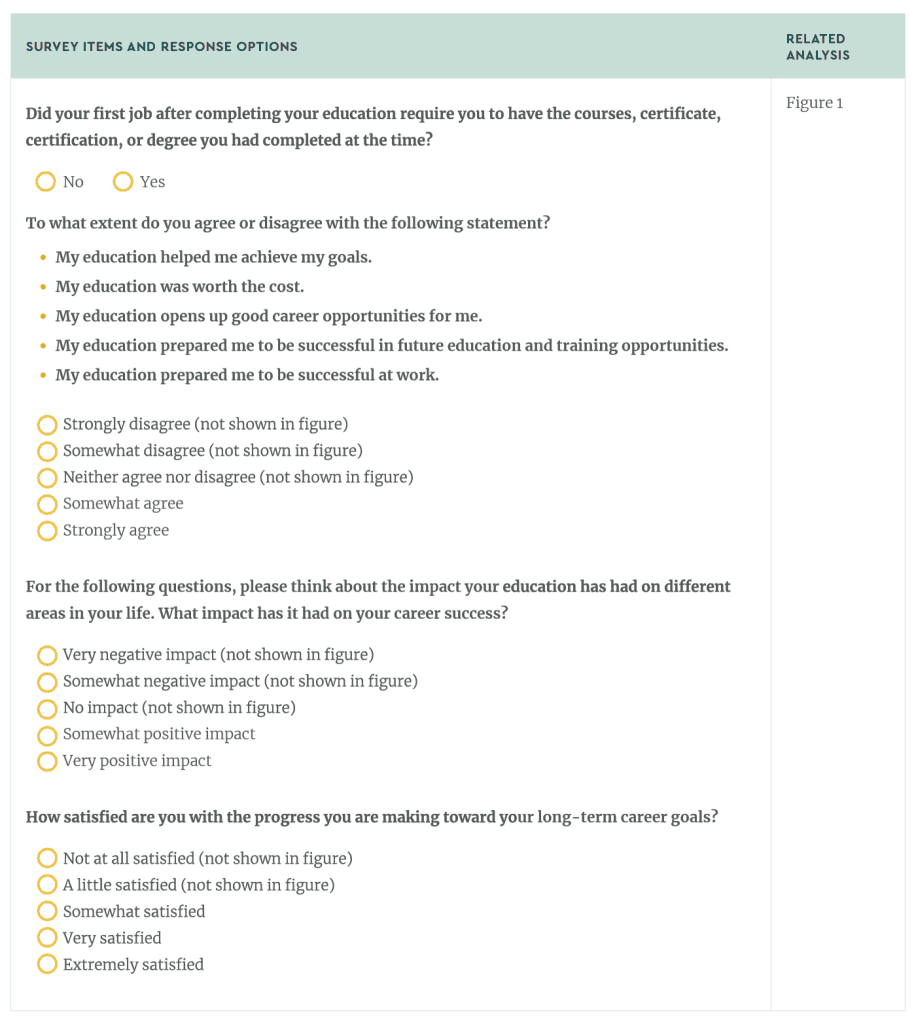
Recent graduates who completed internships while in college reported better early career outcomes than those who did not, a finding that is consistent with prior research6. As shown in figure 1, they are significantly more likely to say that their education prepared them to be successful in future education and training opportunities, opened up good career opportunities, was worth the cost, helped them achieve their goals, had a positive impact on career success, and prepared them to be successful at work. They also are more likely to report that their first job after college required the education they completed and that they are satisfied with their progress toward their long-term career goals.

Most Learners Do Not Participate in Any Type of Work-Based Learning
Despite the benefits of internships, fewer than half of students participate in them or other types of work-based learning. Among near-graduates who expect to complete their degrees by the end of the following calendar year, only 42 percent participated in any of the four types of work-based learning (figure 2)7. Internships are the most common type of work-based learning, with 33 percent of near-graduates having participated, while 9 percent completed a practicum, 8 percent completed a co-op, and 8 percent completed an apprenticeship. Some learners participated in more than one type of work-based learning.
As for recent graduates, 44 percent completed an internship. This percentage is also higher than the 33 percent of near-graduates who interned, suggesting that some students complete their first internship in their final terms.

Learners’ Field of Study Shapes Their Work-Based Learning Experiences
Participation in specific types of work-based learning, and in work-based learning overall, differs substantially by students’ general field of study. As shown in figure 3, near-graduates in engineering are significantly more likely to complete internships than their peers in other fields of study, whereas near-graduates in business and marketing are significantly less likely to do so. Apprenticeships are most common among engineering students, while co-ops are most common among accounting and finance students. Nearly a quarter of near-graduates in both nursing and education completed a practicum (24% each). This last finding is not surprising given that these programs lead to healthcare jobs that require clinical experience for licensure and teaching jobs that require classroom experience for a credential. Near-graduates in biology complete a practicum at a higher rate (15%) than their peers in other fields of study, suggesting possible alignment with a healthcare career pathway.

Academic Workload and Uncertainty About Finding Positions Are Primary Obstacles to Internship Participation
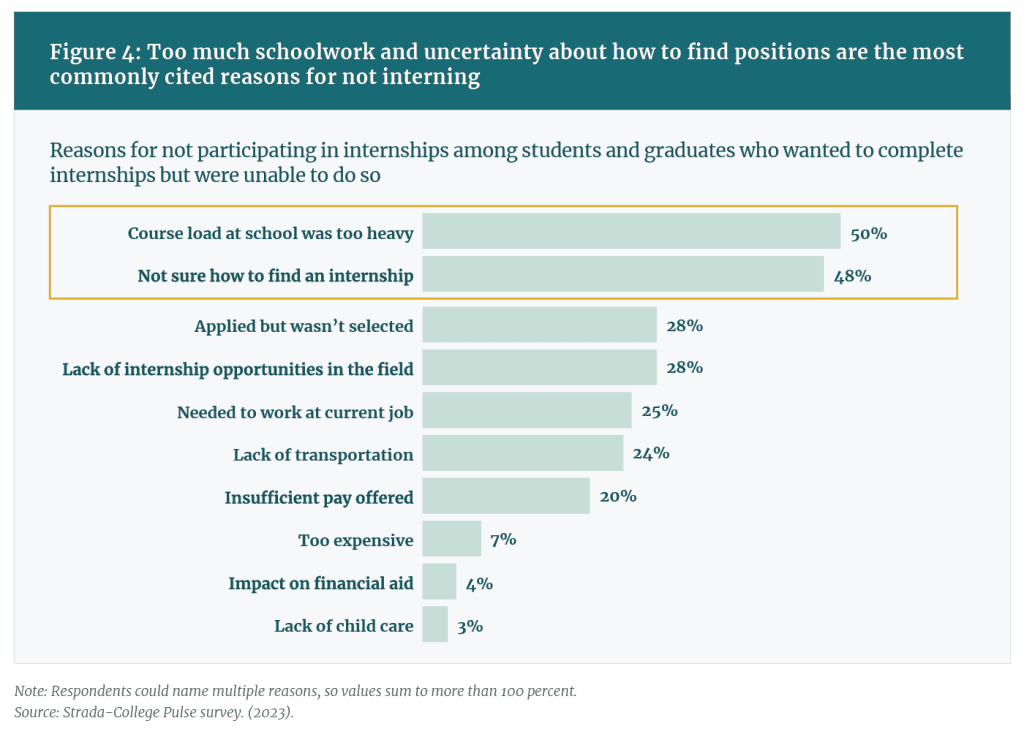
Most students want to complete an internship, but many are unable to do so for one or more reasons. Across all students and graduates, 35 percent completed an internship, 38 percent said they would like to do so but did not, and the remaining 27 percent were not interested. That means that among nonparticipants, more than half (59%) wanted to participate but were unable to do so. As shown in figure 4, among students and graduates who wanted to participate in an internship but did not, the most frequently selected reasons are a too-heavy course load (50%) and not being sure how to find an internship (48%). These responses are far more common than the other eight choices offered, which included not being selected (28%), a lack of internship opportunities in their field (28%), needing to work at their current job (25%), a lack of transportation (24%), and insufficient pay being offered (20%). The smaller proportions of respondents who cited insufficient pay or that the internship would have been too expensive (7%) may seem surprising given the prevalence of unpaid internships, an arrangement that is widely criticized as exclusionary and exploitative8. On the other hand, since they did not actually intern, and given how many respondents said they did not know where to find an internship, these students and graduates may not have realized how many internships offer little or no pay.
Latinx, Asian, Older, and Lower-Income Students Are More Likely to Name Uncertainty About Finding Internships as a Reason for Not Participating
As part of any effort to make internships more accessible to a wide range of students, institutions and policymakers should better understand which students and graduates did not participate because they were unsure how to do so. Looking more closely at who cited uncertainty about finding a position as a reason for not completing an internship reveals large disparities across populations, with several historically underserved populations reporting higher rates of uncertainty. Figures 5 through 7 report the percentage of respondents who selected “Not sure how to find an internship” as a reason for not participating, overall and by selected groups of students and graduates9.
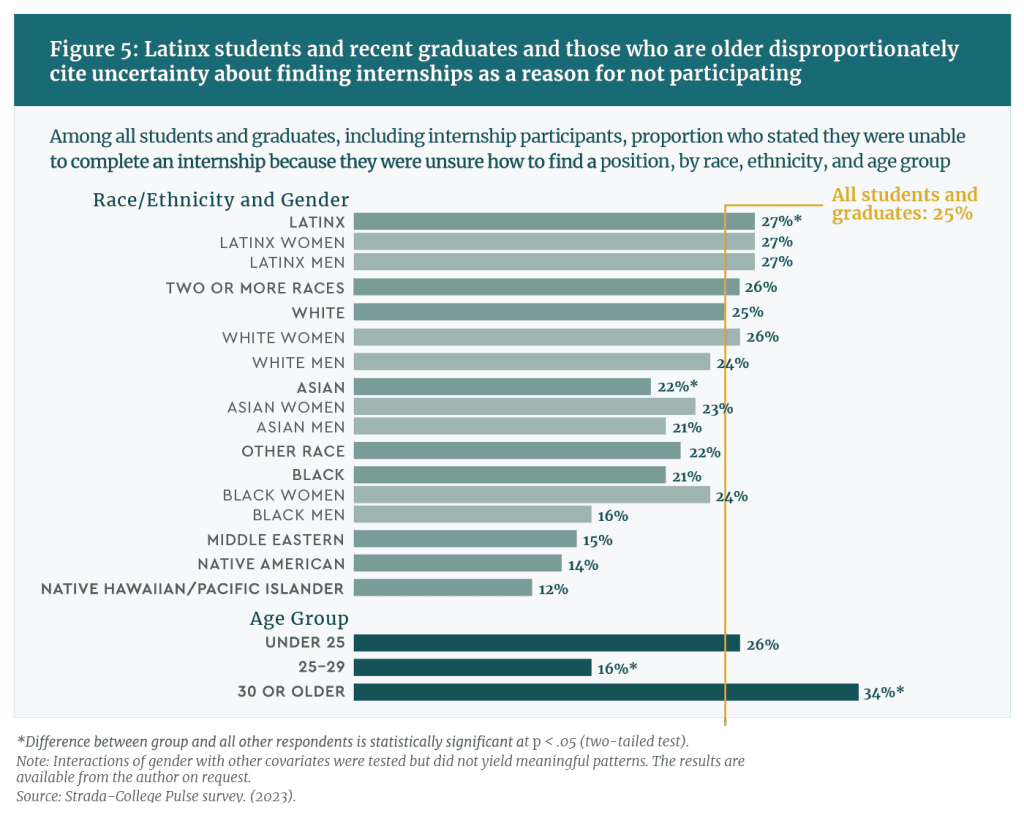
Race and ethnicity. Latinx respondents are more likely to cite uncertainty about finding an internship as a reason for not completing one than other groups (27% vs. 23%), and Asian respondents are less likely (22% vs. 26%). No other differences by race and ethnicity are statistically significant.
Age. Respondents aged 30 and older are more likely and those aged 25–29 are less likely to report uncertainty as a reason for not interning (34% and 16%, respectively).
Socioeconomic status. Respondents who described their background as working class or lower class are more likely to cite uncertainty as a reason for not interning. Conversely, their peers who considered themselves to have grown up middle class, upper-middle class, or upper class are less likely to point to uncertainty. Similarly, first-generation college students are more likely than continuing-generation students to attribute their nonparticipation in internships to uncertainty (30% vs. 21%).

Institution sector and field of study. A larger proportion of respondents who attend or attended California Community Colleges attributed their lack of internships to uncertainty (30%), whereas a smaller proportion of those who attend or attended private nonprofit four-year colleges (12%), for-profit colleges (6%), and other colleges (19%) did the same. Respondents with a major in business and marketing are more likely to say that uncertainty was a reason for not interning than those with a major in accounting and finance (31% vs. 19%). At first glance, it is puzzling to find this disparity between similar fields of study. But given the wide variation in outcomes for graduates of specific business-related majors, this difference in finding internships may reflect true differences in their education and work experiences10.

Recommendations for Future Research and Practice
Faculty, staff, and institution and system leaders share the primary responsibility, and enjoy the greatest leverage, to ensure that California learners can complete the work-based learning experiences that ease the transition from college to rewarding and meaningful careers. Working with funders, policymakers, employers, and mission-aligned community-based organizations, they should redouble their efforts to ensure every student is able to participate in internships and similar activities regardless of their background or financial circumstances.
- Identify the main obstacles to participation in work-based learning specific to the institution and to key groups of learners.
This brief outlines the reasons learners statewide did not complete internships, but the major barriers to participation in internships and other work-based learning likely vary by institution. They may well differ meaningfully by program of study and by demographic group within each institution. Each institution should investigate the primary reasons why its students are unable participate. - Seek to eliminate these obstacles, enabling every learner to take advantage of work-based learning opportunities and encouraging them to do so.
If an overly heavy course load is a primary barrier, for instance, colleges might increase the academic credit they award for work-based learning to allow students to take fewer classes. They could promote shorter experiences during summer and winter breaks. And they could integrate work-based learning into courses and programs so it is not an additional burden. If a large number of students do not know how to find internships, institutions should invest more resources in raising awareness and steering students to appropriate opportunities. These efforts can begin even before students formally matriculate. It is not hard to find examples of colleges actively connecting students to internships11. To ensure that all students have access to work-based learning regardless of financial means, colleges should work to maximize the number of experiences that are paid, perhaps using government or foundation support12. - Leverage survey data to monitor progress and guide future work, and seek deeper understanding with qualitative data.
The Strada Education Foundation plans to repeat this survey regularly and with minimal changes over the coming years, enabling analysts to monitor progress over time. Colleges, funders, and their partners should use these future results to propose, develop, implement, and evaluate promising solutions in facilitating work-based learning. They should also consider collecting and using qualitative data from and about learners through such means as focus groups, interviews, participant observation, open-ended survey items, diary studies, and journey mapping. Qualitative research provides valuable context and nuance that surveys cannot and helps compensate for the well-documented shortcomings of survey research13.
From College to Career: California Graduates’ Early Career Outcomes
Key Takeaways
- Just under half of recent graduates are satisfied with their first postcollege job, and fewer are satisfied with their career progress to date, with substantial variation across groups.
- Graduates’ rates of career satisfaction vary considerably by their background characteristics, the institutions they attended, their fields of study, and their current occupations.
- This level of dissatisfaction may signal a need for better alignment between higher education and career opportunities.
- Colleges should seek out and use sources of longer-term outcomes; support better employment data; and identify, pilot, and evaluate promising practices from other colleges that excel at career preparation.
Nearly Half of Graduates Are Satisfied with Their First Job
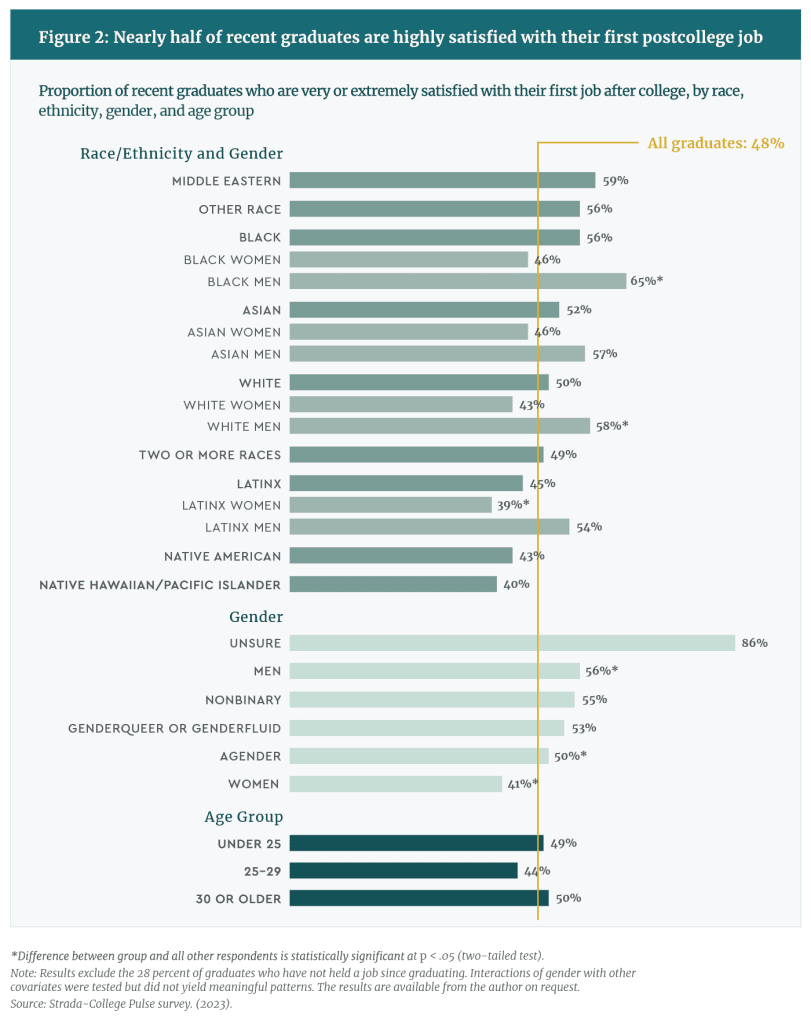
Overall, 48 percent of recent college graduates are very or extremely satisfied with the first job they held after college (figure 1), with levels of satisfaction differing considerably by demographics, institution attended, field of study, and occupation.
Race, ethnicity, and gender. Proportionally fewer Latinx women are satisfied with their first job (39%), whereas proportionally more white men (58%) and Black men (65%) are satisfied. Additionally, men of all races and ethnicities are more satisfied with their first job (56%) than other graduates, whereas women of all races and ethnicities are less satisfied (41%).
Socioeconomic status. As shown in figure 2, respondents who grew up in working-class households are less likely to be satisfied with their first job (39%), as are first-generation college students (44%). Conversely, individuals who grew up upper-middle class and continuing-generation students are more likely than others to be satisfied (57% and 51%, respectively).
Institution sector and field of study. Graduates of the University of California (UC) are less satisfied with their first postcollege job (44%) than other graduates, as are liberal arts and social science majors (42%). California State University (CSU) graduates, on the other hand, are more satisfied (53%), as are engineering majors (73%) and accounting and finance majors (58%).
Current occupation. Individuals currently employed in computer, engineering, and science occupations are significantly more likely to be satisfied (62%) than other graduates. At the same time, individuals employed in management jobs and in office and administrative support jobs are significantly less likely to be satisfied (31% and 32%, respectively) than other graduates.


Fewer Than Half of Recent Graduates Are Satisfied with Their Career Progress
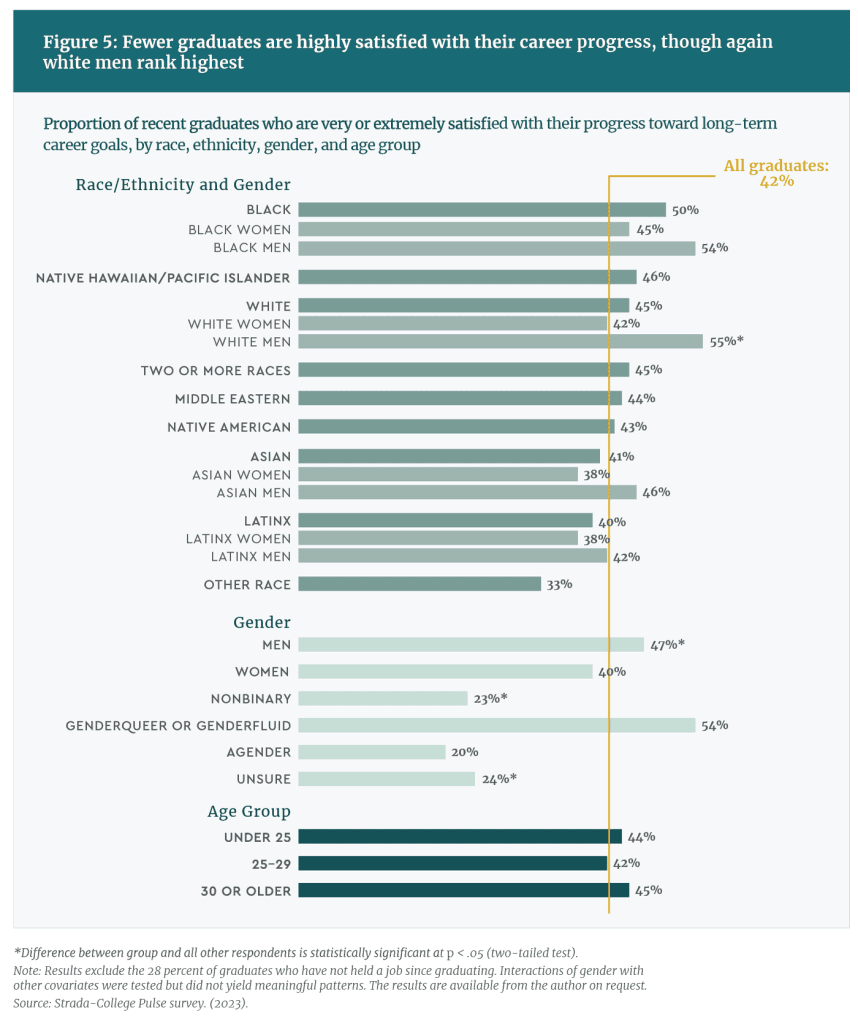
Overall, just 42 percent of recent graduates are very or extremely satisfied with their progress toward their long-term career goals (figure 3). Again, satisfaction varies across groups of graduates.
Race, ethnicity, and gender. White men are measurably more satisfied than other recent graduates (55%). Similarly, men overall have a higher rate of satisfaction with their career progress (47%) than other graduates, while nonbinary graduates have a lower rate of satisfaction (23%). No other differences by race, ethnicity, or gender are statistically significant.
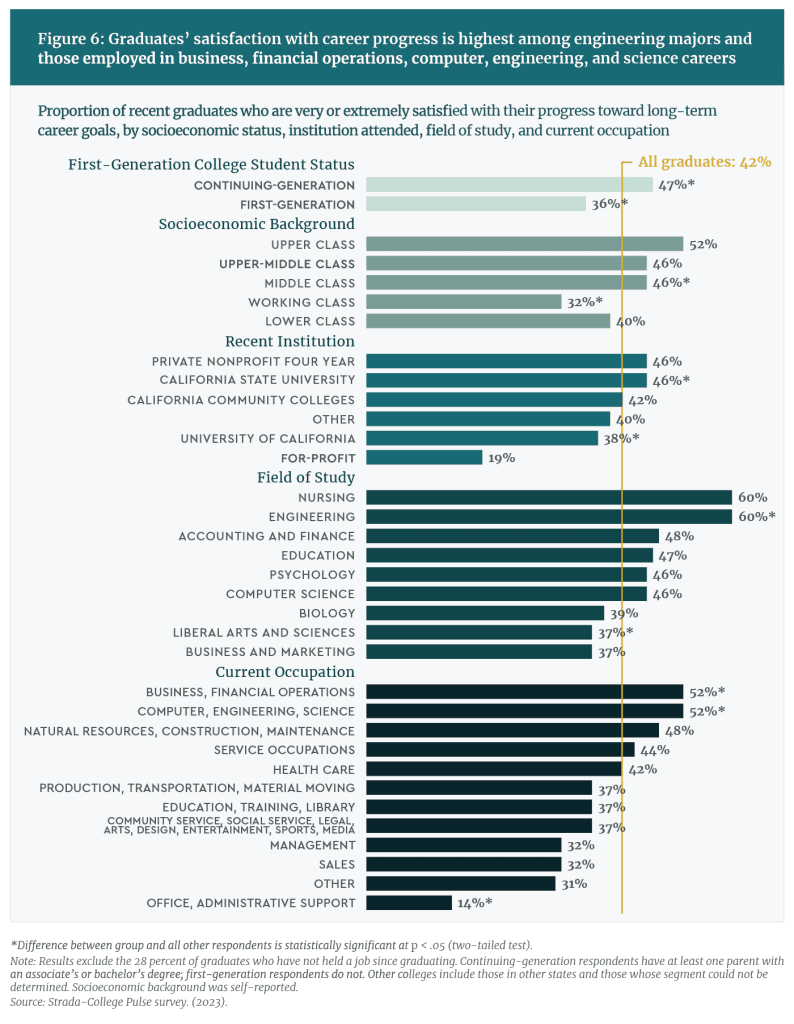
Socioeconomic status. As reported in figure 4, satisfaction with progress on long-term career goals is higher among continuing-generation students (47%) and those who grew up in middle-class households (46%). On the flip side, satisfaction is appreciably lower among graduates who are first-generation students (36%) and those who grew up working class (32%).
Institution sector and field of study. CSU graduates (46%) and engineering majors (60%) have higher rates of satisfaction with their career progress. At the same time, UC graduates (38%) and liberal arts and social sciences majors (37%) have lower rates of satisfaction.
Current occupation. Recent graduates employed in office and administrative support roles are the least satisfied among all the groups included in figure 4, with only 14 percent expressing satisfaction with their progress toward their long-term career goals. In contrast, 52 percent of those working in business and financial operations positions and in computer, engineering, and science positions are satisfied with their career progress, significantly higher proportions than those in other occupations.

Recommendations for Future Research and Practice
Faculty, staff, and institution and system leaders share the primary responsibility, and enjoy the greatest leverage, to ensure that California learners successfully transition from college to employment. Working with funders, policymakers, employers, and mission-aligned community-based organizations, they should direct their efforts toward increasing the proportion of learners who graduate into satisfying jobs and careers.
Seek out and use sources of longer-term outcomes, and support better employment data.
Initial job and career satisfaction are useful early indicators, but colleges and system offices should consider medium- and long-term outcomes as well. At present, merely tracking graduates’ earnings is difficult and constrained by limited data, but it should become easier in the coming years as the state’s Cradle-to-Career Data System and its data tools are fully built out. Additionally, one pending proposal would supplement earnings data with occupation, employer location, and hours worked, which would enable researchers to better measure variation in career outcomes1. Another proposal would add earnings from tax records for the 14 percent of working-age Californians with self-employment income from gig work and other independent contracting to present a more complete and accurate picture of compensation and its relationship to education2.
Identify, pilot, and evaluate promising practices from colleges that excel at career preparation.
There are already many models that seek to better align programs with workforce needs and improve students’ career readiness with the aim of boosting career satisfaction and outcomes3. Colleges should seek out and adopt initiatives that appear to fit their particular needs and constraints, assess how well they work, then make adjustments or test out alternatives as needed.
Leverage survey data to monitor progress and guide future work, and seek deeper understanding with qualitative data.
The Strada Education Foundation plans to repeat this survey regularly and with minimal changes over the coming years, enabling analysts to monitor progress over time. Colleges, funders, and their partners should use these future results to identify which groups of students have lower rates of early career satisfaction and design policies and programs to improve the college-to-career transition. They should also consider collecting and using qualitative data from and about learners through such means as focus groups, interviews, participant observation, open-ended survey items, diary studies, and journey mapping. Qualitative research provides valuable context and nuance that surveys cannot and helps compensate for the well-documented shortcomings of survey research4.
Appendices
Appendix A: Data and Methods
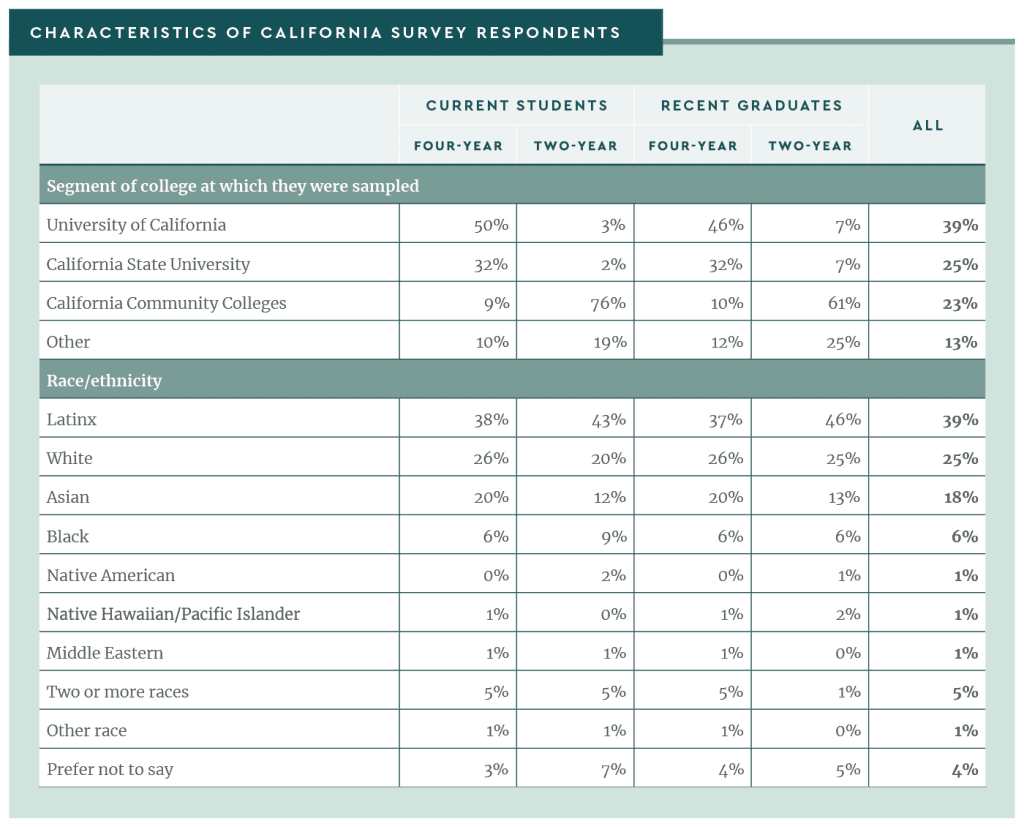
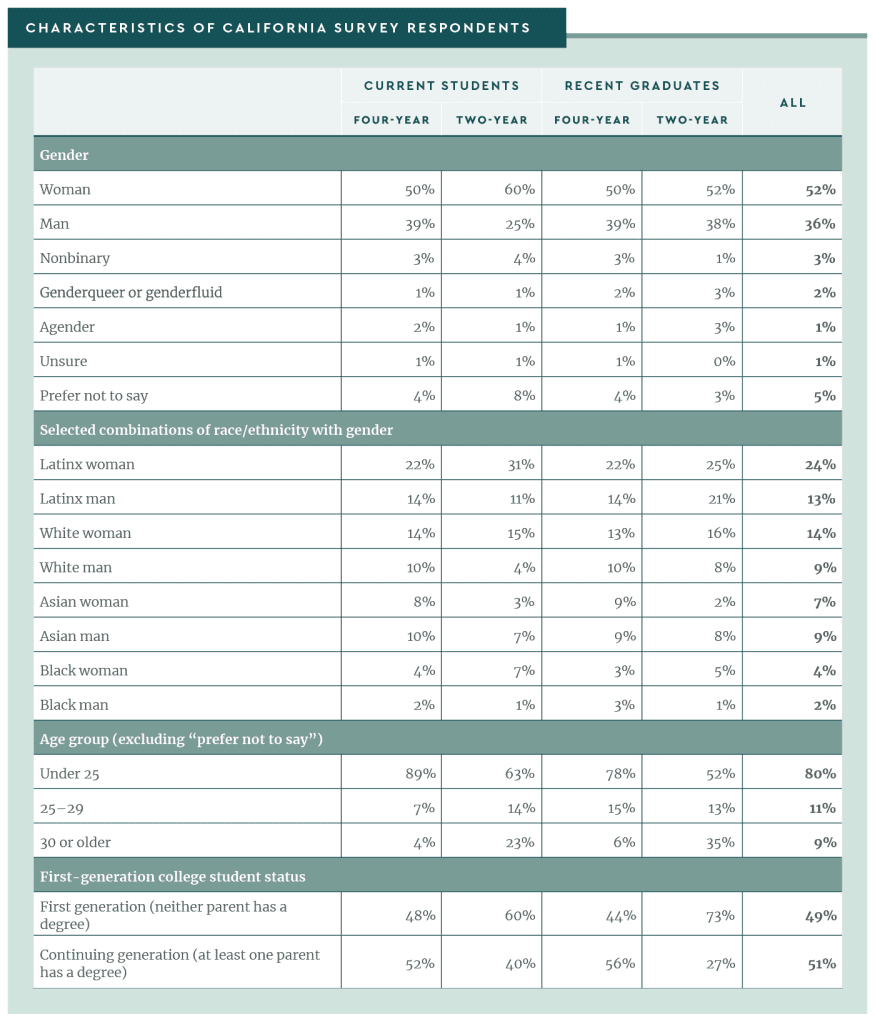
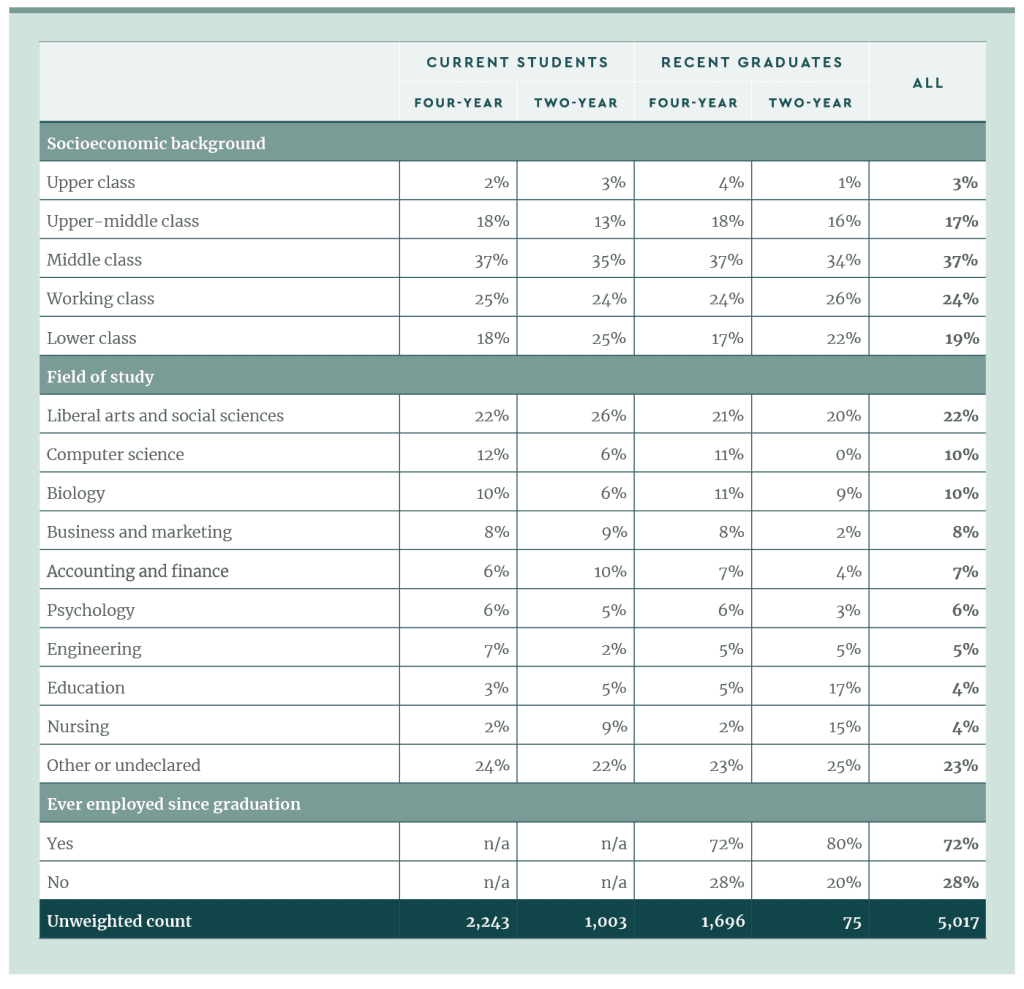
This From College to Career series draws on results from the 2023 Strada-College Pulse survey that informs the foundation’s State Opportunity Index (SOI). The SOI assesses how colleges in each of the 50 states and the District of Columbia measure up in the domains of presenting clear information about employment outcomes, making quality coaching available to students, providing access to work-based learning, and establishing close alignment between postsecondary education and the jobs in the state that require this education2. The Strada-College Pulse survey interviewed 5,017 currently enrolled students and 2020–2023 graduates in California from June 2023 through August 2023 through a web-based platform. Details about the California respondents are presented in the table below.
Unless otherwise stated, the results in these briefs are based on both current students and recent graduates, and responses are weighted to match state-level values of race or ethnicity, gender, and financial aid status. All calculations are based on unrounded values. Where reported, statistical significance is determined by comparing outcomes for a given group of respondents against outcomes for all other responses, such as Black Californians vs. Californians of all other races and ethnicities, or Black Californian women vs. Black Californian men and Californians of all other races and ethnicities.
Appendix B: Career Advice from Family and Friends May Reinforce Inequity
Career advice from family and friends may be well intentioned, but its quality is uneven, which tends to reinforce rather than narrow gaps in education-to-career journeys across racial, ethnic, and socioeconomic groups. Learners from middle-class and upper-class families—whose parents more often graduated from college, hold professional careers, and have networks of other professionals—typically receive more helpful advice from their families about higher education and careers3. These same learners also enjoy an edge in landing highly sought-after jobs, as they tend to participate in social organizations and athletic teams where learners share valuable and little-known information about the firms offering these positions4.
Other research shows declining shares of Latinx, Black, and American Indian or Alaska Native learners enrolled in fields of study associated with higher average postcollege earnings (science, engineering, math, economics, business, and nursing) as college policies restrict entry to these potentially more lucrative majors. When admission to such majors depends on navigating pre-major courses, as is often the case, access to accurate and relevant information about selecting courses, whether from college staff or other sources, gives these better-informed learners a sizable advantage5. Even among learners of the same socioeconomic background attending the same colleges, differences in precollege experiences may strongly influence college and career outcomes. Students from low-income backgrounds who graduated from private high schools, for instance, more easily and routinely build connections with elite college faculty and staff than their classmates who graduated from public high schools, giving the former group a leg up in competitive job and graduate school applications6. Disparities like these, which originate before learners enter college, perpetuate differences across class and race after graduation. Moreover, these gaps in information illustrate the crucial role of colleges in addressing differences in access to relevant and accurate education and career guidance.
Appendix C: Survey Items
Brief 1: Career Pathways Guidance
The following table presents the survey questions measuring the outcomes in this brief, along with the associated response options8.
Brief 2: Work-Based Learning
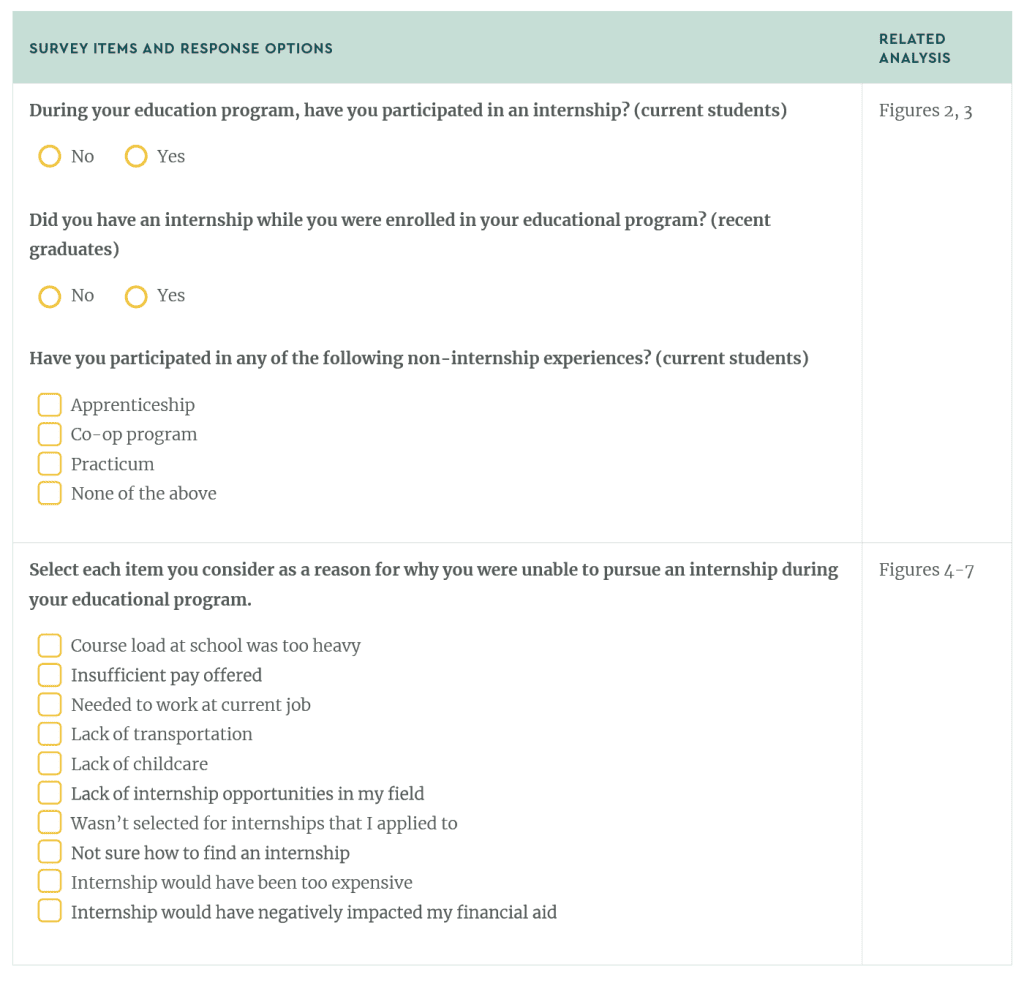
The following table presents the survey questions measuring the outcomes in this brief, along with the associated response options14.
Brief 3: Early Career Outcomes
The following table presents the survey questions measuring the outcomes in this brief, along with the associated response options5.

Acknowledgments
We thank the College Futures Foundation for supporting these briefs. We also gratefully acknowledge general operating support from the Bill & Melinda Gates Foundation; the Evelyn and Walter Haas, Jr. Fund; the Kresge Foundation; and the Molina Family Foundation. We very much appreciate the ideas and critical feedback of Lisa Catanzarite, Theresa Esparrago Lieu, Julia Lopez, and Nichole Torpey-Saboe. We thank the Strada Education Foundation for collecting and providing the data. PrettyMe Creative Solutions, LLC designed this publication, and Dragonfly Editorial provided copyediting. All errors are our own.
Notes
Summary
- Cooperative Institutional Research Program. (2025).
2024 CIRP Freshman Survey data tables. Higher Education Research Institute, University of California, Los Angeles, p. 15. https://heri.ucla.edu/wp-content/uploads/2025/03/DATA-TABLES-TFS-2024.pdf
- A fifth domain, affordability, is measured by the average net price of attendance at public colleges relative to the state’s median wage. Strada Education Foundation. (2024). State Opportunity Index: Strengthening the link between education and opportunity. https://www.strada.org/state-opportunity-index
Brief 1: Career Pathway Guidance
- Armstrong, E. A., & Hamilton, L. T. (2013). Paying for the party: How college maintains inequality. Harvard University Press, ch. 7.
- Bailey, T. R., Jaggars, S. S., & Jenkins, D. (2015). Redesigning America’s community colleges: A clearer path to student success. Harvard University Press, pp. 56–57.
- Armstrong & Hamilton. (2013). Paying for the party.
- Rivera, L. A. (2016). Pedigree: How elite students get elite jobs. Princeton University Press, p. 168.
- Bleemer, Z., Davidson, A. & Mehta, A. (July 11, 2023). Restricted access to lucrative college majors harms underrepresented students most. Brookings Institution. https://www.brookings.edu/articles/restricted-access
- Jack, A. A. (2019). The privileged poor: How elite colleges are failing disadvantaged students. Harvard University Press.
- Porter, S. R. (2011). Do college student surveys have any validity? The Review of Higher Education, 35(1), 45-76
- The survey items measuring demographic and enrollment characteristics are available in Strada Education Foundation. (2024). Appendix: Work-based learning. https://cdn.prod.website-files.com/676597e34ca10568d19ed18f/67a8f2bab5f5590dfe4301f4_SOI_Appendices_Work-Based-Learning_compressed.pdf
Brief 2: Work-Based Learning
- Amechi, M. H. (2022). What everyone should know about designing equity-minded paid work-based learning opportunities for college students. New America. https://eric.ed.gov/?id=ED624548
- Academic Senate for California Community Colleges. (2019). Work based learning in California Community Colleges. https://eric.ed.gov/?id=ED602000; California Competes. (2024). Workforce ready: Exploring equity in paid and unpaid internships. https://californiacompetes.org/resources/exploring-equity-in-paid-and-unpaid-internships
- Academic Senate for California Community Colleges. (2019). Work based learning; Deming, D., Fuller, J., Lipson, R., McKittrick, K., Epstein, A., & Catalfamo, E. (2023). Delivering on the degree: The college-to-jobs playbook. Harvard Kennedy School, p. 7. https://eric.ed.gov/?id=ED636056
- Deming et al. (2023). Delivering on the degree, p. 7; Ross, M., Kazis, R., Bateman, N., and Stateler, L. (2020). Work-based learning can advance equity and opportunity for America’s young people. Brookings Institution. https://www.brookings.edu/articles/work-based-learning
- Deming et al. (2023). Delivering on the degree, p. 8.
- Torpey-Saboe, N., Leigh, E. W., & Clayton, D. (2022). The power of work-based learning. Strada Education Foundation, pp. 5–6. https://stradaeducation.org/report/pv-release-march-16-2022; Deming et al. (2023). Delivering on the degree, pp. 25, 58.
- Limiting this analysis to near-graduates helps facilitate an apples-to-apples comparison of learners at about the same stage in their education paths, though admittedly it glosses over the different program lengths of two-year and four-year colleges.
- Perlin, R. (2012). Intern nation: How to earn nothing and learn little in the brave new economy. Verso Books; Ravishankar, R. A. (May 26, 2021). It’s time to officially end unpaid internships. Harvard Business Review. https://hbr.org/2021/05/its-time-to-officially-end-unpaid-internships
- This analysis includes learners who completed internships and those who did not to account for varying internship rates across fields of study. For example, engineering students completed internships at nearly twice the rate of business/marketing students (47% vs. 24%; figure 3). Even if identical proportions of engineering students and business/marketing students wanted to intern but failed to secure internships because they were not sure how to find one, the overall uncertainty rate would appear lower for engineering students simply because more of them successfully completed internships.
- Burning Glass Institute and Strada Institute for the Future of Work. (2024). Talent disrupted: Underemployment, college graduates, and the way forward, pp. 16–20, 25–26. https://stradaeducation.org/report/talent-disrupted
- Salgado, J. (August 23, 2022). An internship helped catapult me from homelessness to a full-time job. Hechinger Report. https://hechingerreport.org/student-voice-an-internship; Singer, N. (April 5, 2023). This historically Black university created its own tech intern pipeline. The New York Times. https://www.nytimes.com/2023/04/05/technology/bowie-hbcu-tech-intern-pipeline.html
- Kazis, R., & Snyder, N. (2019). Uncovering hidden talent: Community college internships that pay and pay off for students and employers. Boston Foundation. https://files.eric.ed.gov/fulltext/ED602752.pdf
- Porter, S. R. (2011). Do college student surveys have any validity? The Review of Higher Education, 35(1), 45-76.
- The survey items measuring demographic and enrollment characteristics are available in Strada Education Foundation. (2024). Appendix: Work-based learning. https://cdn.prod.website-files.com/676597e34ca10568d19ed18f/67a8f2bab5f5590dfe4301f4_SOI_Appendices_Work-Based-Learning_compressed.pdf
Brief 3: Early Career Outcomes
- Employment Development Department, California Workforce Development Board, and Labor and Workforce Development Agency. (2024). SB 755 (2022): Expanding workforce performance analysis and employer quarterly wage reports: Final report to legislature. https://edd.ca.gov/siteassets/files/about_edd/sb-755-report—expanding-workforce-performance-analysis-and-employer-quarterly-wage-reports.pdf; California Cradle-to-Career Data System, SB 575. (2025). https://leginfo.legislature.ca.gov/faces/billNavClient.xhtml?bill_id=202520260SB575
- Bernhardt, A., Campos, C., Prohofsky, A., Ramesh, A., & Rothstein, J. (2022). Independent contracting, self-employment, and gig work: Evidence from California tax data. ILR Review, 76(2), 357-386.
- For example, Fischer, K. (August 10, 2022). The path from college to career: Career offices are seeking ways to prepare students for a rapidly changing work force. Chronicle of Higher Education. https://www.chronicle.com/report/free/the-path-from-college-to-career
- Porter, S. R. (2011). Do college student surveys have any validity? The Review of Higher Education, 35(1), 45-76.
- The survey items measuring demographic and enrollment characteristics are available in Strada Education Foundation. (2024). Appendix: Work-based learning. https://cdn.prod.website-files.com/676597e34ca10568d19ed18f/67a8f2bab5f5590dfe4301f4_SOI_Appendices_Work-Based-Learning_compressed.pdf
