
Untapped Opportunity:
Meet California’s 6.4 Million Potential Graduates
Adults ages 25–54 with a high school diploma but no college degree

California’s 6.4 million potential graduates represent a major opportunity to expand economic mobility, strengthen the workforce, and fuel California’s economic future.
This updated statewide analysis offers a current picture of Californians ages 25–54 who have a high school diploma but no college degree; the responsibilities and constraints shaping their educational pathways, including work, caregiving, financial insecurity, geography, and language access; and promising, research-based recommendations to help institutions and policymakers better serve them.
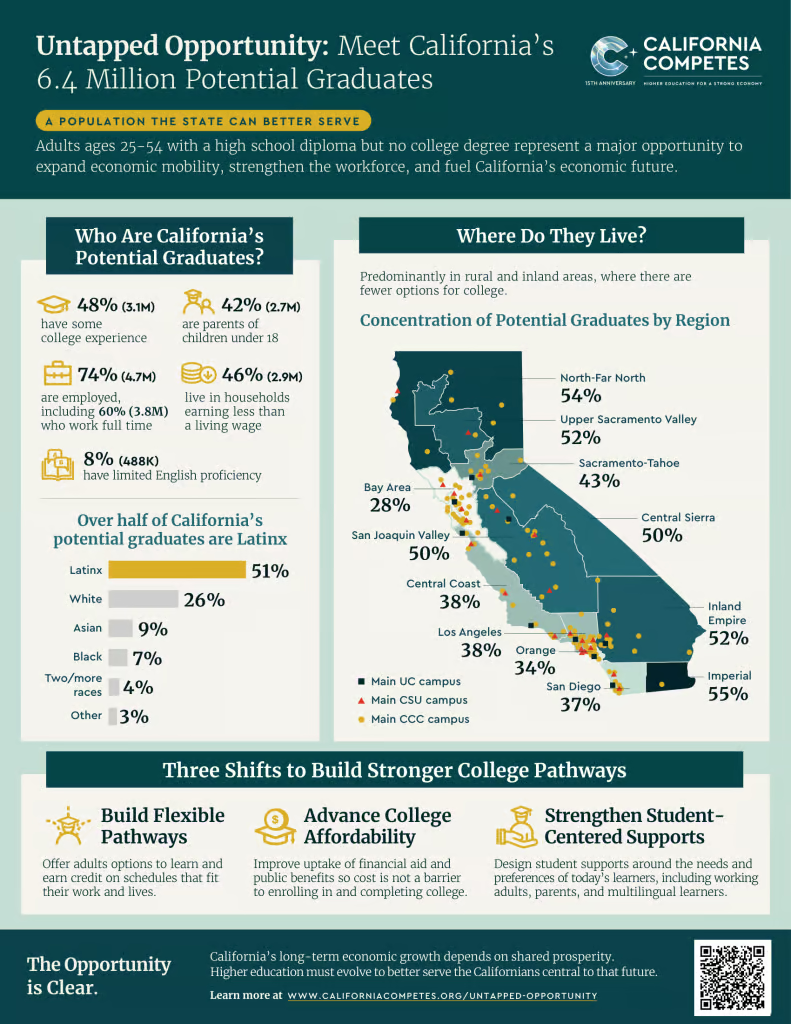
- California’s 6.4 million potential graduates are central to the state’s future. Adults ages 25–54 with a high school diploma but no college degree represent a major opportunity to expand economic mobility, strengthen the workforce, and support California’s long-term prosperity.
- Many potential graduates have already begun their college journeys. Nearly half (3.1 million) have attended college but did not earn a degree. Reengaging them is essential as California faces a declining number of recent high school graduates.
- Potential graduates are balancing college with the realities of daily life. Most are working, more than two in five are parents, and nearly half live in households earning below a living wage.
- The barriers are structural, not individual. College pathways should account for work, caregiving, financial insecurity, geography, and language access, and build on adults’ existing experience, goals, and strengths.
- Colleges can become more adult-ready. The report identifies evidence-informed strategies, including flexible scheduling, credit for prior learning, family-friendly policies, stronger financial supports, to advance pathways for shared prosperity.
Summary
Economic projections show that California needs more workers with college degrees, yet demographic trends are heading in the opposite direction. The number of high school graduates is starting to drop, and the college enrollment rate continues to decline. Having a college degree has become more necessary for residents to support themselves and their families. Low- and middle-income Californians are being squeezed by rising costs, and the state’s poverty rate is now the highest in the nation.
There is an enormous untapped opportunity to reverse the impending shortage of college-educated workers while alleviating poverty and boosting prosperity: California should expand the college attainment of the 6.4 million California adults who are of prime working age (25–54) and have a high school diploma but no college degree. To accomplish this, however, the state’s higher education system will have to change to better serve this population.
WHAT DOES “POTENTIAL GRADUATE” MEAN?
In this report, potential graduates are California adults of prime working age (25–54) who have a high school diploma or the equivalent but do not hold an associate’s degree or higher certification.
Meeting that challenge begins with understanding who California’s potential graduates are, the experiences they bring, and the barriers they face. This report provides a demographic portrait of this population, refreshing the statewide analysis published in California Competes’s 2021 report. It also identifies policies and practices that can create more responsive pathways to and through college and, ultimately, to economic mobility and shared prosperity.
Understanding California’s Potential Graduates
- Many already have some college experience. Nearly half of California’s potential graduates have attended college previously but did not complete their degree. They bring prior learning and experience that higher education institutions could better recognize and build upon.
- Most are already active in the workforce. Most potential graduates are employed full time, and many work in service and retail occupations. Their jobs often involve unpredictable schedules, fluctuating hours, and limited flexibility, conditions that can make it difficult to attend classes regularly.
- Financial constraints are significant. Nearly half of potential graduates live in households earning less than a living wage.
- Many are supporting families. More than 40 percent of potential graduates are parents. Their ability to pursue higher education can be better supported through the availability and affordability of childcare, family-friendly scheduling, financial aid, and other supports that recognize their caregiving responsibilities.
- Potential graduates reflect California’s diversity. Nearly half are Latinx, predominantly of Mexican heritage, and most are people of color. Nearly half a million have limited English proficiency, underscoring the importance of integrating English-language instruction with college-level education and career pathways.
- Geography shapes access. Many potential graduates live in inland and rural regions where residents have fewer nearby college options and may face transportation, broadband, and program-availability barriers.
- Veterans represent another important population. Almost 200,000 potential graduates are military veterans whose experience and prior learning may not be fully recognized or easily translated into college credit and credentials.
Policies and Practices to Strengthen College Pathways
To better serve California’s potential graduates, colleges and policymakers should pursue a comprehensive approach that combines flexible academic programs with clearer routes into and through college and stronger financial, advising, and basic-needs support. Promising policies and practices include:
- Expanding high-quality online and hybrid instruction so working adults can participate without being constrained by traditional class times or lengthy commutes.
- Developing competency-based programs that allow students to progress by demonstrating what they know and can do, including knowledge gained through employment, military service, and other life experiences.
- Simplifying reenrollment and credit transfer for adults who previously attended college, including clearer processes for retrieving transcripts, evaluating prior coursework, and applying credits toward a credential.
- Awarding credit for prior learning so adults do not have to repeat material they have already mastered or spend additional time and money earning credits for knowledge they already possess.
- Improving access to financial aid and basic needs support by accounting for the full costs adults face, simplifying application processes, and connecting students with available public benefits and institutional resources.
- Strengthening support for student parents through childcare, family-responsive scheduling, dependent-care allowances, priority registration, and clearer access to campus and community resources.
- Better serving multilingual learners by integrating English-language development, adult basic education, and college-level coursework rather than requiring students to complete long sequences before entering a degree pathway.
- Reducing geographic and transportation barriers by assessing transportation to campus, offering free or discounted transit passes if warranted, and ensuring adequate online offerings and services.
- Creating welcoming campuses for veterans and improving the recognition of military training, experience, and previously earned credits.
Increasing the college attainment of California’s potential graduates could pave the way to economic mobility for millions of residents and even pay for itself with increased tax revenue and reduced state spending. This population faces serious hurdles, and growing evidence shows that certain policies and practices actually address those challenges to increase enrollment and completion. Changing the state’s higher education system to work better for these adults will not be an easy task, but if successful, it would generate an immense payoff to individuals, their families, their communities, and the state.
Adult Learners Are Essential to California’s Prosperity
California’s economic future, and the prosperity of its residents, depends on whether more adults 25 years and older can enroll in and complete postsecondary education. In the coming years, demand for workers with a college degree will grow and be reflected in 46 percent of California jobs.1
Meanwhile, the number of California high school graduates, the demographic group historically most likely to attend and complete college, is projected to decline more than 30 percent (figure 1). And the share attending college right after high school is also dropping (figure 2). These trends portend a shortage of college graduates needed to fill these jobs and to power the state’s economy.
Fewer Californians will graduate high school in the coming years
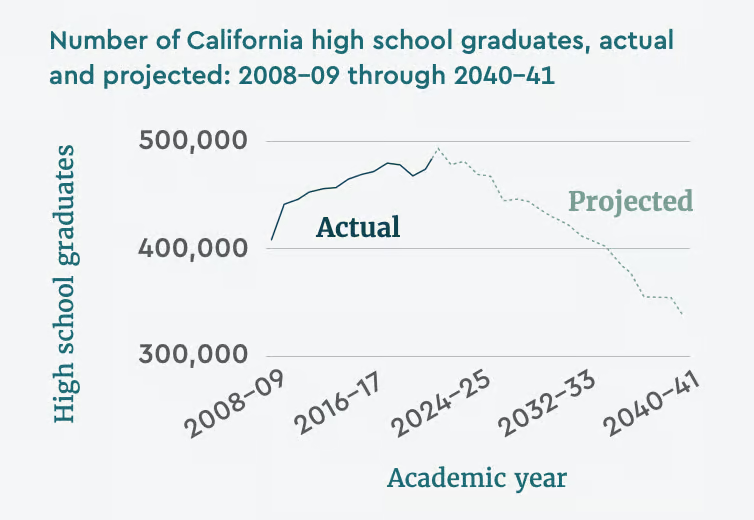
Source: Lane, P., Falkenstern, C., and Bransberger, P. (2023). Knocking at the college door: Projections of high school graduates (11th ed). Western Interstate Commission for Higher Education (replication data).
Recent high school graduates are less likely to enroll in college
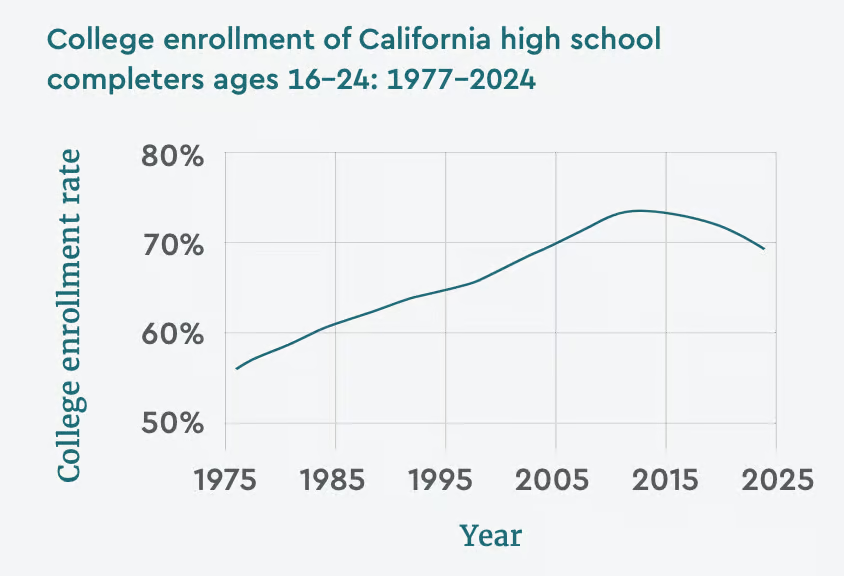
Note: Trendline is estimated using lowess (locally weighted scatterplot smoother), bandwidth = 0.5. Recent high school completers include individuals who earned a GED or other equivalent.
Source: Current Population Survey, October Supplement, 1977–2024, analyzed via IPUMS CPS (replication link).
It is also an opportunity to expand prosperity among current California residents. The economic advantages associated with a bachelor’s degree are considerable. Compared with working-age Californians with a high school diploma but no college education, bachelor’s degree holders are less likely to live in poverty (8% vs. 20%), more likely to be in the labor force (88% vs. 77%), and have a median net worth more than six times higher ($582,000 vs. $76,000).2 These disparities underscore the need to ensure that more Californians can share in the state’s prosperity.
Against the prospect of California’s impending shortage of college-educated workers, a solution is hiding in plain sight. Approximately 6.4 million Californians ages 25–54 have a high school diploma or the equivalent but no college degree. These potential graduates represent an enormous untapped opportunity to meet employers’ needs while creating better economic opportunities for millions of residents and their families.
However, California’s higher education system remains largely unprepared to support this population’s success. The state’s postsecondary system has changed little since the 1960 Master Plan for Higher Education formalized it, despite seismic shifts in the student population and the economy over the past six decades.3 In many ways, institutional structures still presume that students are recent high school graduates, primarily financially supported by their parents, and able to relocate near campus. These assumptions have resulted in a mismatch between the design of the college experience and the realities of current and potential learners.
Potential graduates are not just older versions of the students the system was built to serve. They are far more likely to shoulder responsibilities (like full-time employment and parenting) while financing college on their own, often under financial strain.4 Most attend multiple colleges over the course of their education (at a higher rate than students ages 18–24) as they navigate competing demands on their time and resources.5
Yet colleges often offer classes and services such as advising and counseling exclusively during weekday business hours, when many potential graduates are working. They schedule courses over 10- to 16-week quarters and semesters, which limits opportunities for enrollment and raises the stakes if students have to withdraw midterm for work or family responsibilities.
Persisting Through Institutional Barriers
Joseph attended community college off and on for nearly a decade before enrolling at a public four-year university. Working full time while attending college took a toll on his grades, leading to academic probation and the loss of financial aid eligibility.
No one from school reached out. If someone had showed they cared, it would have helped. I didn’t know what else to do besides leave.
Five years later, when Joseph attempted to reenroll, he learned that he first needed to complete a semester with satisfactory academic progress to regain access to financial aid. This stipulation required him to earn a cumulative 2.0 grade point average (or a C average) and complete at least 67 percent of the credits he attempted. Motivated to complete, Joseph quit his job, took out a personal loan, enrolled full time, and ultimately graduated with a bachelor of science in electrical engineering, eight years after first enrolling in university. Joseph’s experience illustrates the structural barriers that too often make enrolling or returning to college difficult and the determination needed to surmount them.
Source: Degrees of Value research by California Competes.
Organization of Report
This report is organized in two parts. Part 1 examines the demographic characteristics of potential graduates, including their backgrounds, work and family responsibilities, finances, where they live, language needs, and military experience. Part 2 identifies policies and practices that can help colleges better serve them and strengthen pathways to completion, with a focus on evidence-based solutions, especially those involving randomized controlled trials.
PART 1
Who Are California’s Potential Graduates?
Understanding the characteristics of California’s 6.4 million potential graduates is the first step to better serving them. This population varies in background, educational attainment, home responsibilities, living situation, and language proficiency. Colleges must shape their policies and practices for that diversity.
Latinx Californians Make Up the Largest Share of Potential Graduates
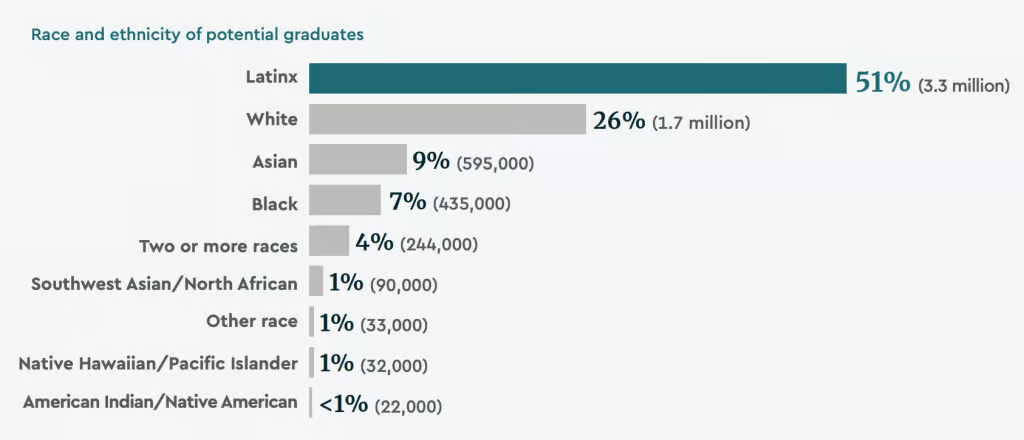
Over half of California’s potential graduates, 3.3 million adults, are Latinx (figure 3). Latinx Californians are also more likely than members of any other major ethnic or racial group to say that they intend to pursue higher education in the next two years.6
Among those ages 25–54, Latinx and Black Californians are disproportionately likely to be potential graduates. Forty-nine percent of Latinx Californians and 50 percent of Black Californians are potential graduates, compared with 39 percent of all Californians ages 25–54.7
The largest share of potential graduates is Latinx
Source: 2020–2024 American Community Survey five-year estimates (replication link).
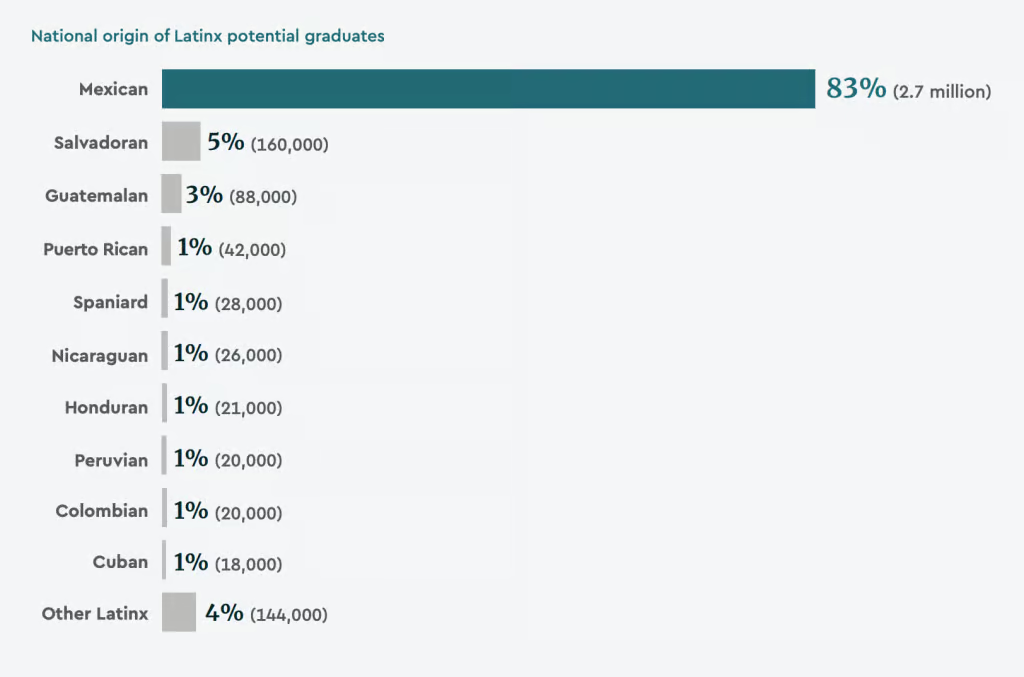
Five out of six Latinx potential graduates (83%, 2.7 million of 3.3 million) are of Mexican descent (figure 4). The next most commonly represented Latinx national origins are Salvadoran (5%, 160,000) and Guatemalan (3%, 88,000).
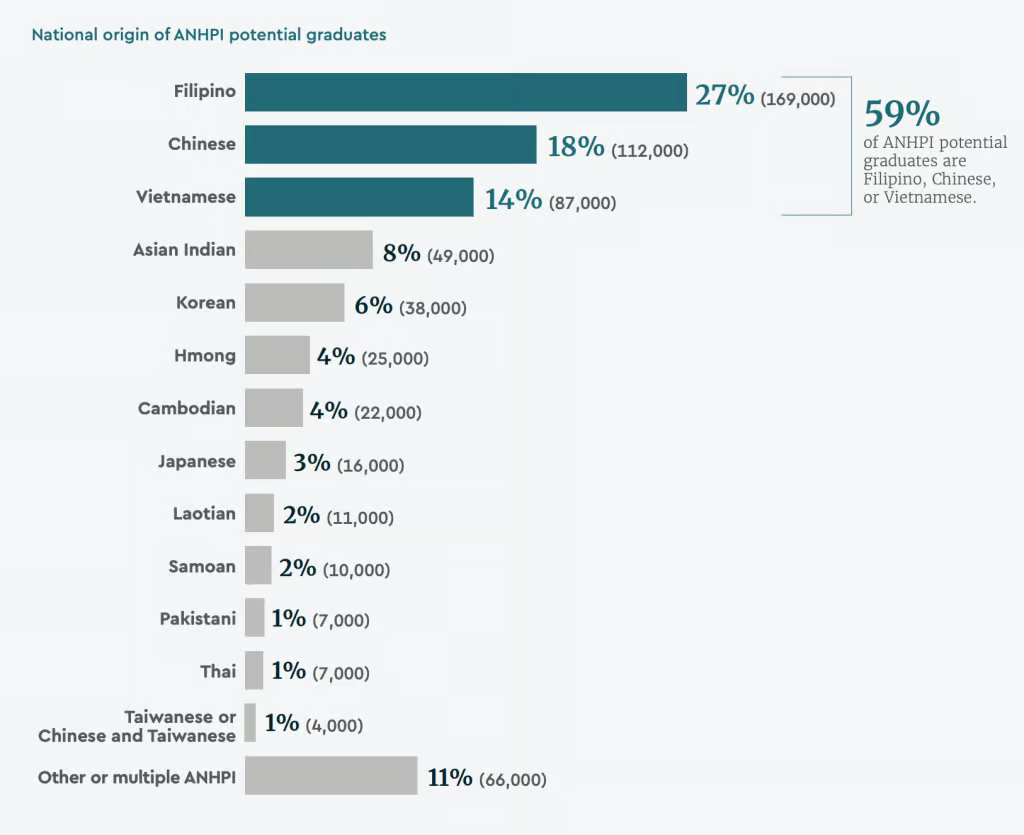
Among Asian, Native Hawaiian, and Pacific Islander (ANHPI) potential graduates, 27 percent are of Filipino descent, 18 percent are of Chinese descent, 14 percent are of Vietnamese descent, and 8 percent are of Indian descent (figure 5). The remaining 30 percent are from other national origins or more than one national origin.
Latinx potential graduates are overwhelmingly of Mexican descent
Source: 2020–2024 American Community Survey five-year estimates (replication link).
Filipino, Chinese, and Vietnamese Californians make up over half of ANHPI potential graduates
Note: ANHPI = Asian, Native Hawaiian, and Pacific Islander.
Source: 2020–2024 American Community Survey five-year estimates (replication link).
Nearly Half of Potential Graduates Have College Experience
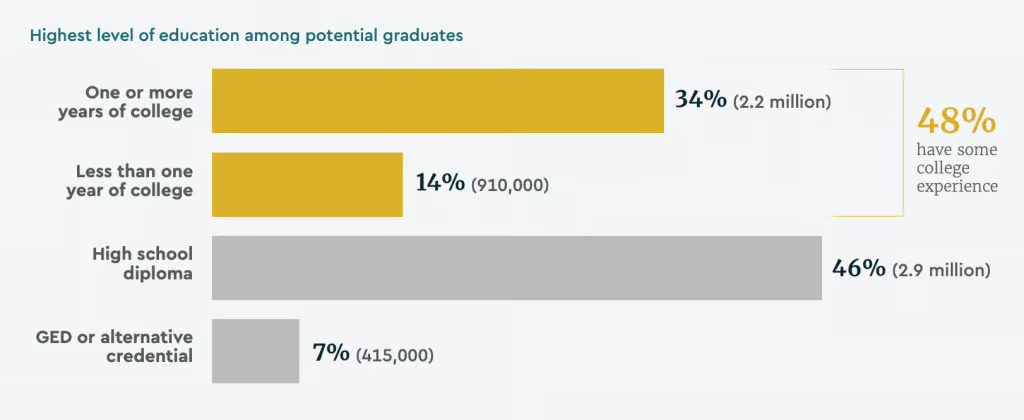
California’s 6.4 million potential graduates may not have an associate’s or bachelor’s degree, but nearly half (48%, 3.1 million) have attended college (figure 6).
About half of potential graduates have some college experience
Note: Detail does not sum to totals due to rounding.
Source: 2020–2024 American Community Survey five-year estimates (replication link).
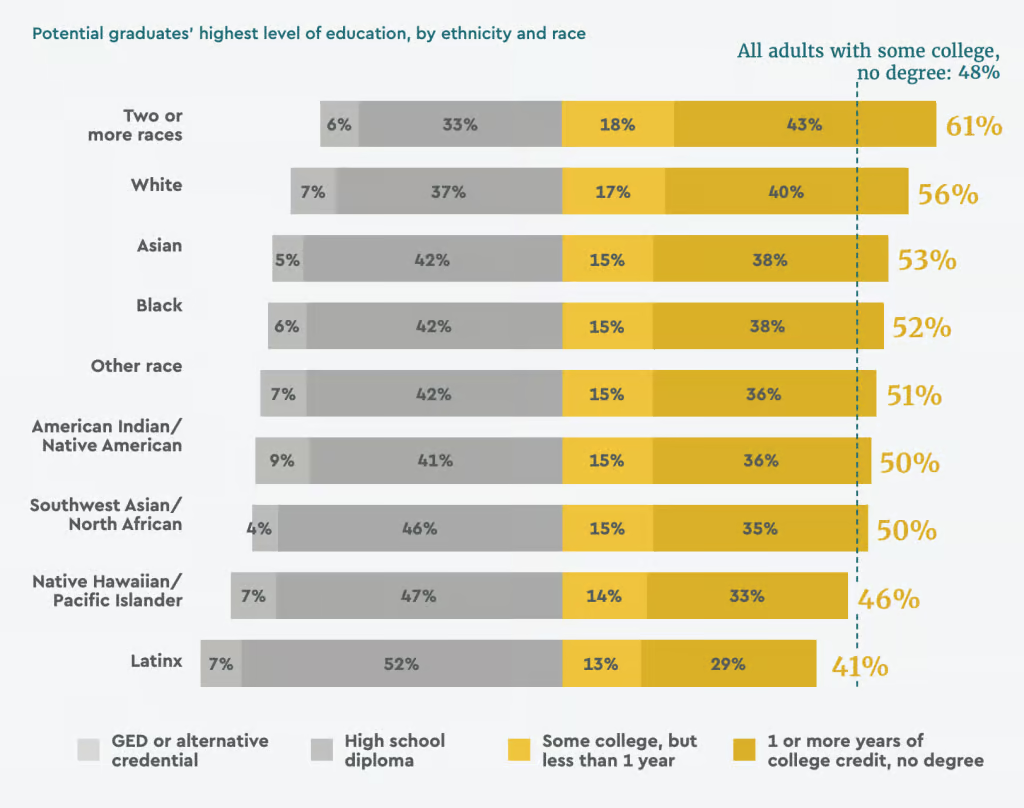
The proportion of potential graduates with any postsecondary education varies widely by ethnicity and race, from 41 percent of Latinx Californians to 61 percent of multiracial Californians (figure 7). (These findings obscure further variation within ethnic and racial groups. Attainment is further disaggregated by national origin for Latinx and Asian Californians in the appendix.)
Multiracial and white potential graduates are most likely to have some college experience, while Latinx Californians are least likely
Note: Detail does not sum to totals due to rounding.
Source: 2020–2024 American Community Survey five-year estimates (replication link).
The Majority of Potential Graduates Are Men
As figure 8 shows, 54 percent of potential graduates are men, and they outnumber women by about half a million (3.5 million vs. 2.9 million).8 By comparison, the overall population of Californians ages 25–54 is more evenly split by sex, with men constituting 51 percent (8.2 million) and women constituting 49 percent (7.9 million).9
More men than women are potential graduates
Source: 2020–2024 American Community Survey five-year estimates (replication link).
Many Live in Households With Limited Financial Resources
Many potential graduates have limited financial means. We cannot measure exactly how many potential graduates will have difficulty affording college because there is no definitive cost threshold.10 The financial resources that potential graduates will need from enrollment through graduation depend on what colleges charge, the amount of financial aid the student receives, and their living expenses, among other things.
For example, a typical low-income California college student can expect annual costs of $4,000 at the University of California (UC), $8,900 at the California State University (CSU), and $9,000 at the California Community Colleges (CCC) after subtracting federal and state grant aid.11 Private colleges usually cost more.12 Living expenses are largely determined by family configuration and the local cost of living.
All of these factors vary widely across the state’s 6.4 million potential graduates, but these two finance-related measures illustrate possible financial constraints.
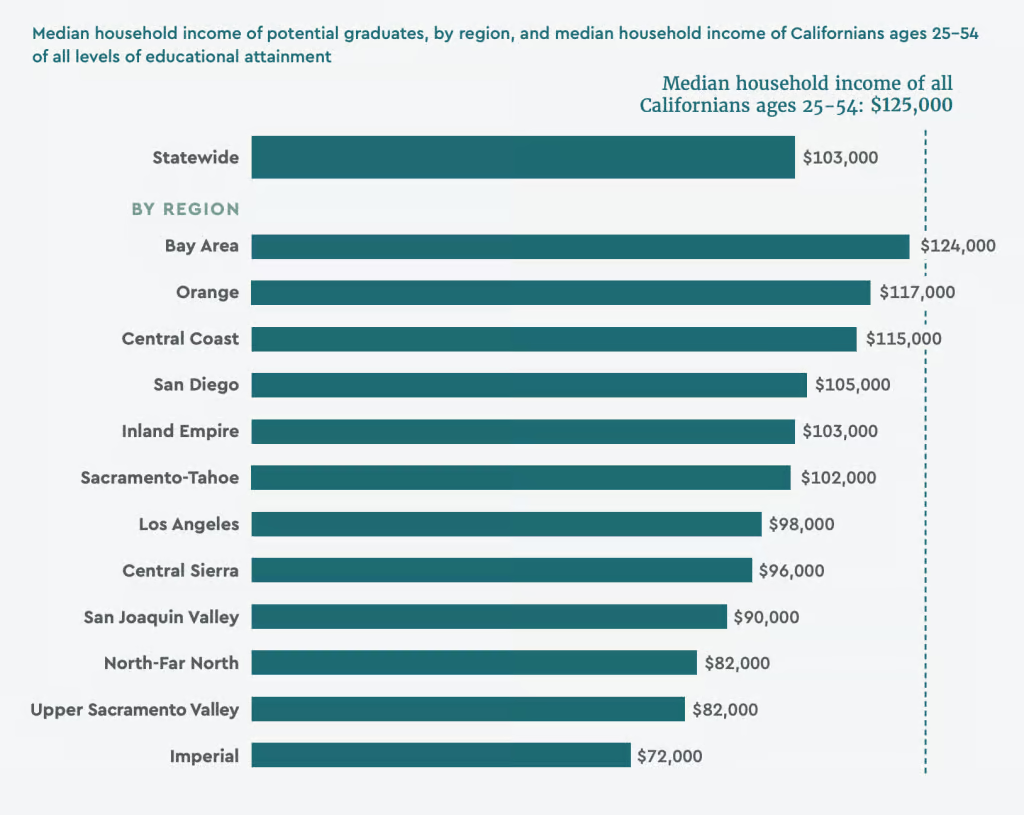
Figure 9 compares the median household income of potential graduates statewide and across California’s regions. Statewide, potential graduates have a median household income of $103,000, with regional incomes ranging from $72,000 in Imperial County to $124,000 in the Bay Area. In every region, potential graduates earn less than the median household income for Californians ages 25–54 across all levels of educational attainment ($125,000).13 While a six-figure income may sound substantial, it stretches much less far in California: in 16 of the state’s 58 counties, a family of three earning $100,000 is still officially considered low-income.14
In every region, the median household income of potential graduates is lower than that of Californians ages 25–54 overall
Source: 2020–2024 American Community Survey five-year estimates (replication link).
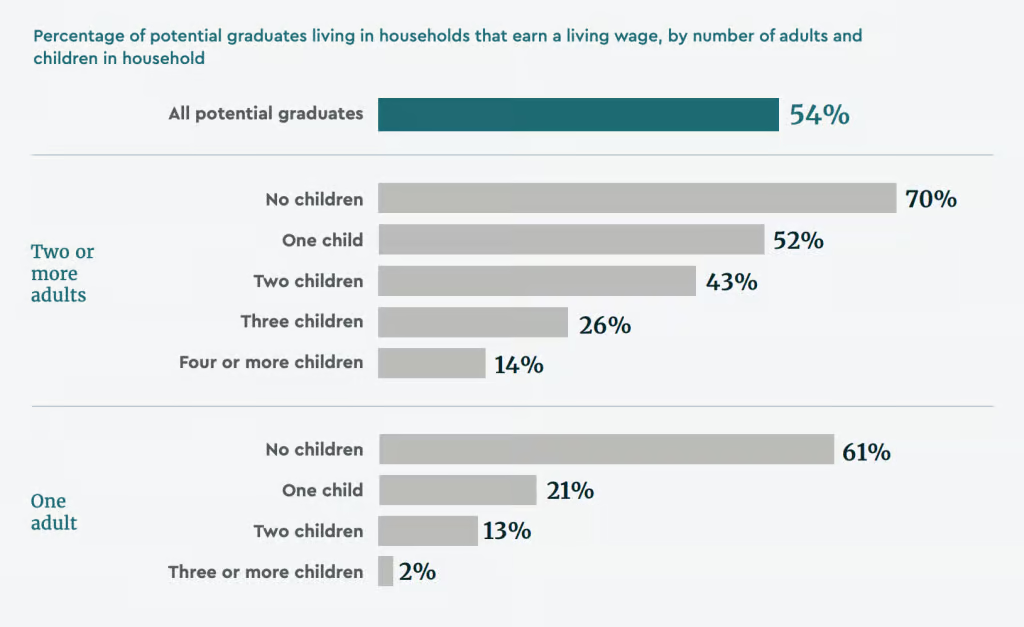
Potential graduates’ ability to purchase basic essentials offers a more direct measure of constrained resources, as just over half of potential graduates (54%) live in households that earn a living wage (figure 10). A living wage is estimated as the minimum amount needed to cover the basic necessities of food, housing, taxes, utilities, health care, transportation, childcare, emergency savings, and miscellaneous essentials (clothing, medicine, personal hygiene products, telephone service, etc.). College tuition, fees, books and supplies, and other educational expenses are not included.15
Potential graduates whose typical expenses exceed their household income are at best teetering on the edge of poverty. The economic situation is bleakest for potential graduates with children, who have substantially higher living expenses, on average, than their counterparts without children. Fewer than half of potential graduates who live in households with two or more adults and have two or more children earn a living wage. Fewer than a quarter of potential graduates in single-adult households with any children earn a living wage (the range includes 21 percent for those with one child and just 2 percent for those who have three or more children).
Potential graduates with children, especially in one-adult households, are less likely to live in households earning a living wage
Note: Living wage estimates vary by county and reflect the number of adults (up to 10) and the number of children (up to 10) and their ages in the individual’s household. Values exclude the 3 percent of potential graduates (178,000) for whom a living wage could not be calculated. Nearly all of these potential graduates (96%) live in a county that is not identified in the survey data. The rest live in households with more than 10 adults or 10 children, which do not have corresponding budgets needed to calculate a living wage.
Source: Calculated from the 2020–2024 American Community Survey five-year estimates via IPUMS USA, matched to living wage estimates from the Self-Sufficiency Standard for California.
Most Work Full Time and Many Have Unpredictable Schedules
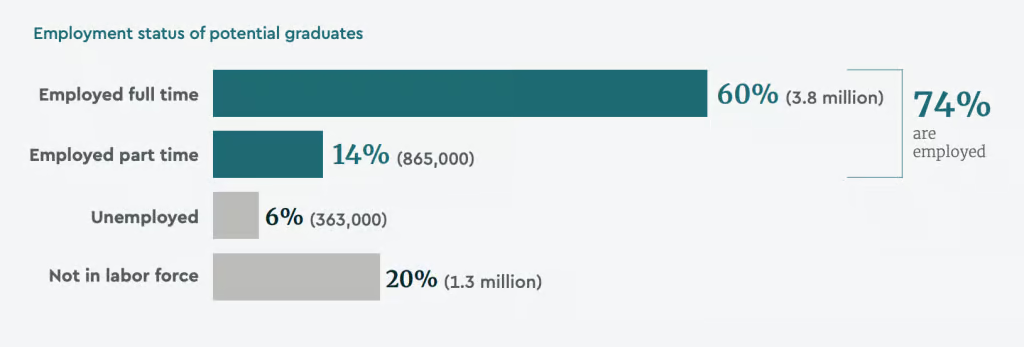
In addition to having limited financial means, most potential graduates are time constrained because of employment obligations. Nearly three-quarters (74%, 4.7 million) are employed, including 60 percent who work full time (figure 11). Given the substantial expense of college, few potential graduates have the option to quit working upon enrollment. For most students, the opportunity cost of forgone earnings exceeds the direct costs of higher education.16
Most potential graduates work full time
Note: “Full time” is defined as usually working 35 or more hours per week.
Source: 2020–2024 American Community Survey five-year estimates (replication link).
Potential graduates must balance not only the time demands of work and school, but also fluctuating work schedules, which make it difficult to attend classes consistently and to maintain a steady source of income to pay their education and living expenses. Three in 10 potential graduates work in service or retail sector jobs (figure 12), which are increasingly subject to unstable working hours that can change at the last minute.
A study of 28,000 service sector workers found that 37 percent worked a variable schedule and another 19 percent had rotating shifts.17 In the same study, 63 percent of employees said they received fewer than two weeks’ notice of schedule changes, including 16 percent who said they were rescheduled with fewer than three days’ notice. A little more than half (51%) had no input regarding their work schedules, and 14 percent had experienced a shift cancellation within the last month.
Many potential graduates work in service and retail jobs, which often have unpredictable schedules and fluctuating hours
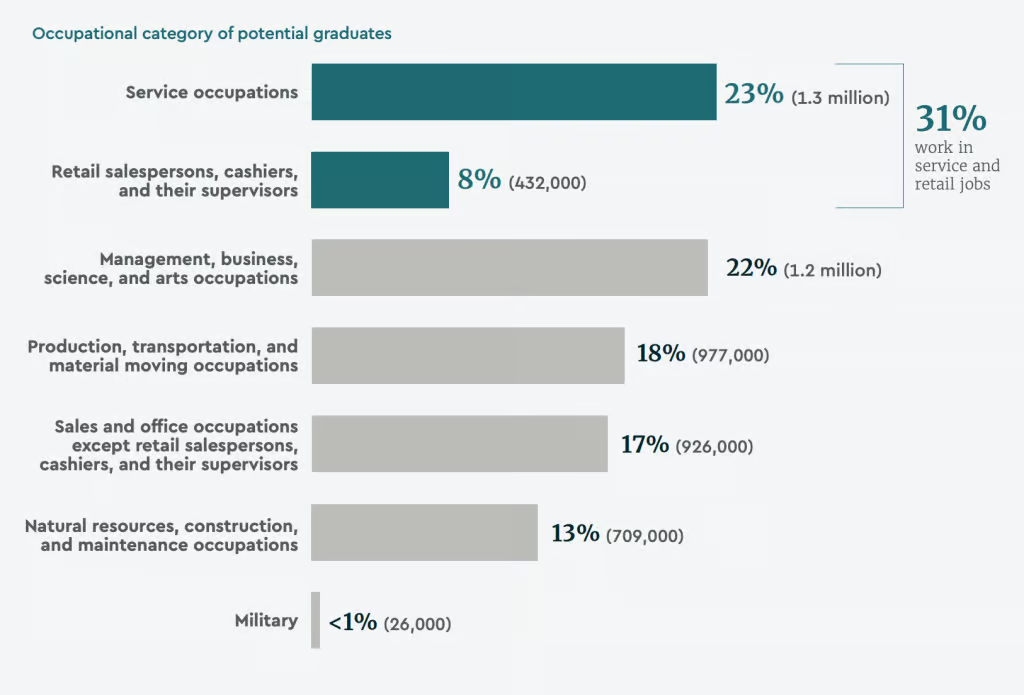
Note: Results exclude the 13 percent of potential graduates (808,000) not in the labor force or with no work experience in the last five years. The categories are based on the 2018 revision of the Standard Occupational Classification, published by the US Bureau of Labor Statistics. From top to bottom, the ranges are 3601–4655, 4700–4760, 10–3550, 4800–5940, 6005–7640, and 9800–9830.
Source: 2020–2024 American Community Survey five-year estimates (replication link).
Two in Five Potential Graduates Are Parents
More than 2.7 million potential graduates are parents of children under 18, making up 42 percent of California’s working-age adults without a degree. Parenting responsibilities are especially common among women with nearly half (49%) raising children, compared with 36 percent of men.
Many potential graduates have children, including half of women and one-third of men
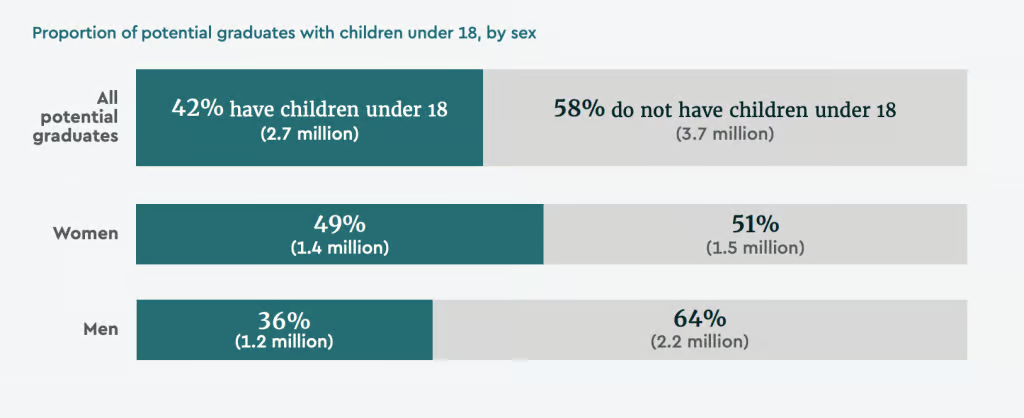
Note: Detail does not sum to totals due to rounding.
Source: 2020–2024 American Community Survey five-year estimates (replication link).
Navigating College as a Student Parent
Meg, a mother of two, stopped out and reenrolled four times over seven years before earning her associate’s degree. During this time, she experienced ongoing periods of housing instability, had limited childcare, and lacked support for basic necessities. She also struggled to find places to breastfeed on campus, so attending college when her children were newborns felt unworkable.
Basic needs, housing, childcare, and transportation are really big factors, especially with babies under two. If you’re breastfeeding, having to be on campus is not really feasible.
Source: Degrees of Value research by California Competes.
Inland and Rural Regions Have Highest Shares of Potential Graduates, But Fewer College Options
Potential graduates are concentrated in California’s inland and more rural areas, regions with fewer college campuses (figure 14). The regions with the highest percentages of potential graduates are Imperial County (55%), North-Far North (54%), Upper Sacramento Valley (52%), the Inland Empire (52%), the San Joaquin Valley (50%), Central Sierra (50%), and Sacramento-Tahoe (43%). These regions are home to 40 percent of potential graduates (2.5 million); however, the regions host only 32 percent of all California residents ages 25–54.18
Potential graduates are concentrated in the state’s inland regions, where there are fewer college options
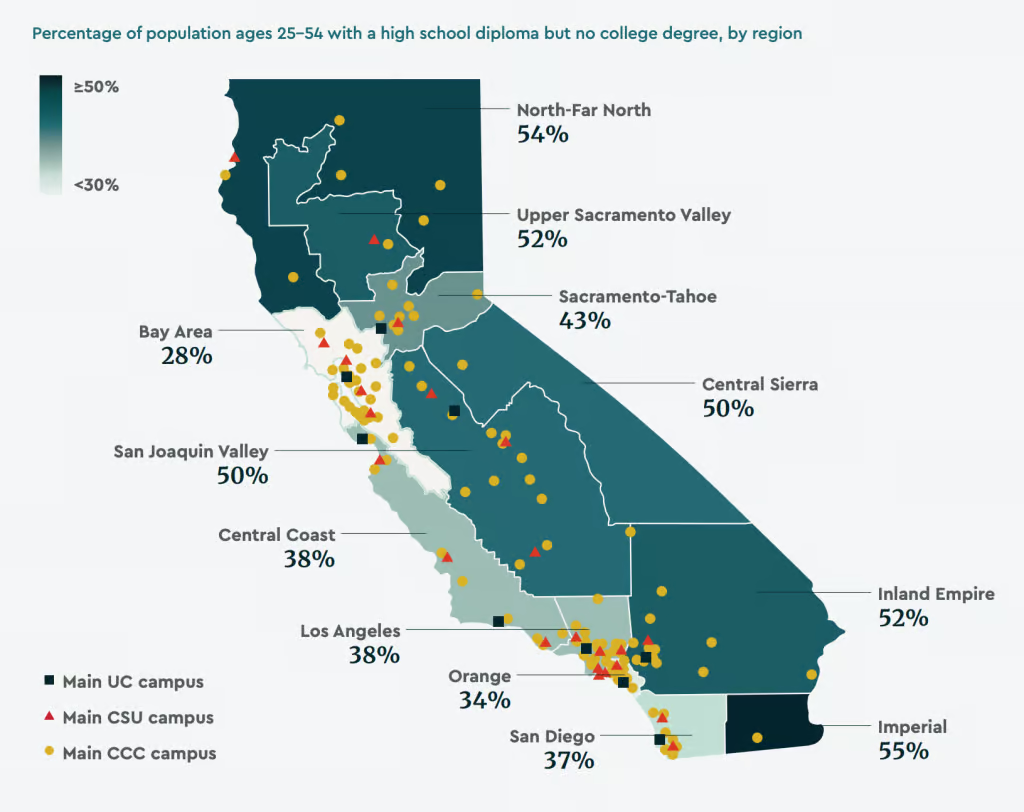
Source: 2020–2024 American Community Survey five-year estimates (replication link).
Potential graduates in rural areas face a more difficult path to college than their urban and suburban counterparts, as they often live far from the nearest college’s main campus or subsidiary branch, satellite, or center (see, for example, “Mia’s Story,” p. 21). If a student is unable to relocate for any number of reasons (their job, their spouse’s or partner’s job, housing or moving costs, caregiving responsibilities, etc.), they may be stuck with a drive of more than an hour, with no public transportation. Even for potential graduates with access to a vehicle, transportation is a major expense, constituting nearly one-fifth of the average student’s budget, and parking on campus can be difficult and costly.19
A Long Commute and an Academic Journey Nearly Derailed by the Pandemic
Mia lived in a rural area of Northern California, far from the nearest college. After attending community college, she transferred to a public four-year university that she selected in large part for its proximity to a major freeway. Even so, it took her an hour to drive to campus.
Scheduling Around the Commute
The timing of offered courses was a significant barrier for Mia, as she had to arrange her class schedule to fit her commute. She appreciated the flexibility of the community college schedule, compared with the more limited offerings at the university.
An Abrupt Shift Online
For many students, remote learning is a welcome alternative to long commutes and the hassle and expense of parking and transit fares. Not so for Mia, at least not in the ad hoc form of online instruction that sprang up at the outset of the COVID-19 pandemic in March 2020.
Academic Notice and Lost Aid
Just weeks away from completing the final courses for her bachelor’s degree, she struggled with her online classes and failed three of them. As a result, she was placed on academic notice (what was formerly known as academic probation), which cut off her eligibility for financial aid.
Return and Completion
After successfully appealing her status, she reenrolled, completed her last three classes, and graduated. The ordeal delayed her completion by a whole year.
Source: Degrees of Value research by California Competes.
Nearly Half a Million Potential Graduates Face Language Barriers
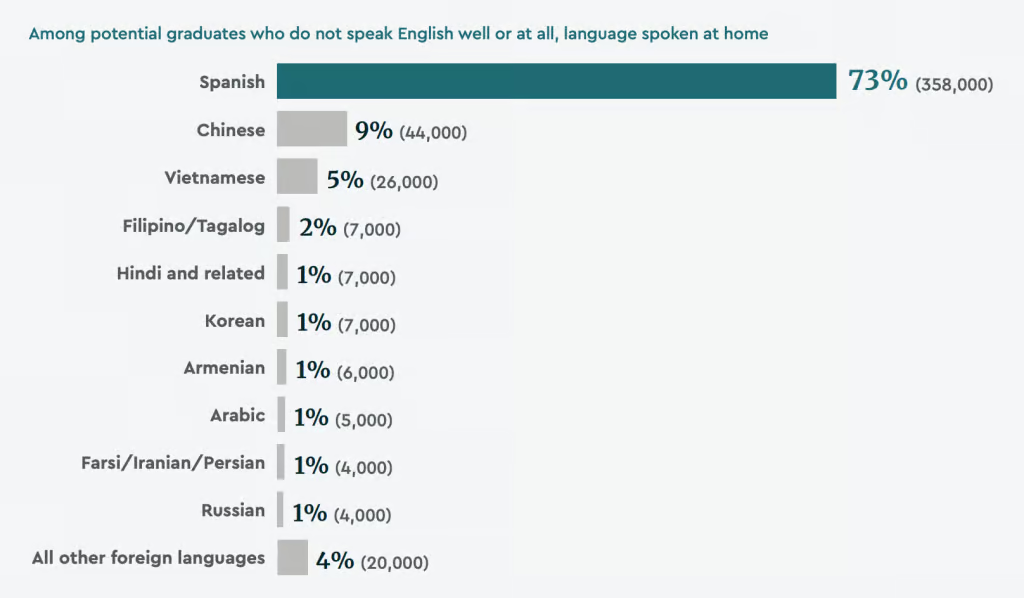
Nearly half a million potential graduates have limited English proficiency or do not speak English at all (figure 15). This is eight times the share of current California undergraduates ages 18–24 (8% vs. 1%).20 This difference illustrates a key challenge: California’s higher education system is not designed to teach college-level coursework to the large number of multilingual adults who could benefit from postsecondary education.
Among potential graduates who do not speak English well or at all, 73 percent (358,000) speak Spanish at home, 9 percent (44,000) speak Chinese, and 5 percent (26,000) speak Vietnamese (figure 16). (Specific Chinese dialects are not measured.)
One in twelve potential graduates has limited English proficiency
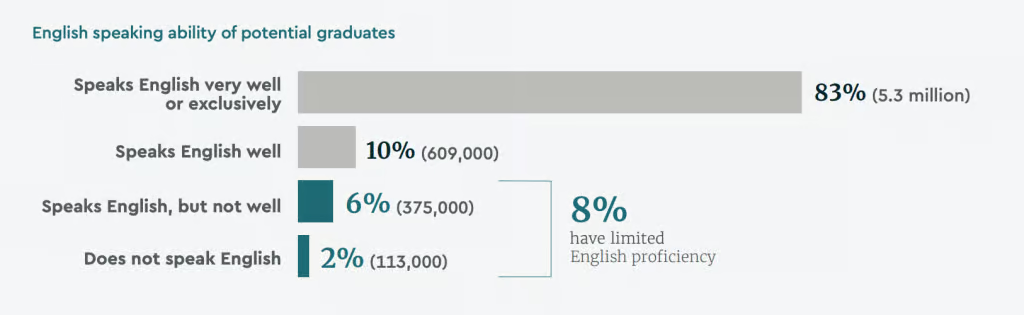
Note: Detail does not sum to totals due to rounding.
Source: 2020–2024 American Community Survey five-year estimates (replication link).
Nearly three-quarters of multilingual potential graduates with limited English proficiency speak Spanish at home
Note: Detail does not sum to totals due to rounding.
Source: 2020–2024 American Community Survey five-year estimates (replication link).
Some Bring Valuable Skills from Military Service
Finally, 191,000 potential graduates (3%) are military veterans. Veterans constitute 5 percent of men (168,000) and 1 percent of women (23,000) who are potential graduates. They bring with them distinct advantages (such as the skills and knowledge they acquired from their military service) and challenges (such as higher rates of disability).

Source: 2020–2024 American Community Survey five-year estimates (replication link).
PART 2
What Policies and Practices Can Strengthen College Pathways for Potential Graduates?
Understanding California’s 6.4 million potential graduates is the first step; the next is identifying what helps them succeed. This section presents recommendations organized by the number of potential graduates who could benefit from them and, where possible, grounded in randomized controlled trials (RCTs). See the appendix for the strengths and limitations of RCTs.
For Greatest Impact, Employ a Comprehensive Approach
Potential graduates often face multiple barriers to college enrollment and completion. Expanding opportunity requires more than helping students through the doors. Institutions must also be ready to support this population from intent through degree attainment. As such, colleges should employ a comprehensive approach that combines an array of supports, such as financial assistance, advising, academic support, flexible scheduling, and instruction, to facilitate smoother onramps and pathways to completion.
One example of a comprehensive approach, the Accelerated Study in Associate Programs (ASAP), illustrates the potential of a holistic strategy that integrates several supports. The program pairs financial assistance, including tuition waivers, textbooks, and transit passes, with dedicated advising and career planning, tutoring, learning communities, a student-success seminar, and encouragement to enroll full time and during summer and winter breaks. ASAP nearly doubled community college students’ three-year graduation rates compared with a control group (40% versus 22%) and also improved persistence, credit accumulation, and transfer to four-year colleges.21 Its effects have held in replications at colleges in several states22 and in an eight-year follow-up study.23 A cost-benefit analysis found it more cost-effective at graduating community college students than more typical approaches.24
ASAP is one example of a broader pattern: interventions that combine more supports tend to produce stronger results. A meta-analysis of 39 studies examining varying combinations of student supports and instructional reforms found that interventions with more components led to greater improvements in student achievement.25 The evidence base includes adult students and student parents: 24% of participants in that meta-analysis were age 25 or older,26 and a meta-analysis of a subset of the studies found a similar pattern of results for student parents.27
Colleges do not need to implement every support at once. They can begin with targeted improvements and build toward a more comprehensive approach over time. The recommendations that follow offer practical strategies to:
- Maximize enrollment and credit-earning opportunities for all potential graduates
- Design flexible programs for working learners
- Reengage Californians with some college but no degree
- Reduce financial barriers for low-income Californians
- Tailor recruitment, programs, and supports to the circumstances of diverse learners, including Latinx and Black Californians, parents, rural learners, multilingual learners, and veterans.
Most potential graduates hold multiple identities and experiences, so many will benefit from more than one of these strategies. Colleges should consider how to combine them in ways that respond to the overlapping needs and strengths of the learners they serve while creating the conditions for more potential graduates to see higher education as part of their future, earn a credential, and thrive.
For All Potential Graduates, Maximize Enrollment and Credit-Earning Opportunities
Regardless of their background, most potential graduates have limited time, competing obligations, and years of life experience gained outside of educational settings. Colleges should design policies (such as the following ones) that recognize their constraints and strengths.
Encourage enrollment over summer and winter breaks: This encouragement emerged (along with encouraging full-time enrollment) as the most effective component of the meta-analysis mentioned above.28 Summer enrollment is a more feasible option for adults who are not able to enroll full time because of work or caregiving responsibilities. A recent RCT concluded that an inexpensive messaging campaign to boost summer enrollment, with and without modest supplemental financial aid, led students to complete more credits.29
Offer in-person courses during shorter academic terms (five to eight weeks): Replacing 15- or 16-week semesters or 10-week quarters, shorter terms allow adult learners more enrollment opportunities each year and reduce the penalty they incur when forced to withdraw midterm for work, family, or other personal reasons.30 Research in three states on the effects of compressed terms found mostly positive effects on persistence, course completion, and enrollment in additional courses in the same subject for in-person instruction but largely negative effects for online instruction.31 At least two efforts are underway to evaluate shortened terms in the CCC.32
Offer credit for prior learning: Such credit could apply to college-level skills and knowledge gained from employment, military service, and other out-of-class settings.33
For Working Californians, Enable Them to Learn on Their Own Schedules
Most potential graduates work full time, often in service and retail positions with limited flexibility and hours and shifts that can fluctuate with little notice. Unstable work schedules have become common in other sectors as well, including technology, media, government, health care, and trucking.34 A recent study revealed how this trend affects students. Last year, 65 percent of working undergraduates told researchers that they experienced a change to their work hours in the prior year, and 27 percent said that the difference in hours affected their enrollment.35
With erratic work schedules come unreliable income streams. A recent study of working Californians found that many have variable hours and paycheck totals, especially those at the lower end of the income scale. “I work part time and my hours are always changing,” explained one participant. “I don’t really have a set amount that I can expect to make every month. So it feels like a surprise—one month I might be okay, but the next month, I might not make enough.”36 Such variability only compounds the financial challenge of paying for college.
These realities can make it difficult to complete college in systems designed around younger students with fewer competing responsibilities. While employers and policymakers have a critical role to play in improving job quality and stability, colleges must also adapt their structures and practices to better meet the needs of working adults.
- Expand asynchronous online instruction: Asynchronous online instruction and other alternatives to traditional classroom instruction can enable students with reliable access to high-speed internet to attend lectures and complete assignments on their own schedules.37
- Promote competency-based education: This option enables students to progress through programs at their own pace, spending more time and effort on academics when work demands are lower and vice versa.38
For Latinx and Black Californians, Tailor Recruitment Efforts and Enhance the Sense of Belonging
Half of potential graduates are Latinx Californians, and another 7 percent are Black, totaling 3.7 million adults. Colleges must take steps to encourage their enrollment and, after they matriculate, bolster their success.
- Employ culturally relevant messaging and tailored recruitment strategies: Use languages other than English when appropriate, particularly when reaching Latinx Californians and other multilingual communities.39
- Pilot and refine initiatives to increase students’ sense of belonging: For example, an RCT involving 27,000 students across 22 colleges found that a 10- to 30-minute reading and writing exercise promoting belonging reduced gaps in first-year persistence for Latinx and Black students (relative to white and Asian students), as well as for first-generation college students (relative to continuing-generation students).40
For Californians with Some College but No Degree, Address the Reasons They Stopped Out and Facilitate Credit Mobility
Nearly half of potential graduates have already attended college. This experience can give potential graduates a head start over first-time students, potentially shortening the time it takes to earn degrees and saving them thousands of dollars. However, prior enrollment can be a barrier if it stirs up negative feelings or requires them to settle outstanding debts (such as parking fines or late fees). To reach potential graduates with college experience, colleges must implement policies that address the reasons they stopped out and smooth the path to reenrollment and completion.
- Understand the reasons why students stopped out: This is a first step toward assessing and reforming policies and procedures.41
- Contact adults with some college but no degree to invite them back to campus: Ideally, this occurs alongside supplemental financial and academic support.42 One RCT found a combination of text messaging and a one-semester fee waiver led to a modest but meaningful increase in reenrollment.43 Another RCT found larger effects by combining outreach with dedicated academic advising and financial aid.44
- Reform academic probation: Remove the classification’s punitive connotations and penalties, and inform candidates for academic renewal that they can reset their grades.45
- End the practice of withholding transcripts for outstanding charges: Some campuses continue to withhold transcripts for late fees and library fines, for example, in apparent violation of state law.46 Offer a process for forgiving institutional debt.47
- Facilitate the transfer of credit across colleges: This could accelerate credit evaluation and reduce the cost of such evaluations—ideally, such a system could work so well that prospective students find out how their credits will carry over and fulfill degree requirements before they even apply.48
- Articulate and promote noncredit-to-credit pathways and conversion: This assistance is helpful for the many adult learners who start in noncredit community college programs and adult schools.49
The Value of Outreach for Reengaging Students Who Stop Out
Bruce started college in 1997 but left for nearly 15 years before reenrolling. He stopped out again after ongoing battles with addiction. During his time away from college, Bruce became sober, moved out of state, and later reenrolled at his previous college through an online learning option. He ultimately completed his bachelor’s degree in communications. Bruce didn’t receive any outreach from the school after stopping out. Reflecting on his experience, he believes that outreach would have helped him return sooner.
When you’re reminded that someone is thinking of you, when there’s so much riding on it—we don’t know why people leave, but someone extending their hand could make all the difference.
Source: Degrees of Value research by California Competes.
For Californians with Low Incomes, Assist with Obtaining Financial Support
Financial strain is a leading barrier to enrollment in higher education and the most common reason students stop out.50 The average potential graduate must find or borrow $4,000 to $9,000 per year to attend a public college or university, even after accounting for federal and state grants. Students with dependent children face additional expenses in the tens of thousands of dollars, not to mention the opportunity cost of fewer hours working for pay.
Moreover, even when these potential graduates scrape together the means to enroll in college, it is a risky endeavor in which one misstep could lead to serious consequences. As one study explains:
[A] student from a high-income family who discovers that he or she has taken a course that does not count toward graduation or transfer can shrug off the time and money as a minor hassle. In contrast, for a low-income student, the time spent on a semester-long course translates to at least a full week of time away from wage earning. The forgone wages, along with any tuition not covered by financial aid, may require cuts in basic household expenses for items such as groceries, health insurance, or children’s clothing. To realize that such painful sacrifices were wasted on an unnecessary course is no minor hassle.51
For those who take out student loans, the consequences of dropping out can be even more dire, as they have to manage debt without the additional earning power of a college degree.52
Compounding the issue for potential graduates with low incomes is a state financial aid system that excludes many adult learners. Cal Grants, the state’s primary financial aid program for students with low incomes, have generally been restricted to those who enroll in college immediately or soon after high school. Reform legislation in 2021 partially expanded access to adult learners who apply and qualify for a Cal Grant while enrolled in California community colleges.53
However, older students who either do not apply for financial aid until after they have transferred or enroll directly in a four-year institution remain ineligible for entitlement Cal Grants in most instances. Instead, they are placed in a competitive grant pool out of which only 13,000 awards are paid each year, leaving out tens of thousands of otherwise eligible students.54 Legislation enacted in 2022 would have entirely eliminated restrictions for older students, but with a lack of available funding, the change never took effect.55
Generally, UC and CSU students with incomes low enough to qualify for a Cal Grant will receive institutional aid to cover their tuition and fees. For student parents, however, receipt of a Cal Grant also unlocks up to $6,000 in supplemental aid for nontuition expenses, such as childcare. Parents kept out of the Cal Grant program because of their age or the length of time since they graduated high school may not always have this amount covered by institutional grants.
With nearly half of potential graduates in households not earning enough to purchase basic necessities, colleges must help students maximize the financial support for which they are eligible. Here are promising avenues for reducing financial pressure for this population:
- Encourage potential graduates to apply for financial aid and other public benefits: This strategy is supported by RCTs.56 Such efforts can be extremely cost-effective, yielding thousands of dollars in benefits for each dollar invested.
- Offer personalized assistance with filing for aid: Assistance increased college application rates eight percentage points in one RCT.57
- Remove barriers to the Cal Grant program that exclude older students: In addition, remove barriers that prevent certain student parents from receiving supplemental aid intended to help cover nontuition expenses.58
For Parents, Expand Family-Friendly Policies and Facilities
Parenting while enrolled in college can require an enormous additional investment of money, time, and effort.59 Colleges often lack facilities to support parenting students (e.g., changing stations, lactation rooms, on-campus childcare, and family-serving housing) and policies that accommodate their needs (e.g., priority registration, consideration of children’s expenses in financial aid eligibility calculations, and a sense of belonging for them and their children on campus).60
Recently enacted legislation addresses some of these issues at public colleges, requiring CCC and CSU campuses to offer student parents priority registration, post resources for them on their websites, and incorporate parenting-specific expenses (such as childcare) in calculating the price of attendance.61 (These laws request the same actions of UC campuses.) Some campuses have dedicated specific spaces on campus for student parents.62
Potential graduates caring for younger children must also contend with what may be the biggest obstacle of all: paying for childcare. The median price of center-based childcare exceeds $20,000 per child per year in some parts of California, with families facing annual expenses as high as $50,000.63 On average, the annual statewide cost of center-based care for one infant is a larger expense than housing or college tuition, constituting 16 percent of income for two-parent households and 49 percent of income for single parents.64
Helping student parents succeed starts with making support easier to find and access. The Student Parent Resource Hub, developed by The California Alliance for Student Parent Success, helps current and prospective student parents find and compare resources—like child-friendly study spaces, student parent groups, childcare, and food pantries—available across California’s public colleges. Explore the tool at castudentparentalliance.org/resource-hub/.
Colleges must act on multiple fronts to successfully accommodate the 2.7 million potential graduates who are parents. The following recommendations represent a sample of policies and practices to support student parents.65
- Streamline processes for student parents to learn about, apply for, and secure relevant resources: Such resources include subsidized childcare, financial aid for students with dependents, and case management services.66
- Audit campus facilities for family-serving accommodations: These accommodations include on-campus childcare, student parent resource centers, private lactation rooms (not bathrooms) for expressing milk and feeding infants, family-serving student housing (apartments), and play spaces for young children.67
- Adopt and enforce policies that support parenting and breastfeeding students: Such policies include formal parental leave for new parents and guardians and a procedure for students to request time off between classes to pump milk.68
- Offer high-quality childcare options that are affordable, are open when student parents need them, and have sufficient availability: With this support, students can enroll their children without waiting months for an opening.69 Making childcare affordable almost certainly entails public funding, but a subsidy may even pay for itself in higher tax receipts and reduced government spending.70
For Rural and Mobility-Challenged Californians, Reduce the Burden of Commuting
Transportation to campus can pose significant logistical and financial barriers to college enrollment, especially in rural areas, which have the largest proportions of adults who are potential graduates.71 Consequently, colleges must find ways to enable Californians to attend college wherever they live. The following recommendations may also benefit suburban and urban residents who have limited transportation options, mobility issues, or time commitments that make it difficult to regularly attend classes in person.
- Assess the accessibility of transportation to and from campus: This activity will help administrators better understand the circumstances of potential graduates and current students.72 Nearly all community colleges in California (93%) have a public transportation stop within a half mile of campus, for example. However, that fact says nothing of whether the transportation is affordable, reliable, or fast enough; whether it runs during the hours that students need it; or whether it operates near students’ homes.73
- Offer free or discounted student transit passes: These could be offered, perhaps, in concert with local government, if the campus transportation assessment indicates that doing so would be helpful. Passes might be distributed as a universal program or specifically to students who need it as part of a comprehensive support package.74 (Most CCC campuses already offer subsidized public transportation for the vast majority of their students who live off campus.75 Other colleges and localities do too, and the effort is sometimes funded by student fees.76) An RCT found that at two New York City community colleges, students who picked up a free transit pass had higher rates of persistence and graduation, though these results may not be generalizable to less urban communities.77
- Ensure that online offerings, including full degree programs and student services, are adequate: Offerings should meet the needs of potential graduates who cannot travel to campus due to distance, physical limitations, or other reasons but do have reliable broadband internet service.
The Value of Online Instruction
Kevin took courses offered asynchronously online so he could stay employed in his full-time day job and complete his coursework in the evenings and on weekends. The transition to online instruction during the COVID-19 pandemic allowed Kevin to switch from part-time to full-time enrollment and to take courses at other campuses in the university system.
It is possible if you’re enrolled at [my university] to take a class from, you know, San Diego or somewhere else in the same system.
He emphasized that the online learning option was the primary reason he was able to earn his bachelor’s degree in 2022. Kevin is currently enrolled in an online master’s program in library science.
Source: Degrees of Value research by California Competes.
For Multilingual Learners of English, Build Pathways That Integrate English Instruction and Supports
For the nearly half-million potential graduates with limited English proficiency, colleges must offer language instruction along with other coursework. For example, our recent work designing career pathways for San José adults with low incomes found that prospective learners, most of whom speak a language other than English at home, prioritize improving their English proficiency.78 Research points to multiple promising practices to help potential graduates and other multilingual learners improve their English proficiency as they seek degrees. Recommendations include the following:
- Involve potential graduates in designing academic programs: This work could include gauging their interest in learning English and considering how such instruction might fit with existing and proposed degree pathways.79
- Monitor and consider adopting emerging approaches to serve students with limited English proficiency: For example, three CCC campuses are piloting an AI tool to guide students through administrative hurdles, such as financial aid applications.80
- Offer transfer-level English courses specifically targeted to multilingual learners: Preliminary research suggests such courses lead to higher rates of success.81
For Veterans, Build Welcoming Campuses Through Outreach, Community, and Support
A Warm Welcome for a Returning Veteran
Andrew began his postsecondary studies at a community college and transferred to a four-year college to pursue a bachelor’s degree in communications. He was deployed during his last semester. While overseas, he set up a virtual meeting with a college counselor to register for classes. When he returned to campus, the same counselor supported him and connected him with the veterans’ center. Andrew emphasized the importance of intentional outreach and opportunities to build community for veterans returning to class and helping them feel supported.
Reach out to comebackers and create a welcome orientation for those students, where they can connect with each other, so they don’t feel alone.
Source: Degrees of Value research by California Competes.
Nearly 200,000 potential graduates are military veterans. This population has characteristics and experiences that differentiate them from potential graduates with no prior military service. Qualified veterans are entitled to educational benefits that cover the full cost of attendance, including locally adjusted living expense stipends that can exceed $5,000 per month.82 They may also earn college credit for their military service.83 Veterans bring valuable experiences and qualities to campus, such as proficiency in foreign languages, leadership skills, and a commitment to teamwork.84
Student veterans also have distinctive challenges, such as difficulty translating their military service into college credits,85 higher rates of disabilities than other undergraduates,86 and the potential to be targeted by predatory for-profit colleges.87
Many organizations give recommendations (such as the following) on how colleges can best serve student veterans.88
- Establish a formal veteran outreach program: This program could be staffed by students or recent graduates with military experience, and the program could connect personally with veterans from the time they consider applying until after they enroll.89
- Designate a physical space on campus for veterans: There, they could meet, study, and obtain access to services.90
- Offer professional development to faculty and staff: This assistance can help them understand student veterans’ experiences.91
California Has an Opportunity to Redesign Higher Education for Today’s Students
California’s need for college graduates is growing just as the number of high school graduates is starting to decline. Low- and middle-income Californians are increasingly being squeezed by rising costs for basics (such as housing, food, and utilities), while their earnings remain nearly flat.92 The state is now tied with Louisiana for the highest poverty rate in the nation.93
Expanding college attainment would help improve these grim statistics and strengthen the financial position of millions of California adults and their families. By one estimate, raising college attainment to 70 percent across all major demographic groups in California would yield a $4.4 trillion payoff over 50 years, averaging over $200,000 per resident ages 25–64. The effort would pay for itself through increased tax revenues and reduced spending on public benefits and incarceration.94
But these 6.4 million potential graduates face a series of hurdles to earning a college degree, including limited time and money, competing commitments, high expenses, and challenging commutes. The state’s higher education system, once considered a national and global model, is increasingly misaligned with the needs of today’s learners.
Mounting evidence shows how colleges can welcome and educate California’s potential graduates. It will not be easy. It will require a sustained commitment of effort and resources to even make incremental progress. Policies and practices will undoubtedly evolve as artificial intelligence and other innovations reshape higher education, work, and the overall economy. But the payoff of increasing college graduation in California will be immense, even life-changing, and there are 6.4 million reasons to try.
Acknowledgments
We gratefully acknowledge the generous support of the College Futures Foundation; the Gates Foundation; the Evelyn and Walter Haas, Jr. Fund; and the Kresge Foundation. We also appreciate the thoughtful suggestions by Leanne Davis, Dr. Taylor Myers, Dr. Sabrina Sanders, and Pete Weber. Merillangie designed the publication, and Dragonfly Editorial provided copyediting. All errors are our own.
Appendix
Data and Methods
The findings in this publication, unless otherwise stated, are based on 2020–2024 American Community Survey five-year estimates. This survey, conducted by the US Census Bureau, includes approximately 2 million Californians of all ages. The data were obtained and, in most instances, analyzed via IPUMS at the University of Minnesota.95 Estimates were weighted by the person weight (PERWT), except for household income (figure 9), which was weighted by the household weight (HHWT).
Additional results for undergraduates are sourced from the 2016/2020 Baccalaureate and Beyond Longitudinal Study, Second Follow-Up, the 2012/2017 Beginning Postsecondary Students Longitudinal Study, and the 2020 National Postsecondary Student Aid Study, all conducted by the US Department of Education’s National Center for Education Statistics (NCES) and calculated using NCES DataLab. College enrollment rates of recent high school completers were calculated from the US Census Bureau’s Current Population Survey October Supplement and analyzed via IPUMS.96 Living wage budgets were provided by the Center for Women’s Welfare at the University of Washington.97
This report focuses on California, but replication links are provided where possible to facilitate similar research in other states and at the national level.
Figures 9 and 14 divide the state into 12 regions, each of which is made up of one or more counties:
- The Bay Area consists of Alameda, Contra Costa, Marin, Napa, San Francisco, San Mateo, Santa Clara, Solano, and Sonoma Counties.
- The Central Coast consists of Monterey, San Benito, San Luis Obispo, Santa Barbara, Santa Cruz, and Ventura Counties.
- Central Sierra consists of Alpine, Amador, Calaveras, Inyo, Mariposa, Mono, and Tuolumne Counties.
- The Inland Empire consists of Riverside and San Bernardino Counties.
- Los Angeles consists of Los Angeles County.
- North-Far North consists of Del Norte, Humboldt, Lake, Lassen, Mendocino, Modoc, Nevada, Plumas, Shasta, Sierra, and Siskiyou Counties.
- Orange consists of Orange County.
- Sacramento-Tahoe consists of El Dorado, Placer, Sacramento, Sutter, Yolo, and Yuba Counties.
- San Diego consists of San Diego County.
- Imperial consists of Imperial County.
- San Joaquin Valley consists of Fresno, Kern, Kings, Madera, Merced, San Joaquin, Stanislaus, and Tulare Counties.
- Upper Sacramento Valley consists of Butte, Colusa, Glenn, Tehama, and Trinity Counties.
All statistics were calculated using unrounded values. For ease of interpretation, percentages are shown rounded to whole numbers. Five- and six-figure values were rounded to the nearest thousand, and seven-figure values were rounded to the nearest tenth of a million. Whenever possible, the figure notes and endnotes that use the sources listed above include links to replicate the analyses and to encourage additional exploration and research. (Users must first create a free account.)
Why Randomized Controlled Trials Matter
Randomized controlled trials (RCTs) are widely considered the strongest form of evidence in education and other research.98 Because this report emphasizes promising practices supported by the strongest available evidence, it gives greater weight to interventions evaluated by RCTs.
Random assignment creates two groups that are similar at the start, so any differences in outcomes are most likely due to the intervention itself and not preexisting differences between research subjects. In contrast, most observational (nonrandomized) studies assume that the researchers statistically control for all such background factors. This assumption is sometimes plausible but is never airtight. These factors (such as motivation, genetic makeup, or childhood experiences) may be difficult to measure accurately and precisely. Even if they were, researchers cannot control for factors they have not considered.
However, RCTs also have limitations, such as artificial conditions that differ from real-world practice and settings, samples of research participants who are often undergraduates at research universities and differ substantially from the broader population they aim to represent, and sample sizes that are too small to reliably detect true effects.99 These issues have contributed to broader concerns about reproducibility in social science research.100 In addition, RCTs can be costly and difficult to implement in educational settings. They also can pose ethical problems, for example, involving subjects in research without informed consent and withholding presumptively beneficial treatments from the control group for the sake of comparison.
Field experiments, a specific type of RCT, address the methodological concerns by combining random assignment with otherwise naturalistic conditions.101 These studies, including all the RCTs cited in this report, assign real treatments in real settings using research subjects who are representative of the broader population, usually at a much larger scale (hundreds or thousands of participants) than a typical lab experiment. They evaluate treatments ranging from simple and low-cost interventions (such as persuasive text messages and emails) to extensive approaches (involving financial aid, intensive advising and tutoring, free books and transit passes, and more).
Educational Attainment of Latinx and Asian, Native Hawaiian, and Pacific Islander (ANHPI) Californians by National Origin
Among potential graduates of Mexican descent, 40 percent have some college experience (figure A1). This value is nearly the same as Latinx potential graduates overall (41%), which is not surprising given how many Latinx Californians are of Mexican heritage. Most other Latinx ancestry groups have higher rates of postsecondary education.
Similarly, disaggregating the educational attainment of ANHPI potential graduates by national origin shows a wide range of values (figure A2). At the low end, 43 percent of Hmong potential graduates have attended college, and at the high end, 64 percent of potential graduates of Korean descent have done so.
Potential graduates of Mexican descent have similar rates of college attendance as Latinx adults overall
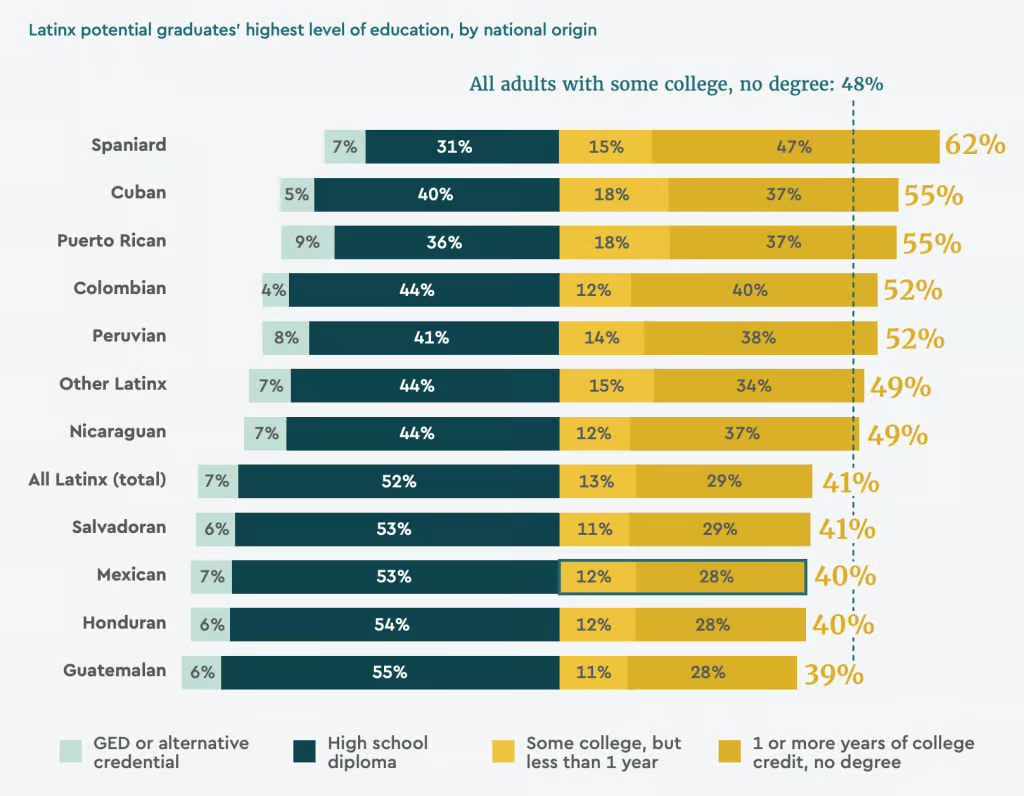
Note: Dashed line shows the 48 percent of all California potential graduates who have some college experience. “All Latinx” includes nationality groups whose numbers are too small to show separately.
Source: 2020–2024 American Community Survey five-year estimates (replication link).
Nearly half of potential graduates of Korean descent have completed at least one year of college
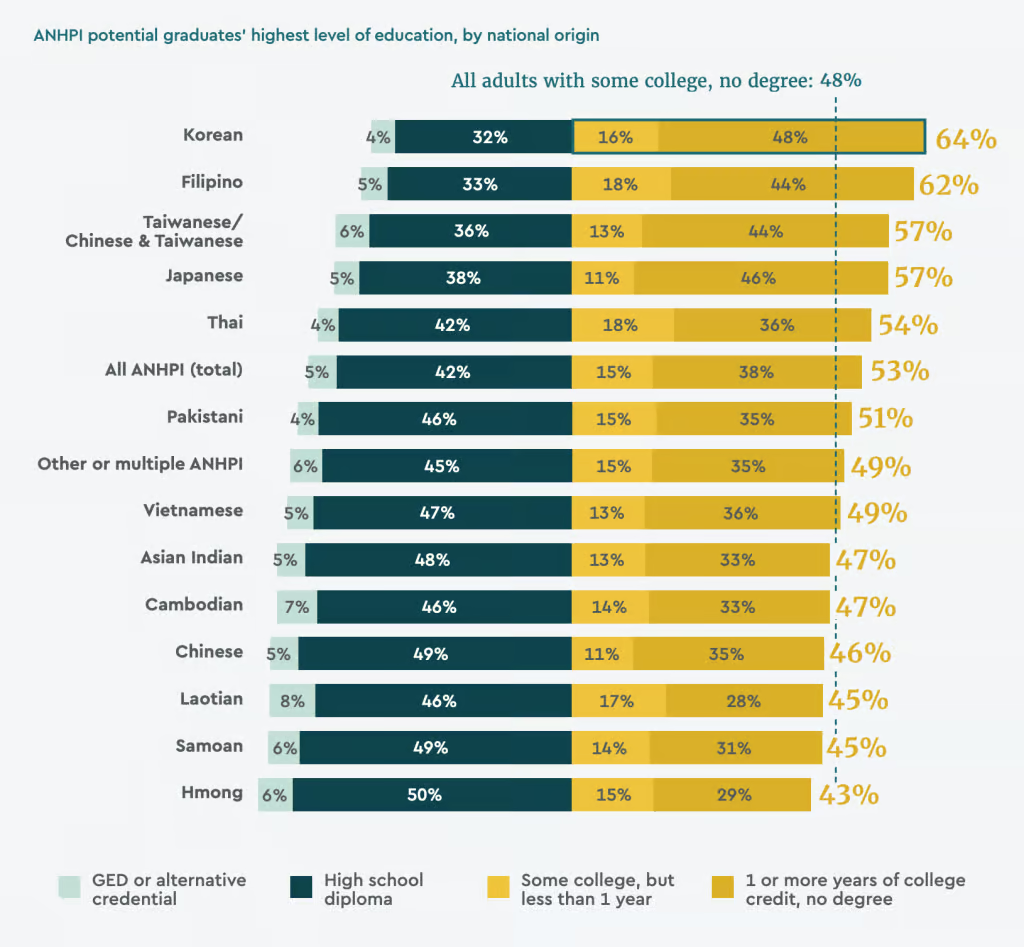
Note: ANHPI = Asian, Native Hawaiian, and Pacific Islander. Dashed line shows the 48 percent of all California potential graduates who have some college experience. “All ANHPI” includes ANHPI nationality groups whose numbers are too small to show separately.
Source: 2020–2024 American Community Survey five-year estimates (replication link).
Notes
- Carnevale, A. P., Smith, N., Van Der Werf, M., & Quinn, M. C. (2023). After everything: Projections of jobs, education, and training requirements through 2031: State report, p. 31. Georgetown University Center on Education and the Workforce.
- Cuellar Mejia, M., Wigul, C., Hsieh, V., & Johnson, H. (2026). Is college worth it?; Public Policy Institute of California.; Public Policy Institute of California. (n.d.). Who’s in poverty in California?; Thorman, T., McConville, S., & Ubois, L. (2025). Assets, debts, and wealth in California. Public Policy Institute of California.
- Jez, S. J. (2025). From institutions to individuals: A paradigm shift for California’s Master Plan for Higher Education. The Civil Rights Project/Proyecto Derechos Civiles, UCLA, and California Competes: Higher Education for a Strong Economy.
- Among California undergraduates enrolled in the 2019–20 academic year, 10 percent of those who started college at age 25 or older received financial help from their parents, compared with 54 percent who started at age 24 or younger. Calculated from National Center for Education Statistics, 2020 National Postsecondary Student Aid Study via NCES DataLab (replication link).
- Among Californians who graduated with a bachelor’s degree in the 2015–16 academic year, those who started college at age 25 or older attended an average of 2.6 institutions (median = 2), while those who started before age 25 attended an average of 1.8 institutions (median = 1). Calculated from National Center for Education Statistics, 2016/2020 Baccalaureate and Beyond Longitudinal Study, Second Follow-Up via NCES DataLab (replication link).
- California Competes. (2021). Get ready: Introducing the millions of adults planning to enroll in college.
- Calculated from the 2020–2024 American Community Survey five-year estimates via IPUMS USA (replication link).
- The American Community Survey records the person’s sex with the two options of male and female. See the codebook entry for sex in Ruggles, S., Flood, S., Sobek, M., Backman, D., Cooper, G., Rivera Drew, J. A., Richards, S., Rogers, R., Schroeder, J., & Williams, K. C. W. (2025). IPUMS USA (Version 16.0) [Data set]. IPUMS.
- Calculated from the 2020–2024 American Community Survey five-year estimates via IPUMS USA (replication link).
- Baum, S., & Ma, J. (2014). College affordability: What is it and how can we measure it. Lumina Foundation.
- Malagon, P., Cha, P., & Perez, C. A. (2025). Reducing college costs for low-income students. Public Policy Institute of California.
- Zinshteyn, M. (2024, April 3). The mystifying costs of college in California, explained. CalMatters.
- Calculated from the 2020–2024 American Community Survey five-year estimates via IPUMS USA (replication link).
- La, L. (2025, May 20). $100K is “low income” in even more CA counties. CalMatters.
- We constructed a bare-bones household budget using average expenses for a specific number of adults and children of different ages. The values vary by county to reflect local differences in the cost of goods and services. To illustrate, the living wage for a single adult ranges from $30,000 (Trinity County) to $74,000 (Santa Cruz County). For a family of two adults and one preschooler, the amount ranges from $71,000 (Modoc County) to $150,000 (San Mateo County). Center for Women’s Welfare. (2024). The Self-Sufficiency Standard for California 2024 [Data set]. University of Washington School of Social Work; Kucklick, A., & Manzer, L. (October 2020). Technical brief: The Family Needs Calculator for California 2021. Center for Women’s Welfare, University of Washington School of Social Work.
- “For the vast majority of college students, the largest cost of higher education is the opportunity costs of their time.” Archibald, R. B., & Feldman, D. H. (2011). Why does college cost so much?, p. 10. Oxford University Press.
- Schneider, D., & Harknett, K. (2019). Consequences of routine work-schedule instability for worker health and well-being. American Sociological Review, 84(1), 82–114.
- Calculated from the 2020–2024 American Community Survey five-year estimates via IPUMS USA (replication link).
- Schuette, A. (2023). Transportation as a barrier to higher education: Evidence from the 2022 Student Financial Wellness Survey. Trellis Company; West, C. (2021, December 10). A surprising reason keeping students from finishing college: A lack of transportation. Hechinger Report.
- Calculated from the 2020–2024 American Community Survey five-year estimates via IPUMS USA (replication link).
- Scrivener, S., Weiss, M. J., Ratledge, A., Rudd, T., Sommo, C., & Fresques, H. (2015). Doubling graduation rates: Three-year effects of CUNY’s Accelerated Study in Associate Programs (ASAP) for developmental education students. MDRC.
- Dai, S., Warner, K., & Sommo, C. (2025). Charting pathways: Three-year findings from the Viking ROADS demonstration. MDRC; Hallberg, K., Harrison, E., Ruiz, E., & Slaughter, M. (2006). Unpacking the long-term impact of holistic supports for community college students. Inclusive Economy Lab, University of Chicago; Hallberg, K., Hofmeister, K., Bertrand, M., & Morgan, B. (2023). Supporting community college student success: Evidence from a randomized controlled trial. Journal of Research on Educational Effectiveness, 16(1), 63–81; Miller, C., Headlam, C., Manno, M., & Cullinan, D. (2020). Increasing community college graduation rates with a proven model: Three-year results from the Accelerated Study in Associate Programs (ASAP) Ohio demonstration. MDRC.
- Azurdia, G., & Galkin, K. (2020). An eight-year cost analysis from a randomized controlled trial of CUNY’s Accelerated Study in Associate Programs. MDRC; Hill, C., Warner, K., & Sommo, C. (2025). From learning to earning: Eight-year findings from the ASAP Ohio demonstration. MDRC; Miller, C., & Weiss, M. J. (2022). Increasing community college graduation rates: A synthesis of findings on the ASAP model from six colleges across two states. Educational Evaluation and Policy Analysis, 44(2), 210–233.
- Levin, H. M., Garcia, E., & Morgan, J. (2012). Cost-effectiveness of Accelerated Study in Associate Programs (ASAP) of the City University of New York (CUNY). Center for Benefit-Cost Studies of Education, Teachers College, Columbia University.
- The meta-analysis reviewed 30 large RCTs and 9 quasi-experimental designs at 45 colleges, mostly community colleges, across the United States. The studies involved a total of 67,400 students, most of whom were from low-income families. Weiss, M. J., Bloom, H. S., & Singh, K. (2023). What 20 years of MDRC RCTs suggest about predictive relationships between intervention features and intervention impacts for community college students. Educational Evaluation and Policy Analysis, 45(4), 569–597. For a less technical summary of the same findings, see Scrivener, S., & Weiss, M. J. (2022). Findings and lessons from a synthesis of MDRC’s postsecondary education research. MDRC.
- This weighted average was calculated from tables A.4 and A.5a of the online appendix to Weiss, Bloom, & Singh. (2023). What 20 years of MDRC RCTs suggest.
- Myers, T. M. (2025). An ecological analysis of post traditional college student success (Doctoral dissertation, Columbia University). For more on the ages and other characteristics of student parents, see California Alliance for Student Parent Success. (2024). Juggling roles and achieving goals: The California Student Parents Almanac.
- Weiss, Bloom, & Singh. (2023). What 20 years of MDRC RCTs suggest.
- A series of messages encouraging summer enrollment led to increased credit completion at an average cost of $15 per student by itself or $79 per student when paired with additional financial aid (p. 30). Participating colleges received $48–$69 per student in additional revenue when using messaging alone and $105–$155 per student when offering additional aid, exceeding the program’s direct costs (p. 33). An analysis of participants who received financial aid found that most earned credits that counted toward their major requirements (pp. 22–23). Anzelone, C., Weiss, M., & Headlam, C. (2020). How to encourage college summer enrollment: Final lessons from the EASE project. MDRC. Regarding summer financial aid, also see Liu, V. Y. T. (2020). Is school out for the summer? The impact of year-round Pell Grants on academic and employment outcomes of community college students. Education Finance and Policy, 15(2), 241–269.
- California Competes. (2020). From practice to policy: How institutions accelerate adult completion and fuel prosperity; California Competes. (2025). Advancing adult learner success through strategic enrollment management.
- Kurlaender, M., Linden, R., & Carrell, S. E. (2026). Recovering enrollment: Compressed courses at California’s community colleges [Working paper]. University of California, Davis; Li, X., & Xu, D. (2026). When intensity meets modality: The effects of condensed course formats in online and in-person instruction. AEA Papers and Proceedings, 116, 367–370; Matheny, K. T., Dell, M., Gluek, G., Baker, R., Bettinger, E., Monday, A., & Mesa, H. (2025). Fast track to success? A mixed methods evaluation of condensed course formats at Tennessee community colleges (EdWorkingPaper No. 25-1346). Annenberg Institute for School Reform at Brown University.
- Mowreader, A. (2025, March 10). Positive partnership: Developing short course academic pathways. Inside Higher Ed; Shasta College. (2026, March 22). Shasta College is honored to be selected for funding through College Futures Foundation’s “Unlocking Economic Mobility for Adult Learners” initiative. Facebook.
- California Competes. (2020). Credit for prior learning: Leveraging past learning to close present-day equity gaps; Lee, S. (2024). Scaling credit for prior learning in California: Vision 2030 and the MAP Initiative. California Community Colleges Chancellor’s Office and California Mapping Articulated Pathways (MAP) Initiative.
- Schneider & Harknett. (2019). Consequences of routine work-schedule instability, p. 109.
- Mentzer, L. (March 2026). Students under pressure: Aid reductions and unstable employment, p. 2. Trellis Strategies.
- Quoted in Bohn, S., Cremin, S., Santillano, R., Thorman, T., & Baldassare, M. (2025). Work and economic insecurity in California, p. 17. Public Policy Institute of California.
- California Competes. (2023). Reimagining online education in California: A roadmap for advancing access and quality.
- California Competes. (2020). Side by side: Comparing credit for prior learning and competency-based education.
- Hatcher, M., Howard, J., Mason, J., Blume, R., Salinas, V., Hood, C., & Parsons, K. (2023). Exploring the college (re)enrollment decisions among adult learners of color. American Institutes for Research; Oates, S., Cole, G., & Hatcher, M. (2025). Supporting adult learners in postsecondary education: A toolkit for implementing key promising practices, p. 22. American Institutes for Research.
- Walton, G. M., Murphy, M. C., Logel, C., Yeager, D. S., Goyer, J. P., Brady, S. T., . . . Krol, N. (2023). Where and with whom does a brief social-belonging intervention promote progress in college? Science, 380(6644), 499–505. Also see RP Group. (n.d.). Resource library: African American Transfer Tipping Point.
- Weissman, S. (2025, November 18). Why community college students stop out. Inside Higher Ed.
- Anderson, L. (2017). State innovations for near-completers. Education Commission of the States; Uriostegui, M., Davis, L., López Trujillo, P., and Vazquez Cano, M. (2026). From stopping out to stepping forward: California Reconnect initiative year two evaluation findings. Education Northwest.
- Ortagus, J. C., Tanner, M., & McFarlin, I. (2021). Can re-enrollment campaigns help dropouts return to college? Evidence from Florida community colleges. Educational Evaluation and Policy Analysis, 43(1), 154–171.
- Rubin, J., Sommo, C., & Ortagus, J. C. (2026). REACT reenrolls nearly twice as many students who have stopped attending college. MDRC.
- California Competes. (2024, September 3). Reworking academic probation to promote student success; Mowreader, A. (2024, October 1). GPA reset can give students a fresh start— if they know it exists. Inside Higher Ed.
- A 2019 statute prohibits California’s public colleges and universities from withholding transcripts for unpaid bills, but a recent analysis found many campuses continue to do so. Martin, A., & Eaton, C. (2025). Investigative findings related to California colleges’ continued use of unlawful transcript withholding practices. Protect Borrowers and the Higher Education, Race, and the Economy Lab, University of California, Merced.
- For example, Love, I., Nzau, S., & Thai, T. (2025). Strategies for re-enrolling adult learners at community colleges, p. 18. New America; Wayne State University. (2023, January 24). Wayne State expands debt-forgiveness program to enable former students with debt—but no degree—a way back.
- At present, transcript evaluation is a slow and labor-intensive endeavor, but advances in artificial intelligence currently being tested will likely render it dramatically faster, less expensive, and more informative. For example, see American Association of Community Colleges. (2025, May 11). Overcoming transfer obstacles with AI. Community College Daily.
- Shasta College Attainment and Innovation Lab for Equity, and Success Center for California Community Colleges. (2021). Improving equity and completion: An adult learner toolkit for California Community Colleges, pp. 6–7.
- Padilla, E. A., Baker, R. B., Lahr, H., & Minaya, V. (2025). Why did they leave? Learning from the experiences of former community college students, p. 10. Community College Research Center, Columbia University. Another study with similar conclusions is Ortagus, J. C., Skinner, B. T., & Tanner, M. J. (2021). Investigating why academically successful community college students leave college without a degree. AERA Open, 7(1), 1–17.
- Bailey, T. R., Jaggars, S. S., & Jenkins, D. (2015). Redesigning America’s community colleges: A clearer path to student success, pp. 25–26. Harvard University Press.
- Fischer, B., Lott, C., & White, E. (2025). Financial distress for student loan borrowers is about to go from bad to worse. California Policy Lab.
- California Competes. (2024). Demystifying the Cal Grant program and plans for reform.
- Calculated from California Student Aid Commission. (2025). Cal Grant program: New offered awardees and eligible non-offered awardees: Average SAI, GPA, and age by segment: Award year 2024–25.
- California Competes. (2024). Demystifying the Cal Grant program, p. 3.
- Linos, E., Lasky-Fink, J., Dorie, V., & Rothstein, J. (2025). Interventions to bolster benefits take-up: Assessing intensity, framing, and targeting of government outreach. Proceedings of the National Academy of Sciences, 122(37), e2504747122; Linos, E., Reddy, V., & Rothstein, J. (2024). Demystifying college costs: How nudges can and can’t help. Behavioural Public Policy, 8(3), 497–518.
- The average cost per participant was $88. Bettinger, E. P., Long, B. T., Oreopoulos, P., & Sanbonmatsu, L. (2012). The role of application assistance and information in college decisions: Results from the H&R Block FAFSA experiment. The Quarterly Journal of Economics, 127(3), 1205–1242.
- California Student Aid Commission. (n.d.). Cal Grant access awards: Additional aid for Cal Grant.
- Conway, K. M., Wladis, C., & Hachey, A. C. (2021). Time poverty and parenthood: Who has time for college? AERA Open, 7(1), 1–17.
- The California Alliance for Student Parent Success. (2023). A policy agenda for California student parents.
- The California Alliance for Student Parent Success. (2024, September 30). AB 2458 (Berman): Greater Accessibility, Information, Notice, and Support (GAINS) for Student Parents Act; AB 2881, Public postsecondary education: Students with dependent children. Cal. Educ. Code § 66023.5 et seq. (2022).
- The California Alliance for Student Parent Success. (n.d.). The California Student Parent Resource Hub.
- California Competes. (2026). Untapped opportunity: Strengthening college pathways for Bay Area parents of young children, p. 7; Gibbs, C., Brobst, C., Ninan, T. V., & Sanchez, A. (January 2026). The economics of the market for early childhood care and education in California. Stanford Institute for Economic Policy Research.
- Child Care Aware of America. (2025). Child care affordability: California [Fact sheet].
- For additional recommendations, see The California Alliance for Student Parent Success. (n.d.). Empowering bright futures for student parents and their families.
- Agrawal, N. (2019, December 27). For students with kids, college can be a lonely struggle. One program aims to help. Los Angeles Times; The California Alliance for Student Parent Success. (2025, August 6). Turning law into action: How California’s public institutions are advancing student parent success.
- McDaniel, M., & Odwarka, A. (2026). Families belong: Supporting student-parents and library patrons with family-friendly spaces. College & Research Libraries News, 87(3), 100.
- The Pregnant Scholar. (2016). Model policy on campus pregnancy and parenting accommodations. Center for WorkLife Law, UC College of the Law, San Francisco; The Pregnant Scholar. (2025). Model student breastfeeding policy. Center for WorkLife Law, UC College of the Law, San Francisco.
- The California Alliance for Student Parent Success. (2023). A policy agenda; US Government Accountability Office. (2019). Higher education: More information could help student parents access additional federal student aid (GAO-19-522).
- One study estimated that every $1.00 invested in on-campus childcare in Virginia would return $1.24 in the form of increased local and state tax revenues and reduced use of public benefits. This result relies on several stated and implicit assumptions, including that substantially expanding the supply of inexpensive childcare would not result in higher wages for childcare workers and therefore higher costs before subsidies. Hicks, G., & Anderson, T. (2024). The taxpayer benefits of supporting student parents: An analysis of three policy options for Virginia’s public colleges. Urban Institute.
- West. (2021). A surprising reason.
- Plumb, M. H., & Schuette, A. (2025). Transportation toolkit for community college leaders. Trellis Strategies.
- National League of Cities and Seldin/Haring-Smith Foundation. (n.d.). Do you need a car to attend community college in California?
- Weiss, M. J., Ratledge, A., Sommo, C., & Gupta, H. (2019). Supporting community college students from start to degree completion: Long-term evidence from a randomized trial of CUNY’s ASAP. American Economic Journal: Applied Economics, 11(3), 253–297; West. (2021). A surprising reason.
- González, C. (2023, January 5). California campuses try to lower college costs with free transit. CalMatters.
- Ahn, A. (2024, August 7). Over 400,000 students in L.A. have enrolled in Metro’s unlimited free ride program. Los Angeles Times; Lippincott, C. (August 15, 2025). BayPass program goes live, providing students with free public transportation. The Daily Californian.
- Leow, C., Wu, J., Twiste, T., & Lundquist, A. (2025). Addressing transportation barriers faced by community college students in New York City: An intervention with free MetroCards. Community College Journal of Research and Practice. Advanced online publication.
- California Competes. (2025). Designed together: Creating educational pathways with and for communities, pp. 4, 5.
- California Competes. (2025). Designed together.
- Bay, J. (2026, January 28). Pilot program supports rural, bilingual students. Inside Higher Ed.
- Rodriguez, O., Hill, L., & Payares-Montoya, D. (2022). English as a second language at California’s community colleges. Public Policy Institute of California.
- US Department of Veterans Affairs. (2026, April 24). Post-9/11 GI Bill (Chapter 33) rates. Living expenses are equal to the Basic Allowance for Housing for E-5 (enlisted pay grade 5) military personnel with dependents, regardless of veterans’ prior ranks and whether or not they have dependents. For an illustration, in 2026 this value was $5,115 in San Francisco, $4,110 in San Diego, $3,864 in Los Angeles and many neighboring cities, and $2,514 in Fresno (replication data).
- California Community Colleges Chancellor’s Office. (2025, November 10). Helping veterans translate military experience into academic achievement. Twenty-three percent of California veterans who first enrolled in college in 2011–12 received college credit for their military experience. Calculated from National Center for Education Statistics, 2012/2017 Beginning Postsecondary Students Longitudinal Study via NCES DataLab (replication link).
- Institute for Veterans and Military Families and Student Veterans of America. (2019). Student veterans: A valuable asset to higher education, p. 4. Syracuse University.
- Jiang, J., Macdonald, K., Mason, J., Payri, M., & Radford, A. W. (2021). Informing improved recognition of military learning: Exploring the experiences of student veterans in postsecondary education. American Institutes for Research.
- Campbell, T., & Wescott, J. (2019). Profile of undergraduate students: Attendance, distance and remedial education, degree program and field of study, demographics, financial aid, financial literacy, employment, and military status (NCES 2019-467), p. 134. National Center for Education Statistics, US Department of Education.
- Fuller, H. (2025, December 3). How veterans lose GI Bill benefits to scams, fraud, and predatory schools. Military.com.
- For example, American Council on Education. (2018). Toolkit for veteran friendly institutions; Mowreader, A. (2025, December 1). 12 ways to improve college for military learners. Inside Higher Ed.
- For example, Dean, J. (2025, November 10). Breaking barriers: Peer outreach boosts student veterans. Cornell Chronicle.
- Mowreader, A. (2024, November 11). Creating a space for student veterans on campus. Inside Higher Ed.
- Anft, M. (2019, June 4). The business case for enrolling military veterans. The Chronicle of Higher Education.
- Bohn, Cremin, Santillano, Thorman, & Baldassare. (2025). Work and economic insecurity in California.
- Anderson, C. (2025, September 10). Despite improvement, California again has highest poverty rate in US. The Sacramento Bee.
- Mabel, Z., Koo, I., & Strohl, J. (2026). The golden ticket: How raising postsecondary attainment rates to 70 percent for all demographic groups would unlock decades of prosperity in California. Georgetown University Center on Education and the Workforce.
- Ruggles, S., Flood, S., Sobek, M., Backman, D., Cooper, G., Rivera Drew, J. A., Richards, S., Rogers, R., Schroeder, J., & Williams, K. C. W. (2025). IPUMS USA (Version 16.0) [Data set]. IPUMS.
- Flood, S., King, M., Rodgers, R., Ruggles, S., Warren, J. R., Backman, D., Breton, E., Cooper, G., Rivera Drew, J. A., Richards, S., Van Riper, D., & Williams, K. C. W. (2025). IPUMS CPS (Version 13.0) [Data set]. IPUMS.
- Center for Women’s Welfare. (2024). The self-sufficiency standard for California 2024.
- Angrist & Pischke. (2009). Mostly harmless econometrics, p. 11.
- Button, K. S., Ioannidis, J. P., Mokrysz, C., Nosek, B. A., Flint, J., Robinson, E. S., & Munafò, M. R. (2013). Power failure: Why small sample size undermines the reliability of neuroscience. Nature Reviews Neuroscience, 14(5), 365–376; Hanel, P. H. P., & Vione, K. C. (2016). Do student samples provide an accurate estimate of the general public? PLOS ONE, 11(12), e0168354.
- Nosek, B. A., Hardwicke, T. E., Moshontz, H., Allard, A., Corker, K. S., Dreber, A., . . . Vazire, S. (2022). Replicability, robustness, and reproducibility in psychological science. Annual Review of Psychology, 73, 719–748.
- Baldassarri, D., & Abascal, M. (2017). Field experiments across the social sciences. Annual Review of Sociology, 43, 41–73.
