Advancing Student Parent Success with Dr. Tina Cheuk
In honor of Student Parent Month and the third anniversary of The California Alliance for Student Parent Success (The Alliance), co-led by California Competes and EdTrust-West, we’re exploring what it takes to build a higher education system where student parents and their families thrive.
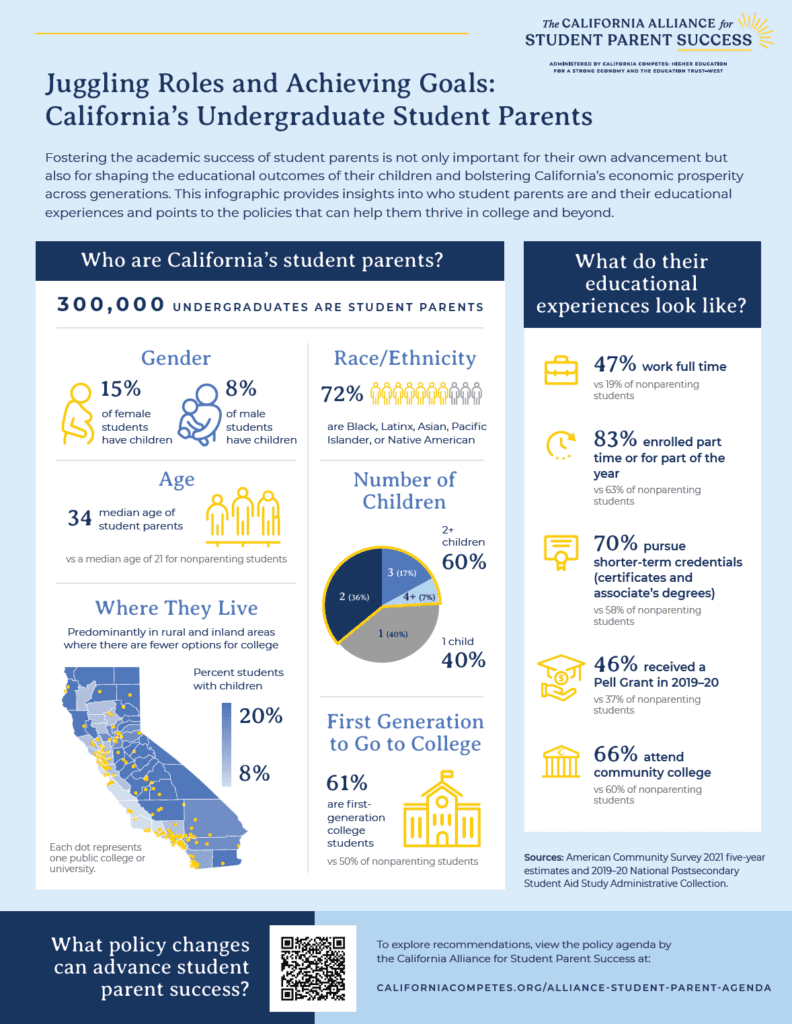
Student parents make up one in eight students in California’s postsecondary system, and millions more parents without degrees may consider college as part of their future. Yet too often, they are expected to navigate systems that were not designed with their lives and responsibilities in mind.
This Degrees of Change episode features Dr. Tina Cheuk, an associate professor of elementary science education at Cal Poly San Luis Obispo and director of #StudentParentJoy, a media and policy research initiative working to redefine what it means to be a pregnant or parenting student in the California State University system. Drawing on her own experience as a student parent and her work as an educator, researcher, and advocate, Tina shares what it will take to make student parents more visible and better supported. She is also a 2025 recipient of the Stanford Graduate School of Education Alumni Excellence in Education Award and has served on The Alliance’s advisory committee.
The conversation reflects on the evolution of the student parent movement, including The Alliance’s first three years and on the work ahead to support student, parent, and family success through higher education and into the workforce.
The following includes excerpts from a conversation recorded on August 25, 2026. To hear the full discussion, listen to the podcast on your preferred platform.
Su Jin: Your advocacy began with your own experience as a student parent. What did that experience reveal about how higher education sees or fails to see students who are raising children?
Tina: This journey for me is personal. I became a mother while I was in graduate school and still nursing, so I needed a lactation space. The place where I worked did not have one. I asked instructors, my advisor, administrators, and facilities staff, and I got the runaround. When I spoke to other faculty members, they said:
“That’s a symptom of the institution passing the buck. It’s a systems problem, but you are tasked to solve it as an individual.”
It took two years of advocacy and organizing a student group to get an institutional response. Later, at Cal Poly, a student parent reached out after she was penalized for missing class to care for her sick child. She organized signatures and worked with student government, and together we helped advance an equitable attendance policy so the decision would not depend on an individual instructor’s discretion.
As our higher education system serves more diverse students, older, antiquated policies no longer meet students’ needs and can create barriers to student success. That is my journey into this space, and now it is part of my role as a faculty member in the Cal State system.
Su Jin: What student parents need and are asking for is, in many ways, how we already treat everyone else. Faculty and staff who are caregivers have recognition that caregiving is valid and important. But student parents are often expected to navigate spaces that were not designed for them—and, in many ways, are designed against them—while they persist and achieve.
Tina: It would have been easy for me to give up, but I knew that if I did not fight for this, students who came after me would face the same barrier. For me, it was worth the investment of time and resources because I wanted to leave the place a little better than I found it.
It is always about expanding access and reducing barriers to access. All I wanted was to make a better life for my family, and I see that same goal in so many of the stories I hear from student parents.
Su Jin: Through #StudentParentJoy, you have worked to shift the narrative to recognize student parents’ strengths, aspirations, and joy. Why does that reframing matter?
Tina: The campaign is borrowed from Black Joy and UndocuJoy. As I spoke with student parents, they were afraid to share that they were student parents. There are a lot of negative stereotypes and biases.
The student parents I have spoken with are so highly motivated. They are problem solvers and time-managers. Their classmates benefit from their perspectives. Without that, we risk designing solutions that are void of the rich perspective of what it’s like to be a parent in this world. The more diversity we have in classrooms, we all benefit from that in terms of innovation, creativity, and ideally generating prosperity for all of California. So I think it’s a win-win.
“If you don’t tell your own story, someone else will tell it for you.”
I encourage student parents to share their stories and educate the public about why they are pursuing higher education. The common thread is it’s not only for themselves, but for their families.
Su Jin: September marks National Student Parent Month and the third anniversary of The California Alliance for Student Parent Success. How have you seen the statewide movement evolve?
Tina: It is like a dream come true. When I was a student parent over a decade ago, this is what I hoped for: a broad coalition of stakeholders coming together with a shared goal for student, parent, and family success through higher education and into the workforce.
The Alliance has been pivotal as a convener across the three public higher education segments, nonprofits, and other stakeholders. The website itself is a one-stop shop for any other state groups to follow. The Alliance has led in advocacy to get policies passed, and now to what I call the “final mile” of implementation, so that the resources and culture exist and, at the classroom, institutional, college, and departmental levels, we know what to do. Schools don’t have to reinvent the wheel. We have language that we can adapt at each institution, along with toolkits and messaging that helps keep us on a similar page.
I also want to acknowledge the two major bills that have passed in a relatively short time. AB 2881 established priority registration for parenting students with dependents and a website that serves as a landing page. Student parents have always existed, but now it is systemic. It is part of the institution.
The subsequent bill, the GAINS for Student Parents Act, has additional teeth to bolster data collection and concrete financial aid policies to make it fairer for student parents to go to and complete college.
Su Jin: We named this season Crystal Clear because we are trying to cut through complexity to reveal what is really needed to strengthen California’s future. What is the biggest misconception about student parents you would like to clear up?
Tina: Student parents are highly motivated. They are driven, problem solvers, and very persistent. There is a lot of clarity in why they want to go to school and what they want to do with that degree. Many student parents are low-income, and their exit out of poverty is through education. They know that degree is that ticket.
“Sometimes people see it as a piece of the pie: if we give student parents a piece, we will have less pie. But I [say] we can create more kitchens. We can build bakery factories left and right. There is so much potential, and we just have to be in support.”
Supporting families is a shared value across the ideological and political spectrum. This is good for all of us, whether we have caregiving responsibilities or not.
Su Jin: As you look ahead, what gives you the most optimism for building a higher education system where student parents and their families can thrive?
Tina: California is doing incredibly innovative things, setting the bar for many other states to follow. I think The Alliance and the resources on the website serve as blueprints that can be adapted by other states and other organizations.
My hope in the future is that this becomes embedded into our public infrastructure. The cultural shift that we are leading here in California [includes] recognizing care work and how it is part of our educational system and our workforce, and investing in child care and systems that support families.
There is this critical mass where there is enough momentum in the policies, resources, and cultural shift that is needed for change to happen. Higher education, in particular, always reverts back to the status quo. We have to keep up the momentum. We have to keep on the pressure. You have to play the long game. You have to think about what is the 10-, 20-, 30-year, [and] the generational landscape that we want to create.
I hope the status quo becomes: of course we have priority registration; of course we have a student parent center; of course we have someone who helps us think through family-related issues as a parenting student. Wouldn’t that be beneficial to all of us?