
Degrees of Value:
A Multidimensional View of College
ROI Through the Voices of Comebackers
Summary
More than 6 million Californians ages 25 to 54 have a high school diploma or equivalent but have not yet completed a college degree. Engaging these adults in higher education is essential to expanding economic opportunities, addressing workforce shortages, and strengthening regional and state economic growth. The expectation that a degree will improve earnings is the primary reason many students choose to enroll in college. Yet for adults, work, family, and other responsibilities often shape the decision to enroll. Attending college can mean foregone wages, higher childcare costs, or missed time with family. Consequently, economic outcomes reflect only a partial picture of the true value and costs of going to college.1
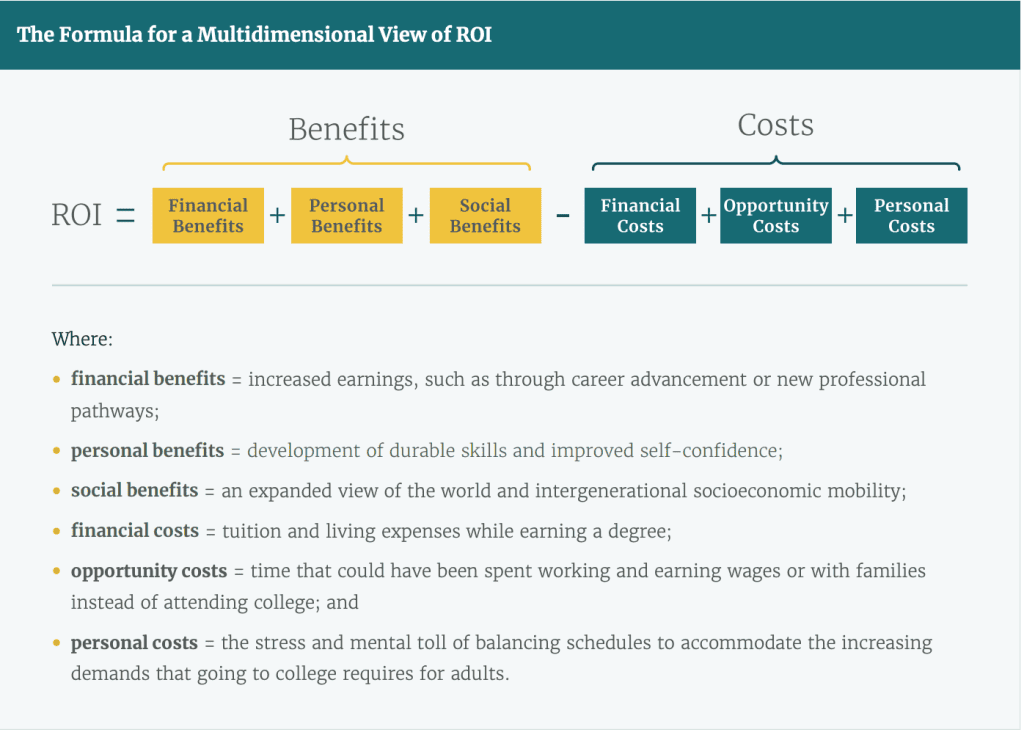
Drawing on interviews with comebacker graduates (students who stopped out and later returned and completed college), this study examines the economic as well as the noneconomic benefits and costs of earning a degree. The interviewees’ experiences reveal a multidimensional view of return on investment (ROI) that is shaped by the financial, personal, and social benefits graduates gain alongside the financial, opportunity, and personal costs they bear while pursuing a degree. This research explores each dimension of the below framework and offers recommendations for key changemakers across the state to enhance the value of a degree, reduce costs, and ensure college is a worthwhile investment for all students.
College contributes to financial, personal, and social benefits
Financial Benefits
- A college degree contributes to economic ROI. A degree can increase comebackers’ earnings by supporting job advancement or opening new career pathways. But the benefits are not uniform, as comebackers in rural areas noted limited job prospects and earnings in their region.
Personal Benefits
- College helps build durable skills that strengthen workplace success. Durable skills are skills that are foundational and transferable across different sectors and over time.2 Comebackers described courses that helped them develop strong writing, public speaking, time management, discipline, and problem-solving skills, which have translated into success in the workplace.
- Degree attainment builds self-confidence. Graduating with a newly developed skill set shifted comebackers’ ideas of what they could accomplish and their abilities, intelligence, and resilience. Increased self-confidence led to improved career outcomes; for example, having the courage to apply for a promotion or higher-paying job after earning a degree.
Social Benefits
- College can broaden worldviews. Comebackers described courses and discussions with faculty and peers that challenged them to reexamine their preexisting beliefs; think more critically about social, political, and cultural issues; and become more accepting of differences.
- A degree helps promote intergenerational socioeconomic mobility. Graduates who were parents said they were motivated to complete their degrees to express the importance of education to their children, to provide a better future for their families, and to strengthen their children’s educational and economic outcomes.3,4
Recommendations for improving the benefits of a college degree
- Provide career advice early to help students choose a degree and major, and develop a course schedule aligned with their career goals.
- Improve local labor market data by integrating hours worked, occupation, or job location into California’s Cradle-to-Career data systems to provide students accurate advice about promising career pathways in their region.
- Embed the development of durable skills into the course curriculum. Measure and track student progress to market skill gains to employers and future students.
- Create ROI measures that capture financial, personal, and social benefits to help colleges design programs and policies that support students’ overall well-being and growth.
- Integrate teaching strategies that center on adult learners’ experiences to increase classroom engagement by validating their lived experiences and building their confidence.
The costs of college comprise financial, opportunity, and personal costs
Financial Costs
- Credit loss and extended time to degree increase the financial costs of college.5 Comebackers spoke of mistakenly taking courses that would not count toward their major or not earning the required credits to transfer. Most comebackers who unintentionally added time to earning their degree took out loans to cover the extra costs.
Opportunity Costs
- Comebackers make significant personal trade-offs to attend college and must weigh the opportunity costs. The opportunity cost is the time that could have been spent working or with family rather than going to college. That time can translate to a loss of wages one might have earned, additional childcare expenses, or missed time with family members. The forgone earnings and personal sacrifices are factors in the true costs associated with a college education.6
Personal Costs
- The strain of balancing competing demands increases the personal costs of college. Comebackers described the stress and mental toll of balancing their schedules to accommodate the increased demands of going to college as adults. The lack of time for other activities, such as sleep, socializing, and exercise, has larger implications for students’ mental health and well-being.7
Recommendations for reducing the costs of a college degree
- Offer flexibility on missed assignments and deadlines to comebackers when unforeseen life circumstances arise to minimize the opportunity and personal costs of attending classes rather than working or caring for family members.
- Expand opportunities for high-quality online learning to provide flexibility for comebackers to maintain their jobs and increase time with families.
- Expand options for competency-based education to allow students to earn credentials at a pace that fits their lives.
- Offer credit for prior learning to recognize students’ skills and knowledge gained outside the classroom and reduce the time to degree.
- Reduce students’ non-tuition costs to attend college by ensuring that their basic needs—including rent, childcare, food, and healthcare—are met.8
- Offer adequate financial aid by strengthening California’s financial aid systems to better serve adult learners and student parents.
Capturing the Value of College Requires Looking Beyond Earnings Alone
A postsecondary credential or degree provides individuals with a critical pathway to economic mobility. Yet more than 6 million Californians ages 25 to 54 have a high school diploma or equivalent but have not yet completed a college degree.9 Engaging these adults in higher education is essential to expanding economic opportunities for Californians, their families, and their communities. Connecting adults to higher education is also necessary to address workforce shortages, reduce economic disparities, and strengthen state and regional economic growth.10
Unlike students who enter college immediately after high school and with limited commitments outside of academics, adult learners often navigate competing responsibilities of work, school, and family. Adult learners are more likely to be parents, and many are single mothers.11,12 Some are navigating health issues with limited access to care or must work multiple jobs to ensure their and their families’ basic needs are met.13,14 Most begin their educational journeys at their local community college to stay closer to home and enroll part time to balance work and family demands.15
Given the complexity of adult learners’ lives, the decision to enroll in college is especially consequential. It often requires adults to make significant personal trade-offs, such as forgone wages, increased childcare expenses, or missed time with family members. Additionally, many adult learners shoulder their families’ financial responsibilities and seek time-efficient returns from earning a degree.16 Yet some barriers can impact time efficiency and increase the financial and personal costs of college, including unintentionally earning excessive credits and extending the time to earn a degree.
This report refers to comebackers as a distinct group of students, but we also see them as overlapping with two larger groups: adult learners and those with some college and no degree. Below, we define each group:
- Adult learner: Any college student ages 25 to 64 or one who has adult-like responsibilities (e.g., has a dependent or is working full time).
- Some college, no credential: Someone who attended college and stopped out before earning a credential or degree.
- Comebacker: Anyone who has attended college, stopped out (for any length of time), and re-enrolled in college (at their original institution or another institution).
While researchers quantify ROI in multiple ways, the measure generally focuses on whether the earnings from a college degree outweigh the financial costs of attendance.17 While understanding college’s impact on earnings is critical, its value also includes personal and social benefits, such as securing employment with stable hours, health insurance, and other benefits and improved personal and familial well-being.18,19 For adult learners, whose decisions to enroll, persist, and complete are shaped by complex life circumstances, economic outcomes reflect only a partial picture of the value and costs. A focus on the qualitative aspects of students’ experiences can strengthen ROI analyses by capturing the personal and social benefits of attending college and accounting for the opportunity costs of attending college rather than working or spending time with family.
This report, part of our Degrees of Value series, digs deeper into understanding ROI by asking comebackers—individuals who attend college, stopped out, and later returned—who graduated about the impacts of completing college (see Who Do We Mean by Comebackers for more information on how we are defining this distinct group of students and About This Research for more information on the study methodology). We found that comebackers who graduated offered a nuanced, multidimensional view of the value of college. They shared that economic mobility remained an essential component of ROI. A college degree provided comebackers with the qualifications to advance in their careers and open doors to new professional pathways. College also contributed to the participants’ growth beyond financial gains. Interviewees found that a degree brought about personal and social benefits, including developing durable skills, improving self-confidence, expanding their worldview, and fostering intergenerational socioeconomic mobility.
Systems, policies, and practices that align with the needs of adult learners can increase the benefits of completing a degree and reduce costs, increasing ROI. Understanding how comebackers who earned a degree describe the value of college and the factors that influence their outcomes is important for designing institutional policies and programs that ensure college is a worthwhile investment for all students.

This report draws on interviews with 27 California comebackers, adult learners who started college, stopped out, and later re-enrolled.20 We first interviewed them in 2023, and followed up in 2025 to explore the value of a college degree.21,22 By 2025, 20 had earned a bachelor’s degree, 7 an associate’s degree, with 3 of them working towards a bachelor’s. See Appendix for additional details about the study’s methodology.
Drawing on these comebackers’ voices, the report introduces a multidimensional view of college ROI, then examines its components—the financial, personal, and social benefits, as well as the financial, opportunity, and personal costs of a degree—before closing with recommendations for California policymakers, higher education leaders, faculty, and advisors.
A Multidimensional View of ROI
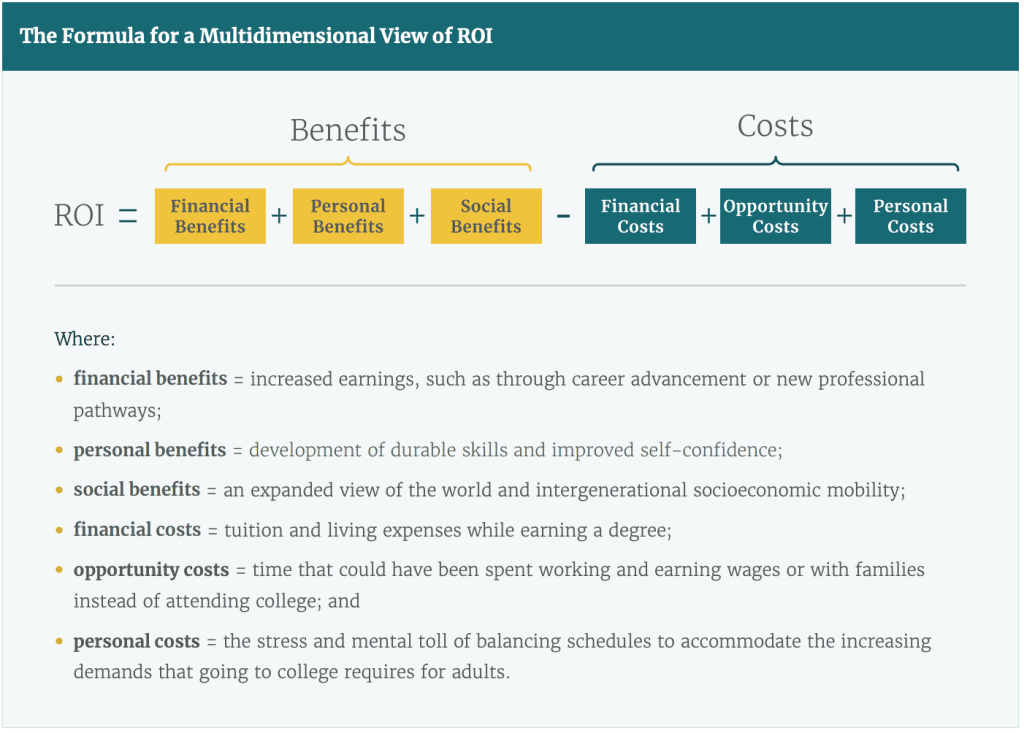
In previous publications in our Degrees of Value series, we expressed ROI as the added economic value of a college degree minus the costs to complete (e.g., education and living expenses) at a public institution.23 In addition, comebackers described the personal and social benefits of earning a degree, including the ways learning expanded their view of the world, reframed their perceptions of themselves and their abilities, and set an example for their children and families. The costs of college also extend beyond financial expenses. Many participants weigh the opportunity costs, such as the time they could have spent working and earning money or with their families rather than attending class and studying. For others, the stress and mental toll of balancing their work, family, and school schedules increased the personal costs of attending college.
Drawing on interviews with comebackers, we developed an ROI calculation that can be expressed in the formula depicted below. ROI is a function of the economic, personal, and social benefits of a college degree and the financial, opportunity, and personal costs of attending college. Comebackers describe how the personal and social benefits are directly connected to positive financial outcomes.
The Benefits of College
Comebackers often describe how earning a degree delivers value in many ways: financially, personally, and socially. While these dimensions may be interconnected, the following section examines each, from career opportunities and durable skills to expanded worldviews and benefits for future generations.
Financial Benefits
Increased earnings, such as through career advancement and new professional pathways
Our previous research finds that a college degree yields a positive ROI for most Californians within 10 years of graduating from a public institution. Yet the benefits are not uniform, with ROI varying by level of degree, region, race, ethnicity, and gender.24,25 Interviews with comebackers who graduated further revealed how a college degree contributes to economic ROI by providing graduates with the credentials to advance in their field or the agency to enter new career pathways with greater economic returns. In the three years since earning either an associate’s or bachelor’s degree, about half of the 27 interviewees experienced improved earnings, such as a raise, promotion, or higher-paying job.
Participants whose earnings improved had been more likely to enroll in college with a clear goal of advancing their careers. Many of these graduates were already working at an organization or in a career of interest and needed a degree to grow in the profession. Often, they were encouraged by an employer to return to college. Once they earned their degree, they received a promotion or pay increase at work.
The Financial Payoff of Earning More Advanced Degrees
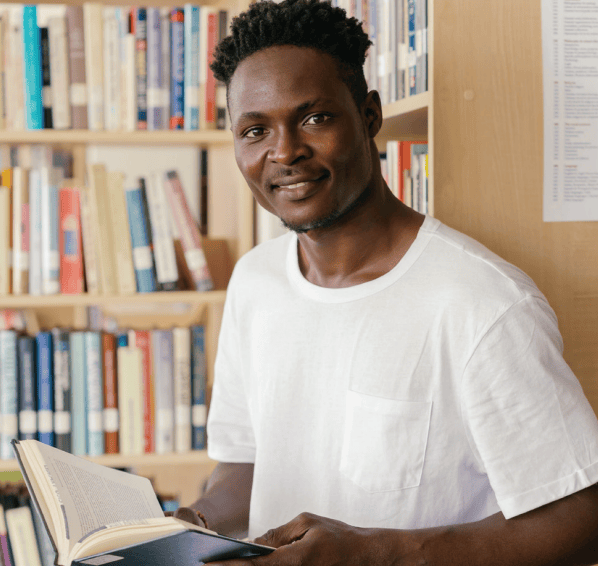
While pursuing an associate’s degree, Kevin began working at his local library for $15 an hour. A bachelor’s degree was required for promotion, so he transferred, earned his degree, and received a pay increase. He later earned a master’s degree in library science to qualify for a supervisor position. Now, Kevin earns close to $50 an hour, more than triple his starting wage.
For Kevin, a degree helped him turn a clear career goal into higher earnings. He said:
“Think about, what is this degree going to get you? How is the degree related to your desired career?”
Other interviewees who spoke of financial benefits said they pursued college to enter a new career pathway with greater economic mobility. One participant was working as a cleaner at a nursing facility for $10 an hour before returning to college. She decided to enroll in college to transition to a career in nursing. After earning her Associate of Science in nursing, she secured a full-time position and now makes more than $100,000 annually.
However, the comebackers we spoke to in rural areas noted limited job prospects and earnings in their region, which reduced their financial benefits. Our statewide data analyses corroborate these findings by showing that bachelor’s degree holders in rural, inland areas of California are less likely to experience a positive economic ROI than those in urban, coastal regions. That trend was less clear for associate’s degrees.26 Some interviewees in rural areas felt that earning a bachelor’s degree or higher would make it more difficult to secure a job because they would become overqualified for positions. Others described circumstances in which the typical degree requirements for a position were waived due to labor supply scarcity in the rural location.
Personal and social benefits often build on financial gains. While most interviewees spoke of going back to college to earn higher wages, nearly all reported personal and social benefits, some directly connected to positive impacts on their career and financial outcomes. As the following sections demonstrate, this multidimensional ROI includes developing durable skills, improving self-confidence, expanding their view of the world, and improving the lives of their families and subsequent generations.
Personal Benefits
Development of durable skills and improved self-confidence
Development of durable skills: Reflecting on the value of their college experience, many comebackers emphasized the importance of developing durable skills. Durable skills—in contrast to technical skills—are competencies that are foundational and transferable across different sectors and over time. They span a variety of cognitive, emotional, and social capacities, such as problem-solving, collaboration, and self-directed learning.27 Employers increasingly evaluate prospective candidates for durable skills, particularly those early in their careers.28 Interviewees described college courses that helped them develop strong writing, public speaking, time management, and problem-solving skills, as well as greater discipline and perseverance, which have translated into success in the workplace.

Durable Skills That Support Professional and Personal Growth
Mary credits college with strengthening skills she continues to use in her career and life, including discipline, problem-solving, and public speaking. After returning to college more than 30 years after stopping out, she earned her bachelor’s degree in business administration. She reflected:
“What college taught me was discipline. It’s not so much that you have all this information that’s made you smarter, but it’s having the ability to figure it out, to find the answers, to solve the problem. It builds the muscle you carry after school. It’s the strength to go after it.”
As a facilities manager, she has taken on greater responsibilities since earning her degree, including overseeing employees.
Improved self-confidence: Most comebackers reflected that earning a degree reframed their sense of self and gave them confidence. Interviewees described particular professors whose confidence in them and support led to success in their courses. Graduating with a newly developed skill set instilled a sense of pride and completion, and it shifted comebackers’ ideas of what they could accomplish and their abilities, intelligence, and resilience. An interviewee who previously was a stay-at-home mother found that college reframed her perceptions of herself and her abilities. She shared, “Going to college showed me that I was smarter than I thought I was. I was more capable than I thought I was.”
Increased self-confidence sometimes led to improved career outcomes. Comebackers spoke of having the courage to apply for a promotion or higher-paying position after earning their degree. One participant described how, when a position opened at his workplace, he felt he was the right person for it. He applied and was awarded the promotion. While he isn’t sure if the degrees are directly related to his selection, earning them gave him the confidence to pursue the promotion in the first place.
Owning Her Skills
Earning a bachelor’s degree didn’t increase Penny’s earnings, but it allowed her to keep her job and strengthened her confidence in her professional abilities. After a health emergency forced her to stop out, one of her former professors hired her for her dream job. They encouraged her to return and complete her degree to comply with federal regulation requirements. She said:
“I no longer look over my shoulder. I don’t feel like I’m an impostor. I feel like I own my skills now and [have] self-confidence.”

Broadening Perspectives
Throughout Natalia’s decade in and out of college, she balanced caring for her children as a single mother and working two jobs. Despite a demanding work and family schedule, Natalia found that classes gave her the space to examine her preexisting beliefs and to learn how to advocate for herself. Those experiences helped shape her career path and her decision to earn a bachelor’s degree in social work so she could help others experiencing hardships similar to her own. She reflected:
“College changed my world in so many beautiful ways. I learned things in classes that helped reshape my worldview and challenged me to assess who I am and what my identity is. I gained more awareness about my own background, what I’d been taught, and ways to advocate for myself.”
Social Benefits
Expanded worldviews and intergenerational socioeconomic mobility
Expanded worldviews: Many comebackers said attending college broadened their view and encouraged a critical perspective of the world. Participants described courses that challenged them to reexamine their preexisting beliefs; think more critically about social, political, and cultural issues; and become more engaged and informed citizens. College classes brought comebackers into the same room as faculty and other students with different life experiences and perspectives from their own.
Discussions with faculty and peers reshaped how comebackers saw themselves in the world and made them more accepting of differences. For example, a comebacker described the ways an anthropology course “opened my mind to a whole slew of new perspectives.” Some spoke of going on to impart their new insights and experiences onto their families, friends, and members of their communities.

Intergenerational socioeconomic mobility: The parenting graduates we interviewed were motivated to complete their degrees to express the importance of education to their children and to provide a better future for their families. Interviewees discussed going to college to change their families’ lives and completing their degree to “prove to myself and my kids” that they could finish. Often, parenting students credited their children with helping them clarify their ambitions to further their education. In turn, earning a college degree can signal the value of a postsecondary education to a graduate’s family. Parents with degrees also can draw on their personal experiences to guide their children through college and typically have higher incomes to support their children’s education.29 Taken together, a parent’s postsecondary education is an important factor in their children’s education and economic outcomes.30,31
Setting an Example for the Next Generation
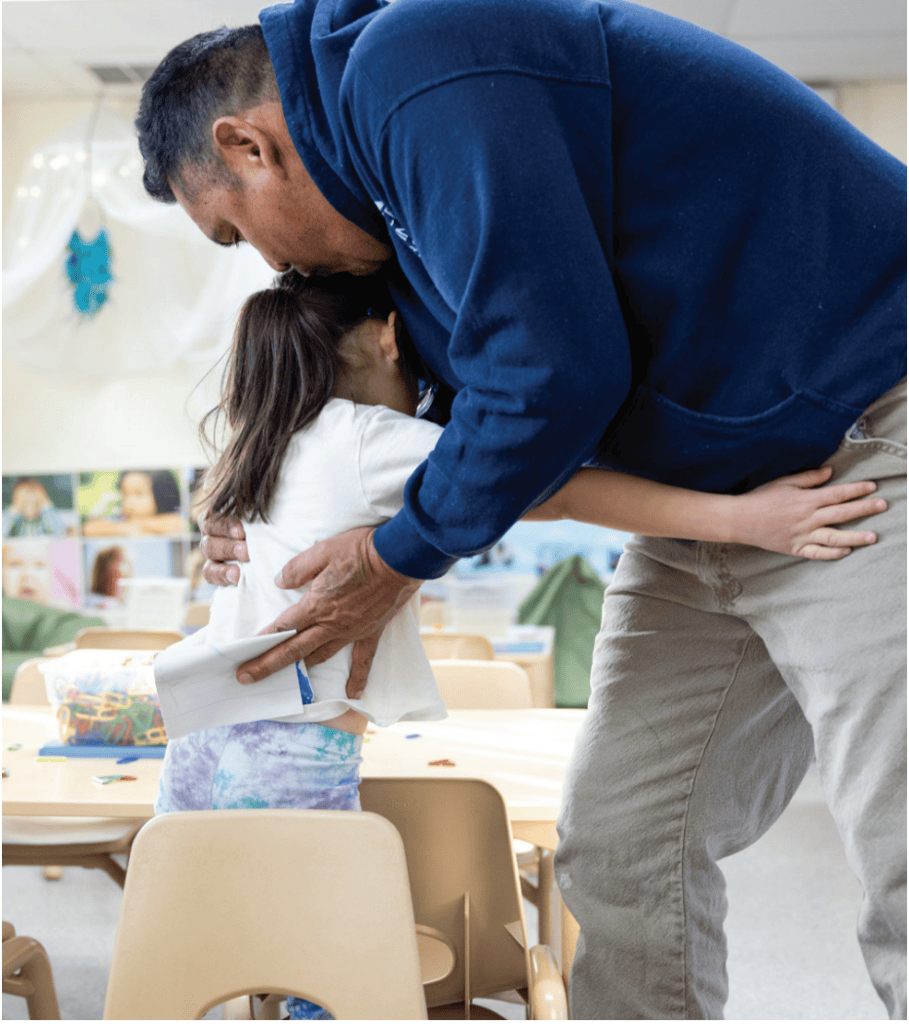
Bruce’s college journey spanned more than two decades, with stops along the way to move, care for family, and navigate battles with addiction. He ultimately returned and earned his bachelor’s degree in communications in 2021. Finishing brought a sense of accomplishment and closure, along with an opportunity to model perseverance for his daughter. He shared:
“I wanted to be able to finish so that she could see when she’s old enough that I started college and I finished. She can do whatever she wants and be whatever she wants.”
The Costs of College
Comebackers described how the financial, opportunity, and personal costs of college can add up, creating barriers that delay or derail progress toward a degree.
Financial Costs
Tuition and living expenses while earning a degree
While community college is often tuition-free for most in-state residents, students must pay non-tuition costs for books, supplies, and living expenses.32 As a result, college is often more expensive than the stated tuition price, particularly for adults who live independently off campus.33
Reducing one’s time in college reduces the tuition and living costs associated with earning a degree.34 Yet comebackers reported mistakenly taking courses that would not count toward their major or not earning the required credits to transfer. Earning excessive credits lengthened their time to degree and increased the cost of their education.
Students who remain enrolled longer than anticipated can exhaust their financial aid eligibility before completing a degree.35 Most of the comebackers who unintentionally added time to earning their degree took out loans to cover the extra costs. Those attending a four-year university often needed to borrow more to cover the costs of a bachelor’s degree. Some comebackers described accruing $80,000 to $100,000 in debt for their time in college. For others, the fear of accumulating debt led them to discontinue their education after earning an associate’s degree.
The Cost of Extending Time to Degree
McKenna transferred from community college to a four-year university to pursue her bachelor’s degree after being assured she had the proper credits. She later learned she needed additional coursework and returned to community college to complete it. By the time she finishes, she expects to have earned 100 credits and four associate’s degrees. Her experience underscored the need for better career and transfer advising.
“I wish I could sit down and speak to someone about my long-term goal and understand that it requires a bachelor’s degree, so why not work on a degree for transfer?”
Navigating the Trade-Offs of a Degree
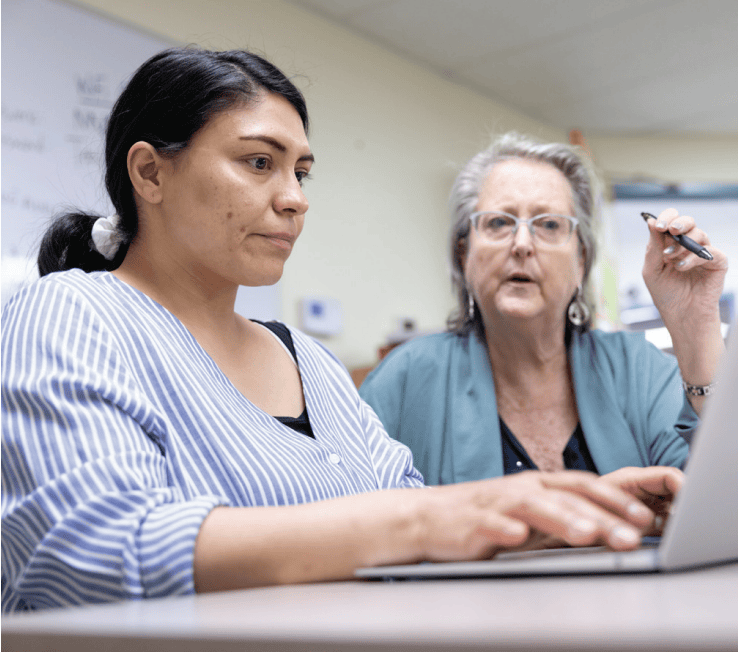
Meg returned to college to build a better life for herself and her children, balancing school with work and caregiving. Along the way, she faced forgone wages, childcare expenses, housing instability, and time away from her family. After earning an associate’s degree in 2020, she continued toward a bachelor’s degree in elementary education. She reflected on the difficult trade-offs.
“I want to finish [my bachelor’s degree], but I don’t want to do it at the expense of my kids. It’s been arduous caring for them, trying to provide for them, at the same time as going to school.”
Opportunity Costs
Time away from work, wages, and family while attending college
The opportunity cost is the time that could have been spent working or with family rather than going to college. Given adult learners’ competing life obligations, many must make significant personal trade-offs to attend college.36,37 Most of the interviewed comebackers were caring for children or ailing family members and working full time. Adults in rural areas of the state could spend hours commuting to campus. Taking time away from work or family to commute to campus, study, or attend classes can result in a loss of wages, additional childcare expenses, or missed time with family members. The forgone earnings and personal sacrifices are factors in the true costs associated with a college education.38

The Emotional Toll of Balancing Work, Family, and School
Ezra, a single mother, enrolled in college to improve her income and support her family. But while working unpredictable shifts and caring for her child, she struggled to find the time and energy for school and eventually stopped out. After securing a job with more stable hours, Ezra re-enrolled, but balancing work, family, and college continued to take a toll.
“I would work eight to five, and then get out of work and go straight to my online classes until bedtime. I would do that a lot, and it was rough.”
Personal Costs
The stress and mental toll of balancing competing demands
Interviewees described the stress and mental toll of balancing their schedules to accommodate the increasing demands that going to college requires of adults. Adult learners who are parents or who work full time have significantly fewer hours to spend on their education due to external commitments.39 Many interviewees said they carved out time to study or attend online classes in the mornings before dropping their children off at school, after a full day of work, or in the evenings after taking their children to extracurricular activities. One interviewee described being up at 2 a.m. with her newborn doing accounting homework. The strain of juggling competing demands and the lack of time for other activities, such as sleep, socializing, and exercise, can have larger implications for students’ mental health and well-being.40
Recommendations
Improving ROI requires strengthening both components of the equation: increasing the benefits of earning a degree while reducing its costs. The following sections offer solutions for key changemakers across the state, including California policymakers, higher education leaders, faculty, and advisors, to strengthen each piece of the ROI formula.
Improving the Benefits of a College Degree
Most comebackers described ROI as a combination of financial, personal, and social benefits. According to interviewees, improving the value of a degree involves strengthening the connection between higher education and career pathways and offering students meaningful college experiences.
Provide Career Advice Early
Key changemakers: Higher education institutional leaders, faculty, and advisors
Colleges play a critical role in helping students choose a degree and major pathway and developing a course schedule aligned with their career goals. Yet interviewees needed more, and earlier, guidance to help them make informed decisions about their careers. Several of the comebackers we spoke to were unaware of the type of degree needed to achieve their career goals, the pay associated with their intended career pathway, or whether that career was a viable option in the region where they lived.
All students, regardless of major, could benefit from career advising and determining prospective pathways.41 For undecided students, planning can begin with exploring careers aligned with their interests, investigating whether there are livable wage positions in their area, and determining the degrees or certificates needed to succeed.42 Once a student determines their educational pathway, advisors can support them in declaring a relevant major and mapping the required courses to earn their degree.43 By ensuring students receive well-rounded guidance, colleges will help them make informed decisions about their future careers.
Improve Local Labor Market Data to Support Career Advising
Key changemakers: State policymakers
Given the variation in workforce opportunities across the state, colleges need local labor market data to inform students about promising career pathways in their region.44 However, the wage data California uses to understand earnings includes only total wages earned, not hours worked, occupation, or job location. Hours worked would allow the state to understand whether an individual is employed full time or part time; occupation would provide insight into which career pathways graduates are entering; and job location would enable analyses of where individuals work after graduating. Integrating each of these data elements into the state’s Cradle-to-Career longitudinal data system would support administrators and faculty in determining which academic programs to scale, faculty and staff in improving career guidance, and students in making informed decisions around their major and degree pathway.
Embed the Development of Durable Skills into the Course Curriculum
Key changemakers: Higher education institutional leaders and faculty
Comebackers who completed a degree emphasized the importance of developing durable skills for their career success. Likewise, employers are increasingly making these skills a hiring priority.45,46 Faculty are often the primary contact for students, making the classroom an important space to integrate career skill development.47 Institutions can continue to focus on and elevate the development of durable skills in their classrooms, such as public speaking, writing, and problem-solving skills. In addition, institutions can measure and track student progress and outcomes, such as through skills-based transcripts, and emphasize the benefits of durable skills to employers and future students to show how education is connected to career success.48
Measures of ROI Should Encompass Financial, Personal, and Social Benefits
Key changemakers: State policymakers and higher education institutional leaders
Comebackers who completed a degree described the importance of the personal and social returns from attending college. Organizations and institutions often focus resources and programming on improving measured indicators.49 California should therefore measure and track the ways colleges contribute to key state priorities and what students value, including financial, personal, and social outcomes. Holistic measures of student success, such as students’ development of durable skills and self-confidence, intergenerational socioeconomic mobility, or long-term employment, can be developed collaboratively with institutional leaders, practitioners, and students. Evaluating how campuses contribute to students’ personal and professional development, along with evaluating measures aligned with community and state priorities, could help colleges develop programs and policies that support students’ personal and social as well as economic growth.
Integrate Teaching Strategies That Center on the Experiences of Adult Learners
Key changemakers: State policymakers, higher education institutional leaders, and faculty
Comebackers spoke of courses and professors that challenged their preexisting ideas and fostered critical thinking. Interviewees valued learning from and forming connections with faculty and peers with backgrounds different from their own. To maximize adult learner engagement, California should increase efforts to center principles of adult learning in the classroom, such as specifying andragogy as a key budget item in the state’s higher education professional development plans. Centering principles of adult learning could include leveraging adult learners’ personal and professional experiences, building upon existing knowledge and skills, connecting education to real-world applications, and providing opportunities for adult learners to claim autonomy over their learning, such as offering choice in assignments and setting learning objectives.50,51,52 These teaching strategies can enhance productive student engagement by validating adults’ lived experiences and building confidence, which can improve retention.53
Reducing the Costs of a College Degree
In addition to increasing the value of a college degree, ROI can be improved by reducing a degree’s costs. Following, we offer recommendations to reduce the educational expenses and opportunity costs that adult graduates face in earning a degree.
Offer Flexibility to Comebackers When Unforeseen Life Circumstances Arise
Key changemakers: Higher education institutional leaders and faculty
To minimize the opportunity costs of attending classes rather than working or caring for family members, comebackers needed professors to be accommodating to unanticipated life challenges. Often, without institutional support, these life circumstances would lead the student to stop out of college. Faculty could support comebackers by offering flexibility for missed assignments or deadlines for unforeseen circumstances, like health issues with a student’s children or demanding work schedules.54 Offering professional development and training on the ways faculty can support adult learners’ and parenting students’ needs could foster positive relationships between staff and students and ensure students can balance their academic needs with external demands.55
Expand Options for High-Quality Online Learning
Key changemakers: Higher education institutional leaders, faculty, and advisors
Online learning reduces the opportunity costs of attending college by providing flexibility, which allows comebackers to maintain jobs and increase time with their families. For many working adults we spoke to, online learning made college attendance possible. It also offered rural students an option to attend school when transportation and long commutes previously posed barriers.
While online learning is essential for adult learners to attend college, it needs to be intentionally designed and of high quality. Interviewees reported variation in the quality of online learning across subjects and professors, as well as missed opportunities to connect with their peers. Institutions can strengthen online course design and integrity through faculty professional development, instructional design support, and rigorous assessment.56 Community-building efforts could include facilitating online events or offering online collaboration tools to help students connect.57
Expand Options for Competency-Based Education (CBE)
Key changemakers: State policymakers and higher education institutional leaders
CBE provides students with the flexibility to earn credentials at their own pace by demonstrating proficiency in high-demand skills.58 CBE offers adaptable pathways toward earning a degree, often in online formats, reducing the direct and opportunity costs of attending college. This approach allows students to earn credentials at a pace that fits their lives, supporting those balancing school, a full-time job, and raising families. Students who participate in CBE often finish degrees faster, borrow less in student loans, and persist at higher rates than similar students in credit-hour-based programs, reducing the direct costs of college.59
CBE acknowledges the experiences and learning that happen outside the classroom by awarding credentials based on proficiency in a skill. Offering CBE to adult learners allows them to leverage their previous work experience to show proficiency rather than determining progress on the number of college credit-hours completed.60,61 State policies should recognize demonstrated competencies rather than seat time as the basis for academic progress while providing funding and financial aid that support self-paced learning.62
Offer Credit for Prior Learning to Reduce the Time to Degree
Key changemakers: State policymakers and higher education institutional leaders
Reducing a student’s time in college lowers the direct and opportunity costs associated with earning a degree, including tuition, living expenses, and time away from work and family. Credit for prior learning (CPL) awards students college credits for skills and knowledge gained outside the classroom and has been shown to accelerate degree attainment.63 Offering CPL is particularly valuable for adult learners who have gained significant professional experience before returning to school. In addition, awarding CPL signals to adult learners that the institution values their prior knowledge. It can further develop their confidence and strengthen the connection between their work experiences and education.
CPL policies and practices vary across California’s higher education segments. Policies that promote consistent statewide standards would make eligibility and credit awards more transparent and equitable for students.64 Further, alignment across the three segments would improve transferability and prevent students from losing credits when moving between institutions.
Reduce Students’ Non-Tuition Costs to Attend College
Key changemakers: State policymakers, higher education institutional leaders, faculty and advisors
Non-tuition costs, such as for books, supplies, and living expenses, can greatly increase the direct costs of college, particularly for adults living off campus.65 In addition to increasing the direct costs of attending college, a lack of basic needs hinders a student’s ability to focus in school and can have detrimental effects on student academics and persistence.66
Higher education institutions can offer and connect students to programs and accommodations, such as emergency grants and zero-cost textbook courses, to ensure that their basic needs—including rent, childcare, food and healthcare—are met.67 Advisors can play a critical role in connecting students to academic, personal, and financial support and resources.68 Institutions may turn to their local communities for support in serving students’ holistic needs. Government agencies, institutions, and community-based organizations can partner to create a coordinated network so students who need help can be connected to services at any entry point. For example, California policy that required basic needs centers on community college campuses expanded access to support.69 California can simplify the administrative process to help students access state and federal public benefits programs, such as CalFresh and CalWORKS, and streamline enrollment by offering cross-program eligibility and enrollment.
Offer Adequate Financial Aid
Key changemakers: State policymakers
Adequate financial aid can reduce the direct costs associated with college tuition. While community college is often tuition-free in most states, some of the comebackers we spoke to incurred debt either by extending their time at community college or by attending a four-year institution. For others, the possibility of debt was a deterrent from even pursuing a bachelor’s degree.
California can strengthen state financial aid systems to better serve adult learners and student parents. For instance, Cal Grants are the state’s primary tool to promote affordable college enrollment for low-income students. However, the grants impose restrictions on students’ age and time out of high school.70 Instead, adults must meet specific need- and merit-based criteria that limit who can access the funding. Removing these restrictions would reduce the costs of a degree for adult learners and encourage engagement of adults not currently enrolled in higher education.
It’s Time to Rethink Higher Education to Maximize ROI for Adult Learners
The adult graduates we spoke to provided a nuanced, multidimensional description of the value of college. While economic ROI is essential, adult learners need a college experience that fosters personal growth, including self-confidence, professional legitimacy, and durable skills. Interactive course experiences, peer learning, and dynamic faculty contribute to broadening students’ worldviews and critical thinking. Online learning, CPL, and adequate financial resources are critical to reducing the financial and opportunity costs of attending college.
California must rethink and redesign its higher education structures to meet the needs of adult learners, supporting their financial, personal, and social ROI and ensuring college is a worthwhile investment. Creating institutional programs and practices to meet the life and career aspirations of adult learners is critical to strengthening educational attainment and expanding economic opportunities to address the state’s urgent workforce and economic needs.

Appendix
Participant recruitment
To recruit participants, in the fall of 2025, we reached out to the 52 comebackers whom we interviewed in 2023 to invite them to participate in a second interview. The individuals were previously enrolled at Sacramento State or Shasta College (and completed enough units to be considered full time for one term), stopped out for at least two consecutive terms, re-enrolled, were ages 25–54 at enrollment, and had completed a degree.
Sample
Of the 52 individuals contacted, 27 agreed to participate in a follow-up interview. More than half of the sample identify as women (56%), and almost half (45%) are parents. About 70 percent identify as white, 19 percent as Hispanic, and 10 percent as Native American, multiracial, or other. More than half (55%) graduated from Sacramento State, and 45 percent graduated from Shasta College.
Analytic approach
All interviews followed a semi-structured approach, allowing interviewers to deviate from the protocol to probe the most fruitful areas of conversation. Our main protocol focused on participants’ career trajectories and views on college, including their current occupation, their initial decision to attend college, the benefits of college, and their overall perspective on college since graduating.
We collected field notes on each interview and recorded all interviews on Zoom. These recordings were transcribed by a third party. We created memos after each interview summarizing key themes, which helped us organize our findings. Profiles of each participant were created to map their trajectories from college to career and what helped or hindered their journeys.
We have incorporated direct quotes from interviewees to reflect their viewpoints and voices accurately. However, actual names and demographics have been omitted for privacy reasons, and all participants are referred to by their chosen pseudonyms. Further, because the goal is not to generalize or appear to represent the larger student population, we do not provide counts and instead use terms such as “few” or “many” to describe any sentiment that was shared by more than one or two participants.
Acknowledgments
We thank the 27 interviewees who generously gave of their time and shared their stories to allow us to write this report. We also thank our external reviewers—our partners within the California Partnership for Adult Learner Success (C-PALS, formerly CaliforniaAttain!), Jodi Lewis, and Libby Schaaf—for their thoughtful feedback. PrettyMe Creative Solutions designed the publication, and Dragonfly Editorial provided copyediting. Photos on pages 10, 15, 16, and 17 are by Allison Shelley/Complete College Photo Library; all other photographs are licensed from Shutterstock. All errors are our own.
Notes
- California Competes. (October 2025). ROI metrics matrix. https://californiacompetes.org/resources/roi-metrics-matrix/
- Education Design Lab. (December 2024). Toward a leveled durable skills competency framework. https://eddesignlab.org/wp-content/uploads/2024/12/EDL_Toward-Leveled-Durable-Skills-Framework_v2_Dec2024.pdf
- Davis-Kean, P. E. (2005). The influence of parent education and family income on child achievement: The indirect role of parental expectations and the home environment. Journal of Family Psychology, 19(2), 294–304. https://doi.org/10.1037/0893-3200.19.2.294
- Bhandari, R., & Timsina, T. (April 2024). Examining the impact of parents’ education on students’ academic achievements. Shanlax International Journal of Arts, Science and Humanities, 11(4): 102–110. https://doi.org/10.34293/sijash.v11i4.7228
- The Urban Institute. (n.d.) Time to Degree. https://collegeaffordability.urban.org/covering-expenses/time-to-degree/#/how_long_are_students_in_college_
- The Urban Institute. (n.d.) Forgone earnings. https://collegeaffordability.urban.org/prices-and-expenses/forgone-earnings/#/
- Wladis, C., Hachey, A. C., & Conway, K. M. (2024). It’s about time, part II: Does time poverty contribute to inequitable college outcomes by gender and race/ethnicity? AERA Open. https://doi.org/10.1177/23328584241237971
- For instance, recently enacted legislation advanced through The California Alliance for Student Parent Success supports parenting students by requiring financial aid adjustments to account for childcare expenses and providing parenting students with priority registration.
- California Competes. (Forthcoming). Untapped opportunity: New insights on Californians without a college degree.
- Cook, K., & Lundy-Wagner, V. (June 2026). Higher education funding in California. Public Policy Institute of California. https://www.ppic.org/publication/higher-education-funding-in-california/
- Institute for Women’s Policy Research (November 2014). 4.8 million college students are raising children [fact sheet]. https://iwpr.org/wp-content/uploads/2020/08/C424_Student-Parents_final-1.pdf
- Anderson, T., Dundar, A., Gittens, S., Ryberg, R., Schreiber, R., Taylor, L., Warren, J., & Westaby, K. (September 2024). Who are undergraduates with dependent children? An updated overview of student-parent characteristics using 2020 data. Spark Collaborative. https://studentparentaction.org/assets/r-file/Who-Are-Undergraduates-with-Dependent-Children.pdf
- Strada. (December 2019). Some college and no degree. https://www.strada.org/reports/some-college-and-no-degree
- Government Accountability Office. (March 2025). Higher education: Students’ health coverage rates have improved, but barriers to coverage remain for some. https://files.gao.gov/reports/GAO-25-107024/index.html
- Kurlaender, M., Reed, R., & Friedmann, E. (September 2025). Reaching California’s college attainment goals: A closer look at adult learners in California community colleges. College Futures. https://collegefutures.org/reaching-attainment-goals-adult-learners-part-one/
- Bowers, A., & Bergman, M. (2016). Affordability and the return on investment of college completion: Unique challenges and opportunities for adult learners. The Journal of Continuing Higher Education, 63(3), 144-151. https://doi.org/10.1080/07377363.2016.1229102
- California Competes. (October 2025). ROI metrics matrix. https://californiacompetes.org/resources/roi-metrics-matrix/
- Mejia, M. C., Wigul, C., Hsieh, V., & Johnson, H., (April 2026). Is college worth it? Public Policy Institute of California. https://www.ppic.org/publication/is-college-worth-it/
- Marken, S. (May 2021). Ensuring a more equitable future: Exploring the relationship between wellbeing and postsecondary value. Gallup. https://www.postsecondaryvalue.org/wp-content/uploads/2021/07/PVC-Marken-FINAL-7.2.pdf
- The participants were graduates of California State University, Sacramento (Sacramento State), or the Shasta-Tehama-Trinity Joint Community College District (Shasta College).
- We did this work as a part of the California Partnership for Adult Learner Success (C-PALS, formerly CaliforniaAttain!), a collaborative group of institutional and regional leaders seeking to advance systems change that will support adult learners to completion, close equity gaps, and meet workforce needs.
- California Competes. (February 2024). From setback to success: Meeting comebacker students where they are. https://californiacompetes.org/wp-content/uploads/2024/02/Comebackers-Report-Final.pdf
- The added value of a college degree is the difference between a college graduate’s and a high school graduate’s annual earnings, multiplied by 10 years. The educational expenses are a college student’s annual education and living expenses minus their annual grant aid, multiplied by the standard number of years to complete their degree (2 for an associate’s, 4 for a bachelor’s).
- California Competes. (October 2025). Degrees of value: Exploring how college ROI in California differs by race, ethnicity, and sex. https://californiacompetes.org/wp-content/uploads/2025/10/ROI-Brief-1-Final.pdf
- California Competes. (March 2026). Degrees of value: Exploring how college ROI in California differs by region. https://californiacompetes.org/wp-content/uploads/2026/03/Degrees-of-Value-Brief-2-Final.pdf
- California Competes. (March 2026). Degrees of value: Exploring how college ROI in California differs by region. https://californiacompetes.org/wp-content/uploads/2026/03/Degrees-of-Value-Brief-2-Final.pdf
- Education Design Lab. (December 2024). Toward a leveled durable skills competency framework. https://eddesignlab.org/wp-content/uploads/2024/12/EDL_Toward-Leveled-Durable-Skills-Framework_v2_Dec2024.pdf
- Glover, H., Napper Walker, A., & Hartzell, S. (October 2025). Durable skills, strong starts: What employers really want from early-career talent. Western Governors University, UpSkill America. https://www.aspeninstitute.org/wp-content/uploads/2025/10/Final-Durable-Skills-2025.pdf
- Kundu, A., Perez, M., & Elliott, C. (2024). The unique agency of parenting-strivers: An anti-deficit, asset-based exploration of Black and Latinx students with children. Journal of Education for Students Placed at Risk (JESPAR), 29(1), 62–82. https://doi.org/10.1080/10824669.2022.2107521
- Davis-Kean, P. E. (2005). The influence of parent education and family income on child achievement: The indirect role of parental expectations and the home environment. Journal of Family Psychology, 19(2), 294–304. https://doi.org/10.1037/0893-3200.19.2.294
- Bhandari, R., & Timsina, T. (April 2024). Examining the impact of parents’ education on students’ academic achievements. International Journal of Arts, Science and Humanities, 11(4). https://doi.org/10.34293/sijash.v11i4.7228
- Malagon, P., Cha, P., & Alesi Perez, C. (February 2025). Reducing college costs for low-income students. Public Policy Institute of California. https://www.ppic.org/publication/reducing-college-costs-for-low-income-students/
- The Institute for College Access and Success (TICAS). (July 2020). What college costs for low-income Californians: 2020. https://ticas.org/wp-content/uploads/2020/08/what-college-costs-for-low-income-californians-2020.pdf
- The Urban Institute. (n.d.) Understanding college affordability: How students, institutions, and the public pay for higher education. https://collegeaffordability.urban.org/covering-expenses/time-to-degree/#/how_long_are_students_in_college_
- Federal Student Aid (n.d.). Options if you didn’t receive enough financial aid. U.S. Department of Education. https://studentaid.gov/articles/financial-aid-not-enough/
- Yate, A. (2024). Student-parent data: What we know, what we don’t, and how to find out. American Council on Education. https://www.acenet.edu/Documents/Student-Parent-Data.pdf
- Lumina Foundation. (n.d.). Working adults. https://www.luminafoundation.org/topics/todays-students/working-adults/
- The Urban Institute. (n.d.) Forgone earnings. https://collegeaffordability.urban.org/prices-and-expenses/forgone-earnings/
- Conway, K. M., Wladis, C., & Hachey, A. C. (2021). Time poverty and parenthood: Who has time for college? AERA Open. https://doi.org/10.1177/23328584211011608
- Wladis, C., Hachey, A. C., & Conway, K. M. (2024). It’s about time, part II: Does time poverty contribute to inequitable college outcomes by gender and race/ethnicity? AERA Open. https://doi.org/10.1177/23328584241237971
- California Competes. (November 2025). Listening to learners: California students’ experiences with career pathways guidance. https://californiacompetes.org/resources/listening-to-learners/#career-pathways
- Dadgar, M., Laffitte, M., & Palmer, K. (November 2025). Community college dual-value framework: A guide for strategic state action. Education Equity Solutions. https://b2cfba7a-6384-4193-adf5-8d143645a9b6.filesusr.com/ugd/e9bb81_979b22d3083147afaf64c76359a3d8e5.pdf
- Karp, M. J. M., & Stacey, G. W. (2013) Designing a system for strategic advising. Columbia Academic Commons. https://academiccommons.columbia.edu/doi/10.7916/D8D798D8
- California Competes. (March 2026). Degrees of value: Exploring how college ROI in California differs by region. https://californiacompetes.org/wp-content/uploads/2026/03/Degrees-of-Value-Brief-2-Final.pdf
- America Succeeds (July 2025). Durable by design: An update on the high demand for durable skills. https://americasucceeds.org/wp-content/uploads/2025/08/Durable-by-Design_July-2025-.pdf
- Glover, H., Napper Walker, A., & Hartzell, S. (October 2025). Durable skills, strong starts: What employers really want from early-career talent. Western Governors University, UpSkill America. https://www.aspeninstitute.org/wp-content/uploads/2025/10/Final-Durable-Skills-2025.pdf
- California Competes. (March 2024). Strengthening a culture of career readiness: Key issues and promising practices. https://californiacompetes.org/wp-content/uploads/2024/03/Strengthening-a-Culture-of-Career-Readiness-FINAL.pdf
- Georger, S. (April 2026). Beyond grades: Brandeis introduces a Second Transcript that shows what students can do. Brandeis Stories. https://www.brandeis.edu/stories/2026/april/second-transcript.html
- Campbell, D. (1979). Assessing the impact of planned social change. Evaluation and Program Planning, 2(1), 67-90. https://doi.org/10.1016/0149-7189(79)90048-X
- Pickens, B.C. (2018). Implementing strength-based programs for adult students. Journal of College Orientation and Transition, 25(2), 112-119.
- Massar, K. (2022). Exploring the lack of training in culturally responsive teaching in higher education. Interchange: A Quarterly Review of Education, 53(4), 477-484. https://eric.ed.gov/?id=EJ1357451
- Amundsen, S. (2023). Focus on their strengths: Recruiting and retaining online adult learners in a hyper-competitive environment [Paper presentation]. International Conference on Social and Education Sciences, Las Vegas, NV, United States. https://files.eric.ed.gov/fulltext/ED656066.pdf
- Quest, M., & Tertell, E. Engaging adult learners: Centering equity from research to practice. Journal of Early Childhood Teacher Education, 46(4),766–785. https://doi.org/10.1080/10901027.2025.2570720
- Dadgar, M., Riggs, S., Hodara, M., & Buck, D. (2023). Counting on math faculty: Examining the role of faculty and instructional practices in students’ gateway math success. Education Equity Solutions. https://www.edequitysolutions.com/_files/ugd/7c1f86_e63f0e647e38441784abac1153f7c767.pdf
- Davidson, S. (December 2024). Trauma- and resilience- informed practices for postsecondary education: A guide. Education Northwest. https://educationnorthwest.org/sites/default/files/pdf/trauma-resilience-informed-practices-508c.pdf
- California Competes. (October 2023). Reimagining online education in California: A roadmap for advancing access and quality. https://californiacompetes.org/wp-content/uploads/2023/10/Reimagining-Online-Education-Final.pdf
- California Competes. (February 2024). From setback to success: Meeting comebacker students where they are. https://californiacompetes.org/wp-content/uploads/2024/02/Comebackers-Report-Final.pdf
- California Competes. (September 2020). Side by side: Comparing credit for prior learning and competency-based education. https://californiacompetes.org/wp-content/uploads/2022/12/CACompetes_CPL_CBE-Brief_Final.pdf
- Klein, J., & DeSchryver, D. (n.d.). Moving competency-based education forward: Lessons from five years of direct assessment implementation. Capella University and Whiteboard Advisors. https://www.cbenetwork.org/wp-content/uploads/2022/03/moving-competency-based-education-forward.pdf
- Competency-Based Education Network. (n.d.). “What is competency-based education?” Close-captioned video. https://www.c-ben.org/resource/what-is-competency-based-education-close-captioned-video/
- Laitinen, A. (2012). Cracking the credit hour. New America Foundation and Education Sector. https://files.eric.ed.gov/fulltext/ED540304.pdf
- California Competes. (September 2020). Side by side: Comparing credit for prior learning and competency-based education. https://californiacompetes.org/wp-content/uploads/2022/12/CACompetes_CPL_CBE-Brief_Final.pdf
- California Competes. (August 2020). Credit for prior learning: Leveraging past learning to close present-day equity gaps. https://californiacompetes.org/wp-content/uploads/2023/01/CACompetes_CPL-Brief_Final_8_11.pdf
- California Competes. (August 2020). Credit for prior learning: Leveraging past learning to close present-day equity gaps. https://californiacompetes.org/wp-content/uploads/2023/01/CACompetes_CPL-Brief_Final_8_11.pdf
- The Institute for College Access and Success (TICAS). (July 2020). What college costs for low-income Californians: 2020. https://ticas.org/wp-content/uploads/2020/08/what-college-costs-for-low-income-californians-2020.pdf
- The Hope Center for Student Basic Needs. (February 2025). 2023-2024 student basic needs survey report. https://hope.temple.edu/research/hope-center-basic-needs-survey/2023-2024-student-basic-needs-survey-report
- For instance, recently enacted legislation advanced through The California Alliance for Student Parent Success supports parenting students by requiring financial aid adjustments to account for childcare expenses and providing parenting students with priority registration.
- Klempin, S., Kalamkarian, H. S., Pellegrino, L., & Barnett, E. (July 2019). A framework for advising reform. Community College Research Center. https://ccrc.tc.columbia.edu/publications/framework-advising-reform.html
- Blachman, E., & Danielson, C. (September 2022). Basic needs centers at California colleges can help fight student hunger. Public Policy Institute of California. https://www.ppic.org/blog/basic-needs-centers-at-california-colleges-can-help-fight-student-hunger/
- Zinshteyn, M. (April 2021). Expanding Cal Grant would help a quarter million older students — and cost hundreds of millions more dollars. CalMatters. https://calmatters.org/education/higher-education/2021/04/cal-grant-expansion-older-students/
